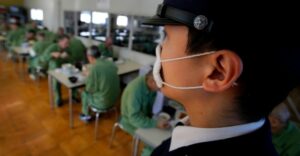
Prisons in Japan are increasingly housing elderly inmates, who often end up behind bars for minor offenses, mainly to secure shelter, food, and medical care.
This trend is gradually changing the nature of the penal system, shifting the focus from punishment to care and reintegration.
Prisoners with serious health problems
Those with serious physical issues are transferred to facilities with medical infrastructure, while inmates with mental or cognitive difficulties remain in prisons.
Fukushima Prison has a capacity of 1,655 inmates but currently houses about 860, reflecting the country’s demographic shrinkage. Of these, only 25 are over 65, roughly 3%.
At the national level, the percentages are much higher. According to official 2024 data, 13.5% of prisoners in Japan are over 65. Most have been convicted of minor offenses.
The Japanese government’s 2024 crime report notes that 71% of crimes committed by elderly women and 39% by elderly men were petty shoplifting.
13.5% of prisoners in Japan are over 65, turning prisons into nursing homes.
Many elderly in Japan end up in prison for minor offenses, mainly to secure shelter and food.
The oldest society in the developed world
Japan has one of the highest life expectancies globally, averaging 81 years for men and 87 for women. According to official 2025 data, nearly 30% of the population is over 65.
Low birth rates, labor shortages, and limited immigration lead many elderly people to continue working after retirement, mostly in part-time or informal jobs. However, low pensions and a lack of social support networks intensify isolation.
The problem of loneliness
Since 2021, Japan has had a Ministry for Loneliness and Social Isolation. The scale of the problem is reflected in police data: in 2024, 58,044 deaths of people aged 65+ living alone were recorded, representing 76% of all such cases.
In this environment of social weakening, prison sometimes functions as a last-resort safety net for some elderly individuals.
Repeated convictions
In Fukushima, almost all elderly inmates have been convicted more than once. They mostly return repeatedly to prison for minor offenses, often related to meeting basic needs.
Prison activities include educational programs and low-intensity workshops aimed at maintaining daily functionality and reducing recidivism.
In 2023, a revision of the Penal Code abolished mandatory prison labor to allow more time for education and social reintegration—the first major reform since 1907.
Until then, there was no differentiation for elderly inmates with repeated minor offenses or for members of criminal organizations like the Yakuza, according to Kyodo News.
Costs and social impact
In 2022, the annual cost of operating Japanese prisons was about $1.69 billion. The expenditure per inmate exceeded $40,000 per year, or roughly $3,400 per month.
Meanwhile, the national minimum pension for someone who contributed for 40 years is about $440 per month—insufficient for independent living.
The phenomenon of elderly prisoners highlights the limits of the social welfare system in a rapidly aging society.
Ask me anything
Explore related questions