




Prime Minister Kyriakos Mitsotakis spoke of one—and only one—difference between Greece and Turkey in an interview with Foreign Policy magazine’s Editor-in-Chief, Ravi Agrawal.
Referring to Greek–Turkish relations, Mr. Mitsotakis made it clear that the agenda of discussions with Turkey does not extend beyond this single dispute, namely the delimitation of the Exclusive Economic Zone (EEZ) and the continental shelf.
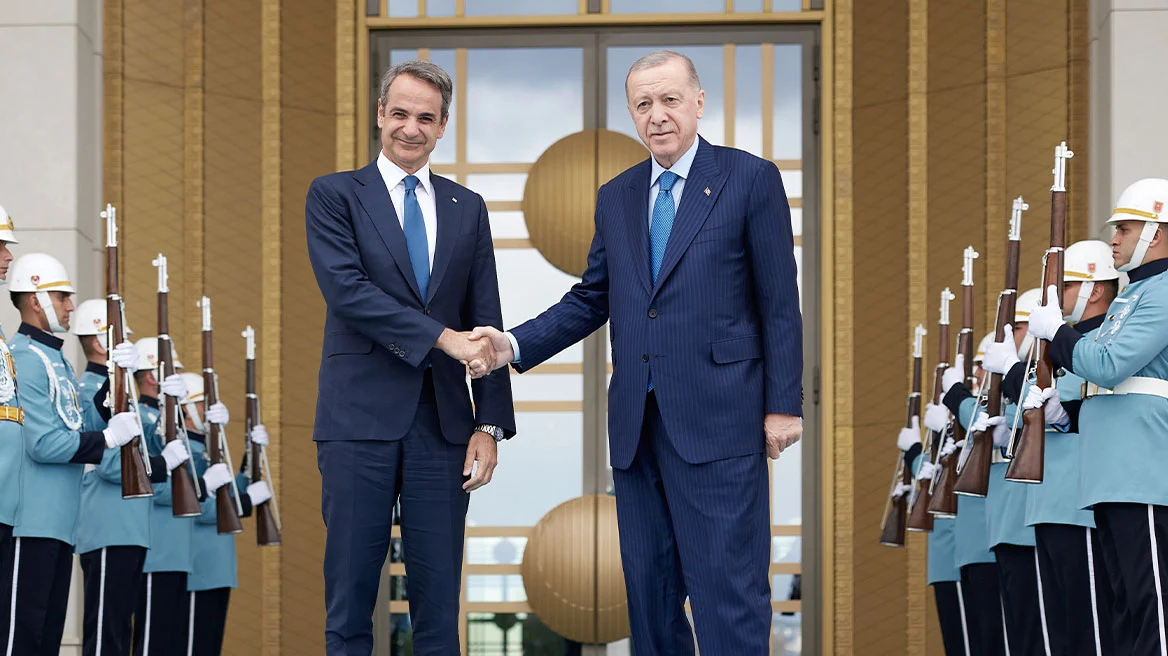
As he said, in recent years efforts have been made to reduce tensions, with the aim of shaping a functional relationship on specific issues, even if the core problem has remained unresolved for decades. He stated that he will travel to Ankara “with clear positions on our dispute,” seeking to build on the progress that has already been achieved.
At the same time, he assessed that he does not see a “significant risk of escalation” with Turkey, noting that the situation is clearly more manageable compared to five years ago. “We are both experienced leaders,” he said, adding that there are already enough challenges in the region and no need to add new ones. He stressed, however, that his primary goal remains strengthening the country’s deterrent capability, pointing out that the Armed Forces are stronger today than they were six years ago.
In the interview, the Prime Minister also referred to the recent tragic shipwreck off Chios, in which 15 people lost their lives. As he noted, “the Coast Guard saved 25 people,” emphasizing that “these boats should never have departed from the coasts of Turkey” and that there is cooperation with the Turkish authorities to prevent further loss of life. Referring to the circumstances of the incident, he stated: “We need a full investigation,” adding that initial information suggests a collision between a Coast Guard vessel and a smaller boat, though the exact causes are not yet known.
Kyriakos Mitsotakis underlined that he is awaiting the findings of the investigation by the competent authorities and reiterated that the Hellenic Coast Guard has a dual role. “The Coast Guard is not a reception committee; our job is to protect the borders, but our job is also to save lives,” he said, adding that he is committed to full transparency should there be any visual material from the incident.
Referring to Greece’s international role, Kyriakos Mitsotakis stressed that “Greece is a steadfast supporter of international law,” noting that, as a non-permanent member of the UN Security Council, it consistently upholds the principle that regional disputes can be resolved on the basis of international rules. At the same time, he made clear that Athens does not ignore changes in the international environment. “We are not naïve; we understand that in these turbulent times it is important to build our own defense capabilities,” he said, adding that international relations have become more “transactional” and require strengthening not only the country’s economic and defense power, but also its soft power.
Regarding Euro-Atlantic relations, the Prime Minister said he has not abandoned them, while acknowledging that the ties that shaped the Western global order “have weakened, but are still there.” As he noted, “it would be naïve to say that Europe can currently defend itself on its own,” while also highlighting Greece’s “privileged defense cooperation” with the United States under the bilateral defense agreement. He stated, however, that he spoke “as a proud European” and that he will continue to work to overcome the rifts in Euro-Atlantic relations.
He made particular reference to the discussion on European competitiveness and defense financing. Kyriakos Mitsotakis noted that, despite fiscal challenges, the United States has the ability to finance its deficits, while for Europe strengthening competitiveness is critical not only for job creation and increasing disposable income, but also for funding higher defense spending. He also recalled that in one week a crucial European Council meeting will take place, with competitiveness at the center of the agenda.
The Prime Minister stated that Greece already “spends 3% of GDP on defense,” while at the same time generating primary surpluses and cutting taxes—something he attributed to the strong growth of the economy.
In the same context, he recalled that after the pandemic a “large pool of funds” was created at the European level to manage the crisis, which he described as successful, and he once again raised the need for a European mechanism for the joint financing of defense. “We could borrow jointly,” he said, acknowledging that Europe is not there yet, but underlining the importance of the discussion.
Ask me anything
Explore related questions