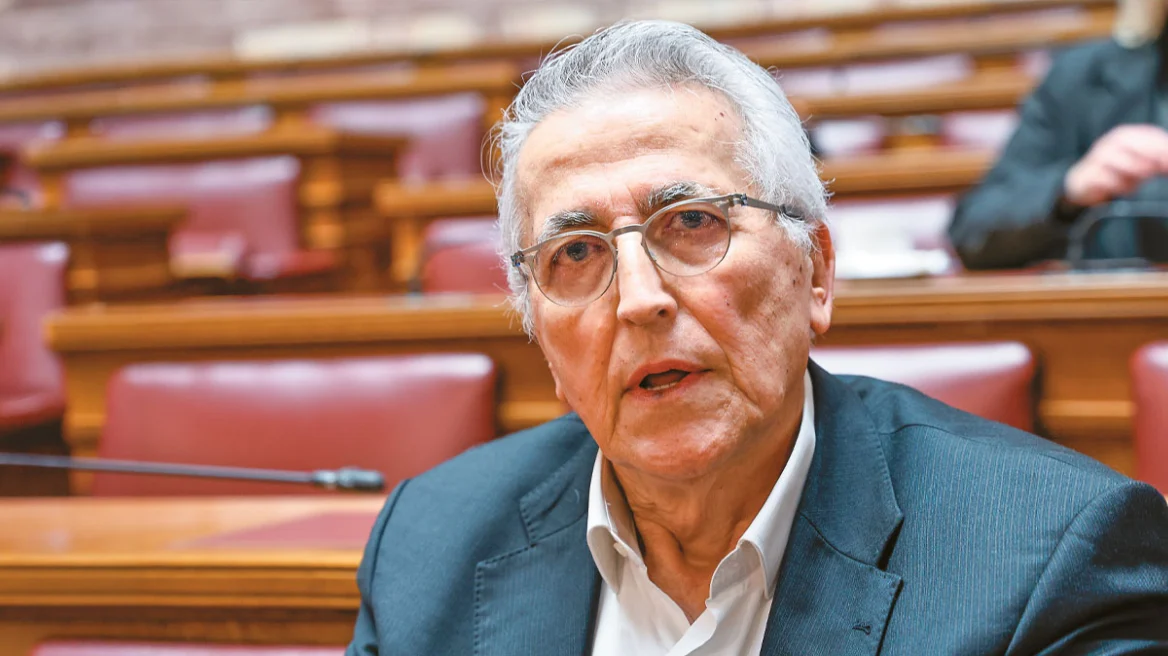
Early Thursday afternoon, the “eternal” trade unionist Giannis Panagopoulos, a PASOK member who has led GSEE for 20 years, was speaking at the Parliament’s Commerce Committee during a celebratory session for the first major post-bailout agreement between social partners regarding labor contracts.
At that exact moment, the press release from the Anti-Money Laundering Authority was made public, stating that his accounts—as well as his entire property, except for his salary from National Bank of Greece—had been frozen due to serious charges against him for embezzlement of EU funds and money laundering. In short, two felonies.
The 72-year-old Panagopoulos did not seem surprised by the news. Like others in the same situation before him, he had been informed by the Authority’s staff prior to the release. He only stated that “it’s a difficult situation” and assured that “I will handle it.”
Unraveling the case
Shortly afterward, the details began to emerge: the Authority’s report, forwarded to the competent prosecutor for criminal investigation, refers to embezzlement of funding provided to GSEE by the Greek State and the European Union, which exceeded €73 million over the past five years. These funds were intended for seven educational and worker training programs.
The Authority’s staff discovered dozens of direct contracts—and, as the report notes, even cash payments and extensive transfers to individual accounts, as well as cash withdrawals over €1.5 million without legal justification. The total embezzled amount is estimated at €2.1 million concerning the State and EU funds.
The last “stronghold”
Giannis Panagopoulos was never a top PASOK executive. He never held the status of Akis Tsochatzopoulos, who even aspired to the premiership. However, he symbolized the party’s dominance in the trade union space—the last “stronghold” of PASOK during and after the bailout era.
He had been active in George Papandreou’s team during the 2021 PASOK leadership election, when Nikos Androulakis was first elected. In the 2023 election, after poor European election results, Panagopoulos publicly stated he had voted for Anna Diamantopoulou in the first round and supported Androulakis in the second. Yet, union officials considered his allies had supported either Haris Doukas or Pavlos Geroulanos in the first round.
Having led GSEE for a fifth of a century, Panagopoulos issued a written statement late Thursday afternoon—shortly after PASOK suspended his party membership—declaring his innocence. The surprise was not that he claimed innocence, but that he explicitly stated he had no intention of stepping back even a single (union) step until the situation with the serious charges against him was resolved. He also stated he was ready for another victory at the GSEE congress scheduled for April 19 in Heraklion, Crete.
In PASOK, his statement fell like a thunderbolt. They had rushed to suspend his membership, hoping he would step back and freeze his GSEE duties until his innocence was proven, thus keeping PASOK as far as possible out of the spotlight.
At the subsequent Executive Committee session, Panagopoulos received support from PASKE unionists. However, other factions—both right and left—chose to wait for the investigation’s outcome before taking a stance.
Funding
The Anti-Money Laundering Authority investigated funding to GSEE exceeding €73 million for 2020–2025 from European and national sources. The inquiry examined how these funds were allocated.
The Authority shed light on the practices followed by GSEE’s president and the five other involved parties, including direct contracts or awarding public projects via tenders to specific companies.
These included a commercial publishing company for graphics, communication, and audiovisual media, owned by two brothers collaborating with GSEE since its material production (posters, brochures, etc.), an event organization company, and an advertising firm.
Among the involved is also journalist Giorgos Kakousis’ communication company C2B, who confirmed his collaboration with GSEE’s Labor Institute (INE), claiming all transactions were legal. Unlike Panagopoulos, he stated he would suspend his journalistic work until the situation was clarified.
The Authority also included in the GSEE network the PR and communications company of Andreas Georgiou from Cyprus, closely connected to Anna Stratinaki, former Consumer Secretary and long-time General Secretary of Employment at the Ministry of Labor, active in negotiations with creditors during the bailout period. Georgiou, who also claims all his transactions were legal, founded the company in 2019 as a single-member LLC, reporting a turnover of €34,000 in its first year.
The day after the Authority’s report was made public, Anna Stratinaki resigned as Consumer Ombudsman, citing personal and health reasons. Earlier in January, she had received “green light” from the Parliamentary Conference of Presidents to be appointed Deputy Director of the Independent Market Control Authority—but the related Government Gazette was never issued. In a later statement, she said the funding decisions for GSEE were signed by the respective Minister of Labor.
The statement
Stratinaki also stated: “No Ministry of Labor program for social partners has been implemented or even started. The only program implemented, titled ‘Creative Industry,’ is worth €7 million, €4 million of which were grants to participants, and it received praise from the European Commission for its success and effectiveness.”
According to the Authority’s auditors, the companies involved participated in tenders in rotation for specific periods and were chosen as contractors by the relevant committee, chaired by GSEE’s president.
Furthermore, based on the Authority’s findings, many direct contracts were not even published on the official “Diavgeia” transparency platform. According to INE/GSEE sources, these companies are non-profit entities not required to post actions on Diavgeia or conduct public tenders for services such as communication, printing, event management, or data protection auditing.
Shell companies
The investigation also found that some companies had no real activity, lacked necessary infrastructure and staff, and received part of the funds in cash. The Authority considers them “shell companies.”
This practice was used to give the appearance of legitimacy to transactions of at least €577,000 for purported services, constituting artificial fund movement and masking the actual use of contract resources.
Extensive transfers to personal accounts without legal justification were also found, along with repeated cash withdrawals exceeding €1.5 million, indicating concealment of the origin and final appropriation of funds. According to the Authority, these withdrawals raise serious suspicions that the amounts ended up in the possession of the trade unionist and other involved parties.
INE/GSEE sources note that programs funded by the NSRF totaling €40 million are being completed, €25 million of which are for subsidizing unemployed participants. These programs, according to INE, were audited and implemented according to all legal procedures.
Ask me anything
Explore related questions