




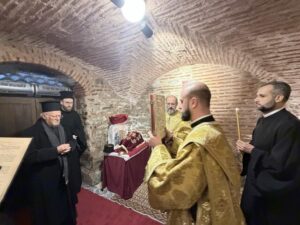
On Tuesday, February 10, 2026, Ecumenical Patriarch Bartholomew attended the Holy Mass, celebrated in the Chapel of St. Charalambos, within the Patriarchal complex in Fanari.
This day is dedicated to the memory of St. Charalambos Martyr, known for his miracles, and the Holy Chapel, where there is a Holy Chapel, attracts a large number of believers every year.
His Holiness actively participated in the liturgy, praying with the priests and the faithful, honoring one of the most important saints of Orthodoxy.
The Greek language: “Mother tongue of the spirit”
On the previous day, Monday 9 February, Patriarch Bartholomew was present at the event organised by the Consulate General of Greece in Istanbul to celebrate the World Day of the Greek Language.
The event was held at the Cultural Center of the Greek Community, in the historic building of the Urban School of Galata, with the keynote speaker for the second consecutive year being the historian and professor emeritus, Mrs. Maria Efthymiou.
In his speech, His Holiness stressed the decisive role of the Greek language in world intellectual culture, letters and sciences, describing it as the “mother tongue of the spirit”.
As he said, “We honour the ‘mother tongue of the spirit’, which has made immense and invaluable contributions to world intellectual culture, letters and sciences.”
He also made special reference to the relationship between the Greek language and Christian theology. Through it, the Church expressed its faith and addressed itself to wider circles,” he stressed.
It is not surprising that the Greek language is the axiomatic language of the Greek Orthodox Church.
His Holiness explained that the Fathers of the Church achieved something unique: to combine philosophical language with theological teaching, without “Hellenizing” Christianity, while at the same time creating an ecumenical dimension of Greek thought that has survived to this day.
Language and faith are the core of Greek identity
In his speech, the Patriarch pointed out that the Greek language and the Orthodox faith are the core of the spiritual and cultural identity of the Greek nation:
“The Church, from the earliest Christian years to the present day, has made a decisive contribution to the formation, preservation, and dissemination of the Greek language. Through its worship, hymnology, and theology, our language still lives on today in church services, connecting us with the past.”
At the same time, he referred to the speeches of Zissimos Lorentzatos: “Only through our faith and our language have we been saved today, and only through these two will we be saved tomorrow.” “Never in the history of our Nation has the lamp of the ancient Greek spirit been extinguished. It is a true miracle that this lamp was placed on the lamp by the Fathers and Masters of the Church.
Our people lived their Greekness together with the experience of Orthodoxy. And today, as the blessed Metropolitan John of Pergamum writes, “the more we draw from ourselves and our Greekness, the more we drink the water of Orthodoxy,” he continued.
His Holiness also noted that the Greek language remains a source of inspiration for the whole world, as works of ancient philosophers and poets are studied and discussed in libraries all over the world, while Greek words and terms continue to permeate scientific terminology internationally:
“We are sure that you, all and sundry, feel proud of our language, the language of our ancestors and our own, the language of the indigenous inhabitants of the City of Constantine, the language of the Homogeny, which is the bearer and expresser of the morality and culture of the person, of freedom as faith and love in their unbreakable unity.”
We rejoice in the wonderful language in which incomparable and unrepeatable were written. This language, which, even in our time, is a source of inspiration and a compass of spiritual orientation for countless fellow human beings throughout the world.
We rejoice that the works of the ancient philosophers and poets adorn the libraries of the world, are studied and discussed, and that thousands of Greek and Greek-derived words and terms are found in the terminology of the sciences and in the languages of the world.”
The Patriarch congratulated the Consul General of Greece in Istanbul, Mr. Konstantinos Koutras, for the initiative of the event, who for his part underlined the worldwide recognition of the contribution of the Greek language, while he made special reference to the work of the Homogeneous Educational Institutions of Istanbul and Imbros, as well as to the substantial contribution of the teachers who work in them. He wished for the reopening of the Holy Theological School of Halki.
Afterwards, His Holiness also congratulated the President of the Galata Urban School Foundation, Mrs. Mary Komorosano, while he also warmly welcomed Mrs. Maria Efthymiou, on the occasion of the theme of this year’s speech “Roman – Roman: historical coordinates of a definition”. “For us, the concepts of Romios and Romiosyne express the universality of the Greek spirit in conjunction with Orthodox Christian universality,” the Patriarch stressed.
The event was also attended by Prelates of the Throne, Archbishops of the Ophelia, teachers of the expatriate schools, and a large number of people, who honored both the language and the faith that keep alive the Greek identity in the city.
Ask me anything
Explore related questions