





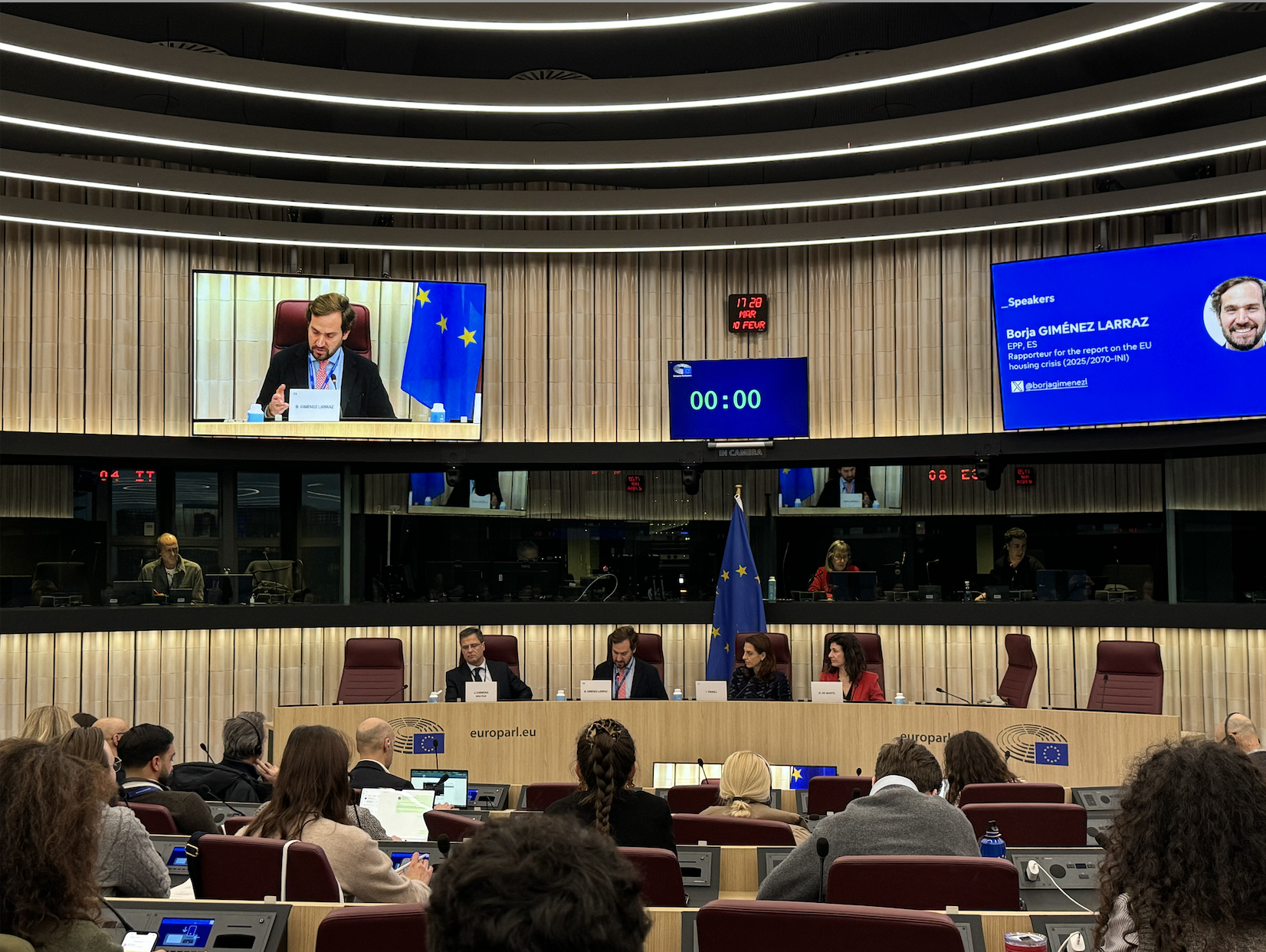
The European Parliament has taken a major step in addressing Europe’s deepening housing crisis, as its Special Committee on the Housing Crisis in the European Union adopted a comprehensive set of recommendations aimed at boosting supply, protecting property rights and supporting households struggling with soaring costs.
The final report was approved on Monday with 23 votes in favour, 6 against and 4 abstentions, marking the culmination of months of work within the special committee established by Parliament on 18 December 2024. The motion for a European Parliament resolution (2025/2070(INI)) now sets out a political roadmap for “decent, sustainable and affordable housing” across the EU.
A crisis hitting millions
MEPs underline that housing has become one of the most pressing concerns for European citizens. Over the past eight years, house prices across the EU have risen by an average of 48%, while rents have increased by 18%, in many cases consuming up to 40% of a household’s monthly income.
The report stresses that young people and families are disproportionately affected, often unable to leave the parental home or start an independent life. It argues that while housing policy remains primarily a national, regional and local competence under the principle of subsidiarity, common structural drivers across Member States justify coordinated European action.
Supply at the core: 10 million additional homes
At the heart of the committee’s recommendations lies a strong focus on increasing housing supply. Rapporteur Borja Giménez Larraz (EPP, Spain) said the report reflects a “broad and responsible consensus across political groups, grounded in pragmatism rather than ideology.”
He emphasised that the EU needs to enable the construction of around 10 million additional homes to rebalance supply and demand.
The committee notes that residential construction fell by 5.7% in 2024, following a 2.6% decline in 2023, highlighting structural weaknesses in the sector. MEPs call for:
- Streamlining and simplifying administrative procedures
- Limiting the processing of planning permits to 60 days
- Reducing regulatory burdens in the Single Market
- Securing stronger protection of private property rights
The report also argues that price controls and excessive market interventions risk discouraging investment and reducing supply.
Short-term rentals and affordability
MEPs warn that short-term rentals must not undermine housing affordability in cities already under pressure. They refer to Regulation (EU) 2024/1028 on data collection for short-term accommodation rentals and stress the importance of better monitoring and comparable data at EU level.
Improved statistics and robust indicators are seen as essential to understand the link between housing, productivity and competitiveness.
Strengthening Europe’s construction sector
The committee also calls for reinforcing EU industrial sovereignty in construction and renovation, recognising the sector’s strategic importance. Self-employed workers represent 17% of total EU self-employment in construction, while micro, small and medium-sized enterprises account for up to 95% of firms in construction, architecture and civil engineering.
MEPs argue that SMEs require targeted protection and support, including improved access to finance and innovation tools.
Mobilising investment and EU funds
Acknowledging that public funding alone will not be sufficient, the report stresses the need to mobilise private capital. It calls for:
- Completion of the Savings and Investments Union
- Greater use of securitisation to boost cross-border capital flows
- Efficient and transparent allocation of EU funds
- A stronger role for the European Investment Bank, including through its 2025 Action Plan for Affordable and Sustainable Housing
EU financing for housing projects should crowd in private investment, including via public-private partnerships and large-scale urban renewal projects.
Supporting demand without distorting markets
In parallel with increasing supply, MEPs propose incentive-based tax systems and targeted financial mechanisms to help low- and middle-income households, particularly young first-time buyers. Mortgage guarantees and tailored housing schemes are among the tools suggested.
The report also highlights the growing difficulty for essential workers – such as doctors, teachers and security personnel – to afford housing in the cities where they are needed.
A balanced European approach
While firmly respecting the principle of subsidiarity under the Treaties, the committee argues that the EU must act as a catalyst – removing barriers, unlocking investment and creating enabling conditions.
“Housing is not a secondary issue,” the report concludes, warning that failure to act would threaten social cohesion, democratic stability and Europe’s competitiveness.
With its adoption in committee, the European Parliament signals that housing will remain high on the EU’s political agenda – as both a social priority and an economic imperative.
Ask me anything
Explore related questions