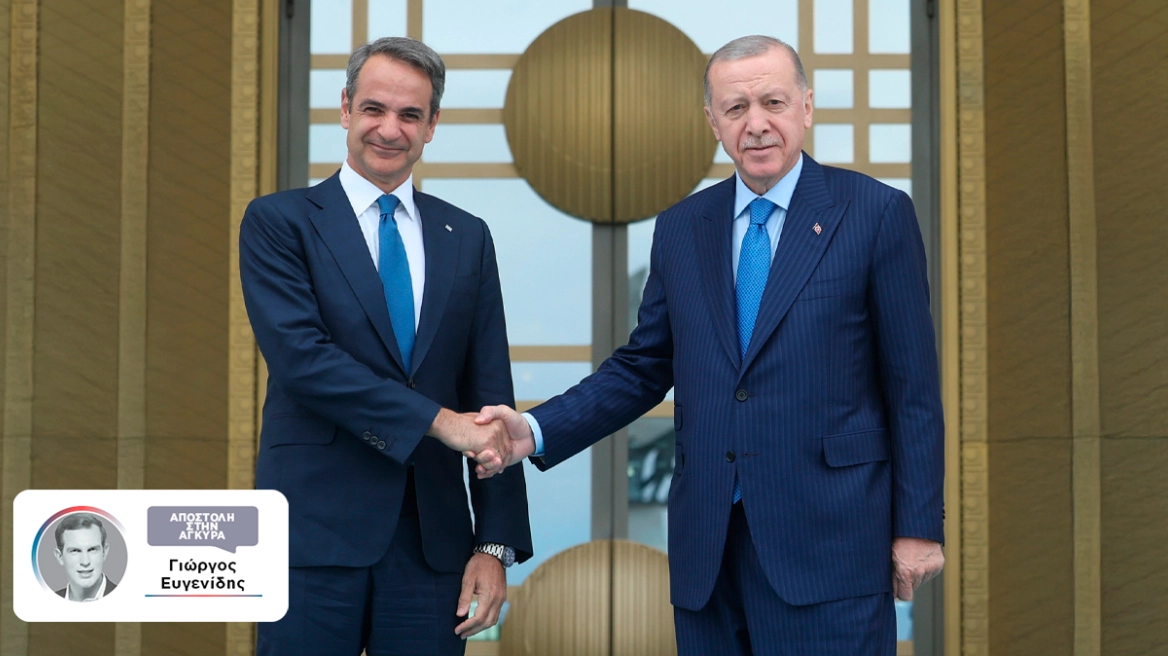
It was May 2024 when Kyriakos Mitsotakis landed once again in Ankara and met Turkish President Recep Tayyip Erdogan at the threshold of the White Palace, the sprawling government complex in the Turkish capital. Much time has passed since then, and global developments now resemble more of a… storm.
In Greek-Turkish relations, the “calm waters” doctrine that took shape after another meeting held in Istanbul, specifically at the Vahdettin Mansion, has experienced ripples but no major turbulence. The goal on both sides, according to statements at least from Turkish officials, is for things to remain that way.
Mr. Mitsotakis will depart from Elefsina airport and arrive in Ankara accompanied by 10 ministers and deputy ministers. According to the schedule, Mr. Erdogan will welcome him at 15:15 (Greek time). A private meeting between the two leaders will take place first, followed by the High-Level Cooperation Council in plenary session. Statements are scheduled for after 17:00, and according to information, this will be a carefully choreographed visit, although the Turkish president can occasionally be unpredictable. While Mr. Mitsotakis meets with Mr. Erdogan, the ministers of the delegation will hold one-on-one meetings with their counterparts in adjacent rooms at the White Palace.
Last-minute additions to the delegation were Finance Minister Kyriakos Pierrakakis and Education Minister Sofia Zacharaki. The delegation also includes Foreign Minister Giorgos Gerapetritis, Migration Minister Thanos Plevris, Civil Protection Minister Giannis Kefalogiannis, Citizen Protection Minister Michalis Chrysochoidis, Culture Minister Lina Mendoni, Infrastructure and Transport Minister Christos Dimas, and Deputy Foreign Minister Haris Theoharis. It is also considered likely that the head of Greece’s National Intelligence Service (EYP), Themistoklis Demiris, will join the delegation. Immediately after the official program concludes, Mr. Erdogan will host a dinner for the Greek delegation, attended also by Ecumenical Patriarch Bartholomew.
The agenda and the “sparring”
As protothema.gr has reported in recent days, during the one-on-one portion of the meeting — where the two leaders are traditionally accompanied by their respective foreign ministers and diplomatic advisers (Miltiadis Nikolaidis and Akif Çağatay Kılıç), who also serve as interpreters — there will be a comprehensive review of bilateral and regional issues.
Greece is expected to raise the issue of Turkish NAVTEX notices that cause irritation and are responded to by Athens, as well as to explain its maritime spatial planning and marine parks initiatives. On the other hand, Ankara is reportedly displeased with its exclusion from the SAFE program and opposes Greece’s strategic alignment with Israel, given Turkey’s relationship with Hamas. Regional issues will also be discussed, such as the situation in Iran, the Middle East, and the war in Ukraine.
A key objective of the visit is for Athens and Ankara to jointly send a message that they can engage in dialogue even when they disagree, without this leading to an escalation of tensions. Obviously, this also serves as a response to various scenarios of “American arbitration” that periodically resurface.
Athens and Ankara have not been in a “war-like” climate for some time, although sporadic incidents and pointed remarks occasionally weigh on the atmosphere. In a “divide and rule” logic, Turkish Foreign Minister Hakan Fidan recently acknowledged that Kyriakos Mitsotakis and Giorgos Gerapetritis have adopted a constructive stance on the Greek-Turkish agenda, in contrast to Nikos Dendias, whom he described as an “obstacle” to the development of bilateral relations.
“Greece pursues an active foreign policy, supporting the values of international law. It will not deviate from these values. We seek good neighborly relations,” Greek diplomatic sources responded yesterday to Fidan’s remarks, aiming to demonstrate that Athens’ stance is unified and indivisible.
Mr. Dendias, however, will be… at a safe distance, as will his Turkish counterpart Yasar Güler, since both are participating in the NATO Defense Ministers’ meeting.
Low-politics agreements
Following the talks, some of the ministers will sign agreements or joint statements with their Turkish counterparts. According to information, Giannis Kefalogiannis will sign a declaration of intent for cooperation on natural disasters, with emphasis on earthquakes. Meanwhile, Takis Theodorikakos will sign a joint declaration with his counterpart on technology, innovation, and research, focusing on biotechnology and agrotechnology, with around 110 research projects considered mature.
Deputy Foreign Minister Haris Theoharis, who handles the positive agenda, will sign two agreements, one of which will concern Enterprise Greece. Finally, Kyriakos Pierrakakis is expected to discuss with his Turkish counterpart Mehmet Şimşek the prospects of increasing bilateral trade, which currently stands at €5 billion and could potentially reach as much as €10 billion.
Ask me anything
Explore related questions