





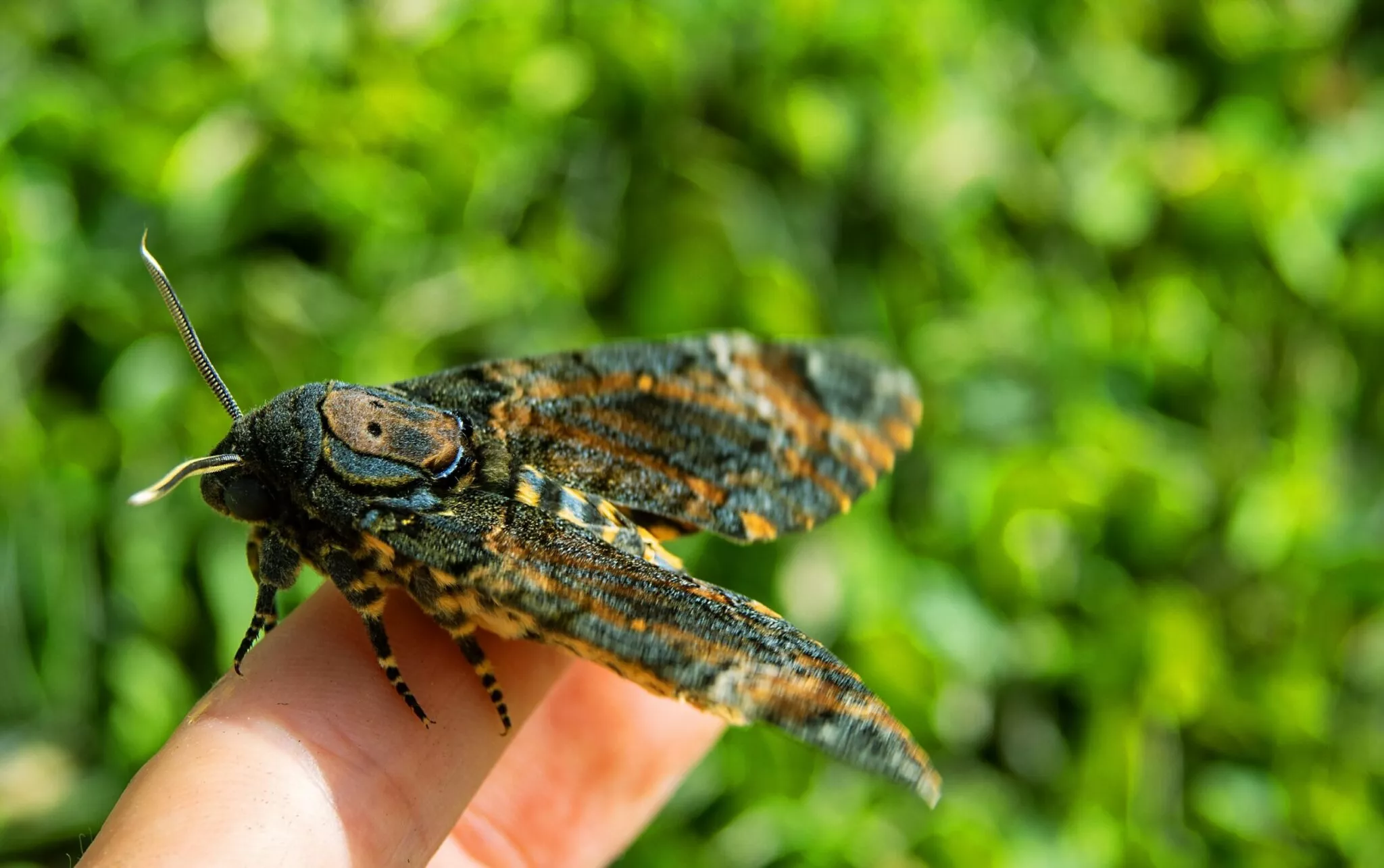
Although moths are a striking group of insects, they are often overshadowed by their colorful and alluring “cousins,” the butterflies.
For many of us, butterflies are associated with beauty and renewal. Moths, on the other hand, tend to evoke more muted impressions, influenced by the drab appearance of many species, as well as the damage some larvae cause to clothing (like clothes moths) and crops.
In reality, however, this highly successful group of insects is not only essential for the planet’s ecosystems but also displays an incredible diversity. Some species are as visually striking as the vibrant patterns of their butterfly relatives.
From the majestic Atlas moth, with a wingspan reaching 24 centimeters, to the Polyphemus moth, adorned with eye-like patterns, moths include truly mesmerizing species that captivate the eye.
One of the most famous is Acherontia atropos, a moth bearing a skull-like pattern on its thorax, made famous by the iconic thriller The Silence of the Lambs. Its distinctive appearance, combined with the unusual sound it produces, has led to its association with superstitions over the years—unfounded beliefs that unfairly cast a shadow over this fascinating insect.
Three Sisters with “Dark” Names
Acherontia atropos is one of three species in the genus Acherontia, alongside Acherontia styx and Acherontia lachesis. Their scientific names are inspired by dark themes from Greek mythology, connected to fate and death.
The genus name itself refers to the river Acheron, which ancient Greeks believed was where Hermes delivered the souls of the dead to Charon, the ferryman, to cross into the underworld. Atropos and Lachesis were two of the three Fates in mythology.
Atropos was arguably the most fearsome of the sisters, cutting the thread of life without hesitation. Lachesis measured each person’s lifespan with her staff. Styx, the third species, is named after the river Styx, a primordial chthonic deity and personification of the underworld river.
Morphology: Skull or… Face?
Acherontia atropos is arguably the most recognizable of the three sisters, thanks to the short, pale hairs on its thorax that form the skull-like pattern. This moth is fairly large, with a wingspan of up to 13 centimeters. Its forewings are patterned in shades of brown and orange, while the hindwings are yellow with dark stripes, creating a strong contrast.
A 2020 study offered a different interpretation of the patterns on the moth’s wings and thorax. The author argued that when the moth is viewed upside-down (head down), the thoracic skull appears like a human face: the skull pattern resembles a nose with nostrils, the forewing markings become eyes, and other lines suggest ears and lips. This visual illusion likely serves as a defense mechanism to deter predators.
Geographic Distribution and Flight Abilities
As its English name, African death’s-head hawkmoth, suggests, Acherontia atropos is native to Africa but can also be found in Europe, reaching as far as the United Kingdom. The other two species in the genus are Asian.
The moth’s impressive flight capabilities were studied in 2022. Researchers found that it possesses a sophisticated navigation system compared with other insects. By attaching tiny transmitters to the moths, scientists observed that during long-distance flights, the moths periodically adjust their course according to wind patterns, helping them maintain a relatively stable trajectory. The exact mechanism of their navigation, however, remains a mystery.
The Strange Chirp and Its “Passion” for Honey
Acherontia atropos produces a unique chirping sound from its pharynx, rare for moths, which usually generate sound by rubbing external body parts.
The sound is typically triggered by external stimuli: the moth inhales, causing a vibration in a flap between its mouth and pharynx, and exhales rapidly. The entire process lasts only about a fifth of a second.
The purpose of this sound is unclear. Some researchers suggest it deters predators, while others associate it with the moth’s raids on beehives—it loves honey. According to one unproven theory, the chirp resembles the signal a queen bee gives worker bees to remain still, allowing the moth to steal honey undisturbed.
However, the fact that beekeepers often find dead moths in hives indicates that these tricks—along with odors that mimic bees—are not always foolproof.
The Silence of the Lambs and Other Horror Stories
Although Acherontia atropos is harmless to humans, it has long been associated with bad luck and death in various cultures. Its macabre appearance, combined with historical misconceptions (for instance, in South Africa, it was once described as poisonous), contributed to this reputation.
Depictions of death’s-head hawkmoths in art and literature are notable. One moth appears prominently in William Holman Hunt’s painting The Hireling Shepherd (1851), sparking discussion in artistic and theological circles. References also appear in darker-themed novels, including Bram Stoker’s Dracula and Susan Hill’s I’m the King of the Castle.
Cinema, however, cemented its place in pop culture. In Jonathan Demme’s award-winning thriller The Silence of the Lambs (1991), a death’s-head hawkmoth pupa is placed on victims’ necks by the serial killer Buffalo Bill, symbolizing his desire for transformation. Although the script names the species as Acherontia styx, the insect shown in the film—and on the iconic poster on Clarice Starling’s face—is unmistakably Acherontia atropos.
Ask me anything
Explore related questions


