





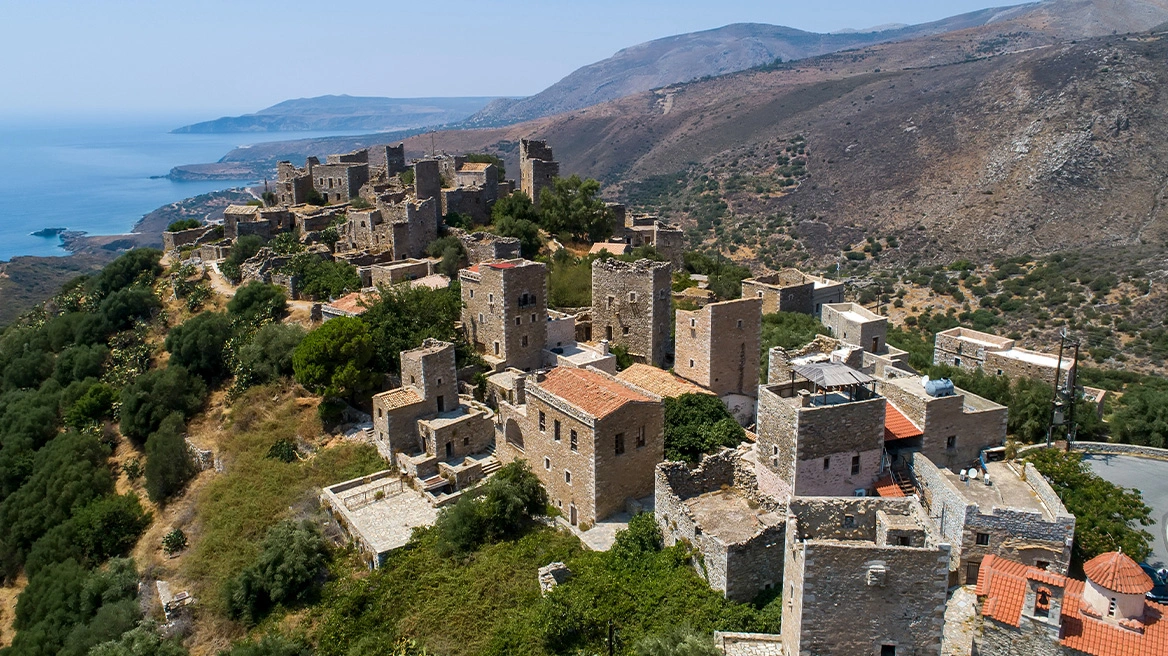
Half the men of Inner Mani share a common ancestor, according to a genetic study conducted by an international research team led by Assistant Professor Leonidas Romanos Davranoglou of Tel Aviv University. Inner Mani — the area south of Areopoli in Laconia — has been shown by the study, published recently, to constitute a “genetic island.” Its inhabitants share common genealogical traits closely linked to the region’s geography, social organization, and the institution of the patria (clan), which remains strong in Mani to this day.
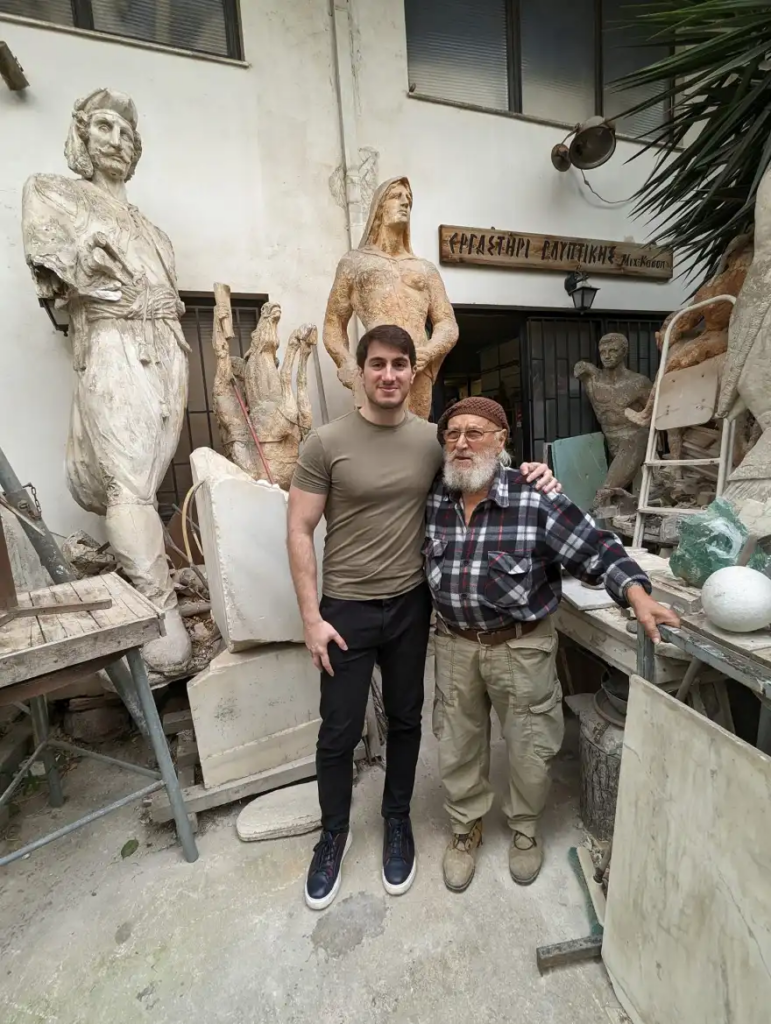
The international research team included scientists from the University of Oxford, Tel Aviv University, the National and Kapodistrian University of Athens, the Areopoli Health Center, the European University Cyprus, and FamilyTreeDNA laboratories. Their study focused on the origins of the Inner Mani population and demonstrated that many genealogical lines of present-day residents can be traced back in Greece to the Bronze Age, the Iron Age, and the Roman period.
A finding that 50% of men share a common male ancestor is considered extremely rare, particularly for a mainland European population. As explained by Dr. Anargyros Mariolis, director of the Areopoli Health Center, who oversaw sampling during all stages of the research, similar patterns internationally have mostly been recorded in small, isolated, or island populations.
In the case of Inner Mani, genetic data suggest that the region once experienced a period of severe demographic contraction — likely due to wars, epidemics, and widespread instability — after which the descendants of a small number of survivors remained in the area for centuries. Dr. Mariolis clarifies that genetics does not identify specific historical individuals but rather records long-term population processes and trends.
Limited external genetic influence
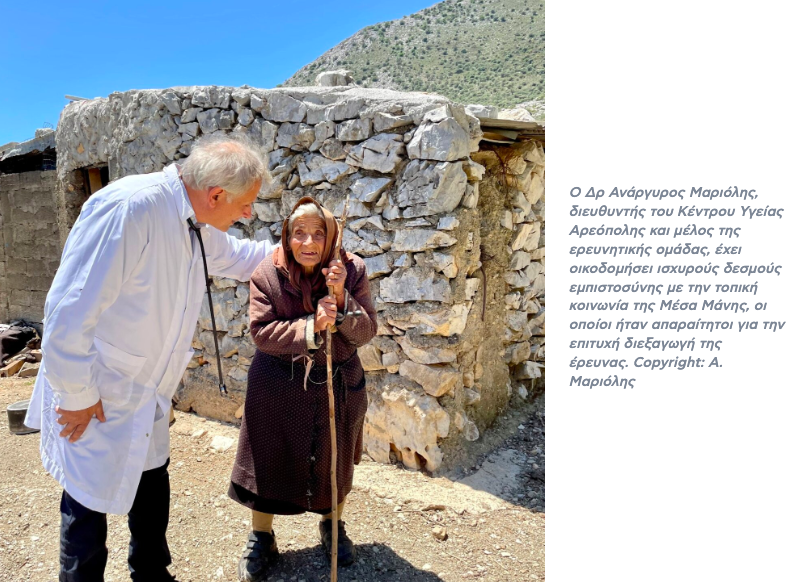
Regarding the limited assimilation from later populations, such as Slavic groups, Dr. Mariolis explains that this conclusion was based on comparisons between Inner Mani genetic lines and thousands of ancient and modern samples from Greece, the Balkans, and wider Europe.
No paternal genetic links were found with populations of Slavic origin, placing Inner Mani among the lowest levels of external genetic influence recorded in mainland Greece. In contrast, maternal lines show limited evidence of outside contact, with percentages not exceeding 12%, indicating that relatively few non-Maniot women integrated into the local population.
Why were only men sampled
Sampling was conducted exclusively among men. The research relied on analysis of the Y-chromosome, which is passed through the paternal line, as well as mitochondrial DNA, inherited from the mother. Researchers note that if the study had focused primarily on women, it would have been impossible to examine paternal ancestry — a central aim due to interest in documenting the Maniot clan system.
The institution of the clan (patria)
For centuries, the clan system was a core pillar of social organization in Mani. Genealogist and Mani native Thanasis Kofinakos, a member of the research team, explains that Maniot clans are extended patrilineal kin groups organized around a common male ancestor, sustained through collective memory, shared origin narratives, and a strong common social identity.
For hundreds of years, these clans functioned as decentralized forms of political and social governance, effectively substituting for state authority. They provided military protection, regulated social relations through customary law, ensured forms of social welfare, and even supported economic development, for example, through collective agricultural labor.
Genetic data show that this system produced a distinct biological signature, characterized by a relatively small number of paternal lines with strong temporal and geographic continuity, while maternal ancestry displays greater genetic diversity.
“Essentially, one could argue that without the clan institution, Maniots and their genealogical structures would hardly have survived — at least not in the form and continuity we know today,” Kofinakos notes.
Why is Inner Mani called a “genetic island”
The term “genetic island,” researchers explain, is used internationally for populations that remained relatively isolated for historical and geographic reasons.
“In the case of Inner Mani, this finding reflects what history already suggested: a region with distinctive geography, difficult terrain, and long-standing autonomy,” says Dr. Mariolis. Its isolation, combined with centuries of weak central governance, helped preserve local social structures and foster a distinct culture.
Researchers emphasize that the study does not attempt to define identity genetically. “Identity is cultural, historical, and experiential — not genetic,” Mariolis notes. Genetics instead provides an additional scientific tool to better understand the past and fill historical gaps that have concerned scholars for nearly a millennium.
Genetic data complement — rather than replace — history, archaeology, and oral tradition. The study’s aim was solely to understand the region’s history and investigate Mani’s oral narratives.
A broader scientific significance
Study leader Dr. Davranoglou stresses that the research extends beyond genetics. Its findings can inform fields such as archaeology, history, and linguistics, opening broader dialogue about Mani’s past.
He explains that Mani was chosen because of its unique social and cultural characteristics, including the clan system, women’s lament traditions, and a customary law-based social structure developed over centuries. Since Byzantine times, Mani has been described as a distinct population with unique cultural features, making it a historical “mystery” for nearly a thousand years.
One of the main challenges during the 2.5-year project was funding, despite the availability of advanced scientific tools. Researchers maintained close ties with the local community and plan public presentations of the findings in Mani and among Maniot associations in Greece and abroad in 2026.
International recognition
The study has received international attention. An Oxford University analysis described Inner Mani residents as a unique “genetic time capsule” in the Balkans, highlighting the rarity of such long-term genetic continuity in mainland Europe.
The research was published in the scientific journal Communications Biology, confirming its global scientific significance.
In a public statement, Dr. Mariolis described the study as a “beacon of light” for modern science and the preservation of Mani’s historical memory, noting that modern genetic methods can transform silent DNA sequences into powerful testimonies of historical continuity.
The research ultimately highlights Mani as a place deeply rooted in the past while laying foundations for future scientific exploration — with respect for people and potential benefits for public health.
Ask me anything
Explore related questions