




A journey of loss—literally and metaphorically. Three years ago, on February 28, 2023, two trains collided head-on. Fifty-seven people, mostly young, lost their lives; dozens were injured. “For you it’s three years; for us it feels like yesterday,” Nikos Plakias tells Protothema.gr, as he opens his home for the first time, in Kalambaka.
How much pain can two pairs of eyes hold? Unimaginable. How much strength must a parent have to go on after enduring the unbearable pain of losing children in peacetime? In 35 years of journalism, this was the first time I wanted to burst into tears and run away.
How do you look Nikos and his wife Sofia in the eye? What words can you find for Chrysa, Thomais, and their niece Anastasia–Maria, who were gone in an instant, leaving empty rooms, an empty house, empty souls, empty lives. “Grandma lost more,” Plakias tells me about his mother. He means her three granddaughters, but also her two sons, Nikos and Dimitris, who “wander like lost souls,” as well as her two daughters-in-law.
The tragedy clearly burns within them. If you don’t know what they’ve been through, you might not notice it. We arrive at Kalambaka square and have coffee. Everyone stops to greet him. Nikos appears hardened, yet remembers every minute. “They were like spirits…” he says of his daughters.
For the first time, he opens the family home—where he last saw his little angels. Sofia and Nikos no longer live there; they couldn’t bear it and moved next door, to Kastraki. Sofia welcomes us with a smile—quiet strength. But in her gaze you see the loss. At moments she tears up, yet with rare delicacy she avoids burdening others with her pain. She does not want to appear on camera.
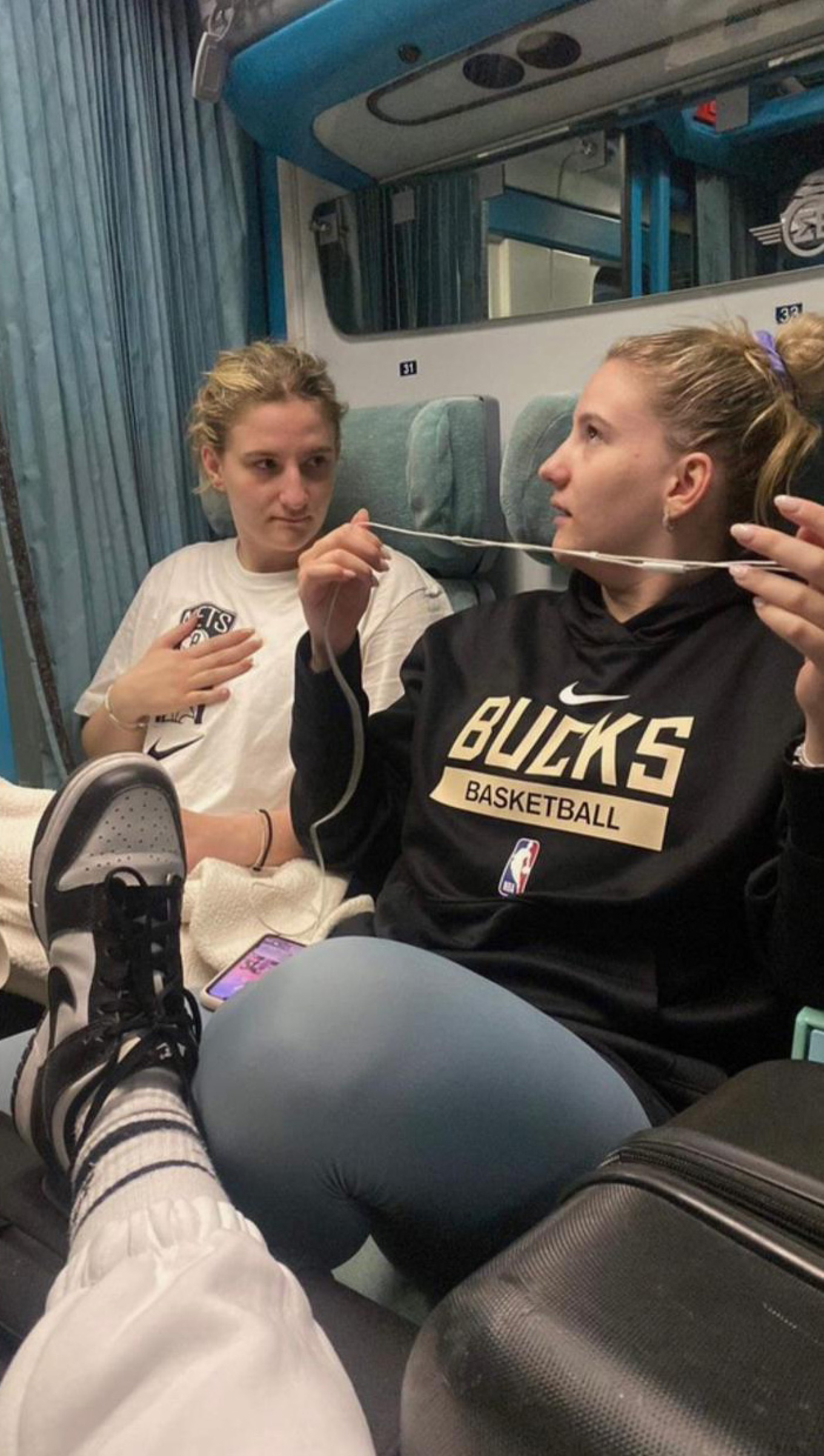
The documentary photo: Nikos Plakias’ twin daughters inside the train, minutes before the fatal collision.
Plakias leads us to the twins’ room. Everything is as they left it that night: Thomais’ white lab coat—she was studying Pharmacy at Aristotle University of Thessaloniki. Chrysa’s house keys she forgot. A birthday note from a friend wishing them “happy birthday.” Photos of the girls—and of the couple they married just two weeks before they died.
“Searching for what happened, we discovered countless mistakes that night, by many people, within a very bad rail network. In short, we paid for years of systemic failures.”
A deep breath. The camera rolls. Nikos Plakias begins to unravel his thoughts and emotions, reopening the wound. He speaks of the bad feeling he had that night upon hearing of a derailment. He describes what he and Sofia saw when they arrived at the scene. He breaks—just once—and cries when recalling the moment that will never leave him: when a doctor said there was a blonde woman with blue eyes in the ICU, 1.75 m tall—his children’s features. A false hope. He shows me the photo the twins and their niece sent his brother ten minutes before the crash—a documentary image from which he pieced together where they were sitting and how they died. He remembers the last words he told them at the door, not knowing it was the last time: “You are the children every parent dreams of.” “I’m very hard, stone-hard,” he says of himself, then adds: “An ECG—one up, one down.”
Games of fate
The girls were in the fifth carriage. At Larissa, many passengers disembarked and seats freed up. They met the young conductor—connected through their grandparents. “Vasilis, can you find us seats up front so we can stretch our legs?” they asked. He did. In the doomed carriage. Had they stayed in their original seats, they would have survived. The conductor also died.
He shows me photos from his phone—the last ones sent from the fatal carriage, ten minutes before the collision. Smiling, joking with a fellow passenger who feared COVID and stood by the door. She was thrown clear by the impact and survived. The twins and their cousin did not. From these photos, Nikos Plakias completed the puzzle of how his daughters and niece died.
Xylene
“The infamous xylene entered our lives through a politician who said—while our children were still burning—that there was xylene and military material on board,” says Plakias. “Some bit, other politicians seized on the word ‘xylene,’ along with experts, lawyers, supposed investigators—but no one knew what it was.” Twenty tons became ten, then five, then two and a half, and finally an unknown combustible substance. “Unfortunately, xylene will remain in history.”
The revelation: “The president of the Hellenic Air and Rail Safety Investigation Authority called me to apologize for the report.”
Nikos Plakias reveals for the first time that the former president of the authority, Christos Papadimitriou, phoned him to apologize for the report and the alleged illegal cargo. “I was pressured,” he told him—“by many, especially ERA,” the European Union Agency for Railways, which was present from day two. “That’s why Bart Accou came,” he says, referring to ERA’s number two and a member of the investigative committee. “His anxiety was when rail service would resume.” Plakias notes that a university professor’s report questioning whether the fireball was caused by silicone oils was submitted within two days. “It was essentially dictated,” he says, adding that evidence will be presented in court and Papadimitriou will testify about the pressure.
He also reveals that when a victim’s relative tried to hand over a USB stick with videos proving there was no illegal cargo, lawyers for other families pressured them not to—because “it doesn’t suit us.” “What do you mean it doesn’t suit us? I won’t go to trial with what suits me; I’ll go with the truth,” he insists.
Of the 200 videos in the case file, only three—from the Leptokarya tunnels—are certified, he says. “By some relatives’ logic, even the fireball video isn’t authenticated.”
He feels rage, pain, hatred toward those responsible since 2016—but will never forgive those who approached families for profit. “After this big trial, the lawyer will go home with fame and money, to his children. We’ll come back here—to an empty house.”
They painted the train blue, red, green
“Tempe was politicized. They painted the train blue, red, green. ‘It has xylene, you’re left-wing; it doesn’t, you’re right-wing.’ What is this? I’m a father who lost two children. I’ll accept the truth from anyone. I won’t reject a truth because of who says it.”
He is angry with the opposition too. “When the government accused them in Parliament of exploiting Tempe, it turned out to be true. Where is the opposition? They left first. They abandoned us.”
“I will neither bring down nor raise governments”
“What vindication could there be for me? Vindication would be the door opening and my children walking in,” he says, clarifying: “I’m not here to bring down or raise governments.”
“The timing bothered me” — on Karystianou
Asked about Maria Karystianou and her announced political move, he says they knew she would enter politics. “Her motive isn’t money or career but to put some people in prison,” he says, adding that the timing—one month before court hearings and the three-year anniversary—bothered him. “I’ll always see her as a mother who lost her child, like my wife. But politics is different. From me she’ll be treated as a politician.”
He rules out entering politics himself—though not entirely. “Let’s keep a reserve,” he says pointedly. “I speak about Tempe—not geopolitics or agriculture.”
“I’m ashamed I’m standing”
He returns to his guilt and daily struggle. “We see death now as relief,” he confides. Each night he and Sofia say, “Where are our children?” Each morning, he looks in the mirror and feels shame. “How am I standing?”
Sofia and their youngest daughter, Anastasia, who lives in Corfu, are his strength. “I’m lucky to have these two women,” he says—despite the painful moment when Anastasia once asked, “Dad, did you just remember you have another child?”
Sofia wears two chains the twins wore. “That’s how we identified them.” Nikos says he alone saw his children’s bodies. “How did you endure?” “I had to—but I felt like a third party, like a medical examiner.”
He looks at their room—the forgotten keys, the lab coat. “How did they forget them? As if they left them for us to remember.”
They visit the cemetery. All three are buried together: Chrysa, Thomais, Anastasia–Maria. He lights a candle and sits on the bench. “My children aren’t here,” he says—and believes it.
He hasn’t yet found refuge in faith. “I believed in love and integrity,” he says. Now he hopes to come closer to religion—to find peace and shed the hatred.
Ask me anything
Explore related questions