




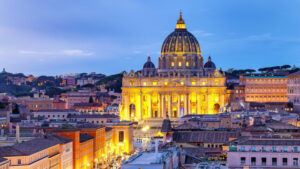
The entire square of St. Peter’s Basilica will soon be fully accessible to the public, allowing visitors to explore new areas and enjoy a coffee, the Vatican announced today.
“ The entire square of the Basilica will be accessible, whereas today only one third of it is,” said the Archpriest of St. Peter’s Basilica, Cardinal Mauro Gambetti, during a press conference, adding that the café will double its surface area to reach 100 square meters.
In the past, the Vatican had sought to downplay reports about the opening of a café in the square, which had sparked intense public debate over the potential commercialization of a sacred space.
Exhibitions dedicated to the history, construction, and maintenance of the church will also be held in the area.
Around 20,000 people visit the Basilica every day—an architectural jewel of the Renaissance—and managing these tourist flows represents a major challenge.
The Vatican also announced the introduction of a new real-time booking system for access to the Basilica, linked to a network of sensors monitoring the number of people inside.
In addition, a new application has been created allowing visitors to follow the liturgies celebrated at the Basilica, featuring lectures, music, and simultaneous translation of ceremonies into 60 languages.
Regarding security measures, Cardinal Gambetti said the Vatican is strengthening protection inside St. Peter’s Basilica following recent acts of vandalism, but wants to avoid the “militarization” of one of the most visited churches in the world.
He noted that more than 20 million people visited the Basilica over the past year and that the recent incidents were “very limited” compared to the overall volume of visitors.
“We are reflecting—and will now take action—on further protecting certain areas,” he emphasized at the press conference.
Visitors are currently screened before entering, while between 40 and 60 personnel provide discreet security inside. Gambetti said the new measures will remain unobtrusive.
“We asked ourselves what the limit should be between protection and militarization in order to manage and control everything,” he said. “We believe it should remain a place that offers those who enter the Basilica a sense of freedom, so that certain boundaries are not crossed.”
St. Peter’s Basilica, located within Vatican City—the smallest state in the world—houses the tomb of the Apostle Peter the Apostle, one of the twelve disciples of Jesus Christ, who is regarded as the first pope.
The foundation stone of the Basilica, which replaced an ancient church, was laid by Pope Julius II in 1506, and the Basilica was consecrated in 1626.
Ask me anything
Explore related questions