






More than seven out of ten junior doctors in Europe work more than the legal limit of 48 hours a week, while one in ten even exceeds 80 hours, with Greece holding the negative lead in overtime. European health systems, already under pressure from staff shortages and increased care needs, appear to be “bleeding” by relying on the depletion of younger doctors.
The picture painted in the new pan-European report on the working conditions of residents is not just a labour distortion. It is a symptom of a deeper pathology. When the statutory 48-hour period is systematically violated and rest becomes a luxury, then the problem is not an isolated one, but a structural one. And like any “open wound” left untreated, it threatens to become chronic.
The picture painted by the new pan-European report on the working conditions of medical trainees is not just a case of occupational distortion. It is a symptom of a deeper pathology. When the legally mandated 48-hour workweek is systematically violated and rest becomes a luxury, the problem is not isolated—it is structural. And like any untreated “open wound,” it risks becoming chronic.
According to the REST-JD report by the European Junior Doctors (EJD), the largest pan-European study on working hours and job satisfaction among medical trainees, 6,165 young doctors from 26 countries participated in the survey, revealing the reality behind official schedules.
On January 27, 2025, the European Junior Doctors Association formally presented the REST-JD findings to the European Commission during a meeting with the Directorate-General for Employment, Social Affairs and Inclusion (DG EMPL) and its Director-General, Mario Nava. The discussion focused on working hours, inadequate rest, and the growing dissatisfaction among Europe’s young doctors.
57 Hours a Week, 9 Above the Legal Limit
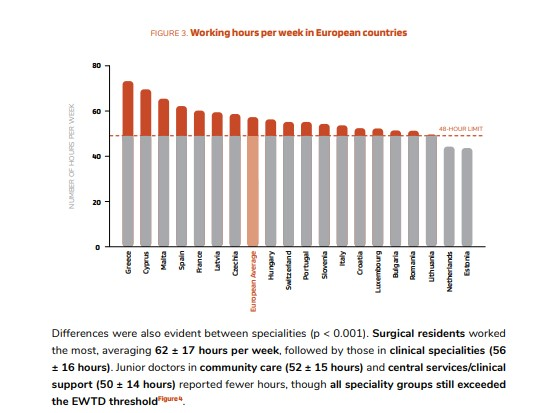
The average weekly workload for young doctors in Europe is 57 hours—17 hours above the standard 40-hour workweek and nearly 9 hours over the 48-hour maximum set by the European Working Time Directive.
71% of respondents report exceeding the 48-hour limit, a situation the report describes as a “systemic and widespread violation” of European law.
Even more alarming are the figures for extreme working hours:
- 20% work more than 70 hours a week
- 10% exceed 80 hours
- 88% report working overtime
- 69% of overtime is unpaid
The median duration of the longest continuous shift reaches 24 hours, directly conflicting with basic occupational safety standards.
Greece at the Top of the Overwork League
Greece records the highest average weekly working hours in Europe, at 72 hours—far above the European average and 24 hours over the legal limit.
This places Greece at the top of a negative ranking that also includes Malta, Portugal, and Italy.
In contrast, countries like Estonia and the Netherlands show significantly lower averages, proving that enforcing the 48-hour limit is not a utopia, but a matter of political will and organization.
Less Rest, More Burnout
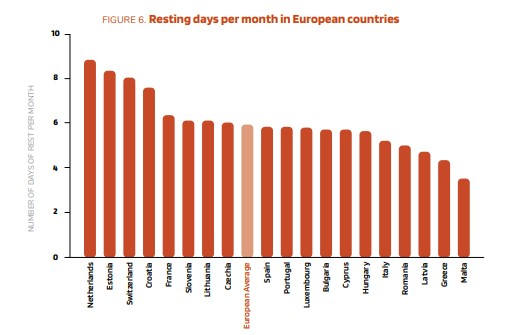
Medical trainees report an average of just 6 rest days per month. In Greece, Malta, and Latvia, rest days are limited to 4-5. 35% did not receive the minimum four weeks of annual leave mandated by law.
The lack of rest has cumulative effects: fatigue, professional burnout, and an increased risk of medical errors. When recovery is insufficient, the entire system—and its patients—suffer.
As Hours Increase, So Does Dissatisfaction
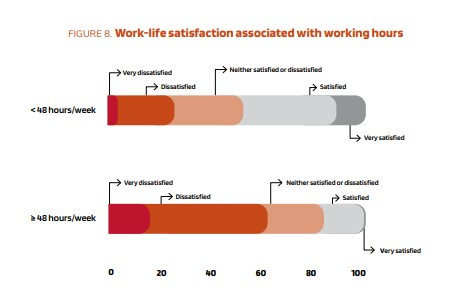
More than half of young doctors are not positively satisfied with their work. The balance between professional and personal life is even more concerning: 52% report dissatisfaction, while only 25% are satisfied.
The most critical finding is the correlation between working hours and psychological strain: exceeding the 48-hour limit more than quadruples the likelihood of dissatisfaction.
Exceeding the 48-hour limit is not just a numerical deviation. It translates into real, measurable harm.
A Warning for the Future of Healthcare Systems
The report frames the issue within the context of Europe’s looming healthcare workforce crisis. The continent is expected to face a shortage of up to 600,000 doctors by 2030. In this environment, overwork is not a sustainable solution. Instead, it may accelerate the exodus of young doctors from the profession or drive them to emigrate.
The problem is not just occupational. It is a matter of public health.
Systematic violations of the 48-hour limit, inadequate rest, and rising dissatisfaction paint a picture that cannot be ignored. With Greece leading in overwork, the discussion is not only about the rights of young doctors. It is about the very sustainability of the healthcare system itself.
When hospitals operate with exhausted doctors and legislation is applied selectively, the system is not “healed”—it merely prolongs the symptoms. And any system that remains “ill” for too long, sooner or later, collapses.
Ask me anything
Explore related questions