×
GreekEnglish

×
  • Politics
  • Diaspora
  • World
  • Lifestyle
  • Travel
  • Culture
  • Sports
  • Cooking
Sunday
18
Jan 2026
weather symbol
Athens 6°C
  • Home
  • Politics
  • Economy
  • World
  • Diaspora
  • Lifestyle
  • Travel
  • Culture
  • Sports
  • Mediterranean Cooking
  • Weather
Contact follow Protothema:
Powered by Cloudevo
> Culture

Computer science reimagines Hagia Sophia’s acoustics, offers journey back in time

The "Icons of Sound" project reveals the Hagia Sophia's mystical acoustic character

Newsroom January 2 02:51

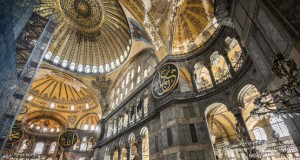
An impressive figure of the architectural beauty hailing from the Byzantine-era, the Hagia Sophia at Istanbul’s Sultanahmet Square is still inspiring new studies, like the “Icons of Sound” project from Stanford University.


Having served as a cathedral, the mosque and now a museum over its 1,500-year-long lifespan, the Hagia Sophia is now the subject of a study from Stanford’s Center for Computer Research in Music and Acoustics (CCRMA) and its art history department.


Focusing on the interior of the Hagia Sophia, the study digitally imprints the museum’s resonating acoustics accompanied by visuals to create an immersive experience. The “Icons of Sound” project employs thorough musicological research and reveals the Hagia Sophia’s mystical acoustic character. “The Hagia Sophia challenges our contemporary expectation of the intelligibility of language. The wet acoustics of the Hagia Sophia blur the intelligibility of the message, making words sound like emanation, emerging from the depth of the sea. Not surprisingly, much of the ritual at the Hagia Sophia involved chanting and not recitative speech,” said the team on the project’s official website.


The team applies a method by using balloon pops that identify the space’s acoustic parameters, allowing them to introduce a computer model. This brings the experience that makes it seem as if listeners were in the Hagia Sophia. For the study, the research team has collaborated with chamber choir Cappella Romana, which has performed Early Music including Byzantine, Slavonic, and Gregorian chants by applying the computational model. The choir has already given a series of concert performances and continues to make listeners feel as if they were in the Hagia Sophia.

>Related articles

Hagia Sophia: At the mercy of…crony contractors, the adventures of the monument of Orthodoxy in Erdogan’s hands

Hagia Sophia: Photos of heavy vehicles inside the Church raise concerns about floor protection (photos)

The structure of Imamoglu’s “criminal organisation” published by the Turkish prosecution – Prosecuted for 142 offences


Built in the sixth century, the Hagia Sophia, which means “Holy Wisdom” in Greek, was converted to a mosque in 1453 when the Ottomans conquered Istanbul, in what was then called Constantinople. In 1935 it was transformed into a museum. The masterpiece features an immense dome supported by huge pillars,its walls sheathed with marble and decorated with mosaics.

Source

Ask me anything

Explore related questions
#constantinople#hagia sohpia#istanbul
> More Culture

Follow en.protothema.gr on Google News and be the first to know all the news

See all the latest News from Greece and the World, the moment they happen, at en.protothema.gr

> Latest Stories

War, diplomacy, or insurrection: What’s next in Iran

January 17, 2026

New tensions in the Middle East as Trump invites regional leaders to the Gaza Peace Council

January 17, 2026

Weather: A return to winter in the coming days – Cold and strong northerly winds – Kolydas’ post

January 17, 2026

A view of Nikolaos Stasinopoulos of Viohalco – The “enduring imprint” of Greece’s greatest industrialist

January 17, 2026

The horror of the “Tariff of the Dead”: how the Iranian regime prices the bodies of protesters

January 17, 2026

Mitsotakis on the Karystianou party: “There is a long distance between being the parent of a tragedy victim and being the leader of a political party”

January 17, 2026

Patras in carnival mode – This evening, the city’s official opening ceremony

January 17, 2026

Greenland as the first line ofdefense for the U.S. and NATO:

January 17, 2026
All News

> World

War, diplomacy, or insurrection: What’s next in Iran

The Iranian regime faces the most serious threat to its survival, despite the repression of protests - The possibility of a US strike remains on the table - The landscape for the next day is blurred

January 17, 2026

New tensions in the Middle East as Trump invites regional leaders to the Gaza Peace Council

January 17, 2026

The horror of the “Tariff of the Dead”: how the Iranian regime prices the bodies of protesters

January 17, 2026

Greenland as the first line ofdefense for the U.S. and NATO:

January 17, 2026

Changes at top universities: Oxford abolishes the term ‘doctores’ for inclusion reasons

January 17, 2026
Homepage
PERSONAL DATA PROTECTION POLICY COOKIES POLICY TERM OF USE
Powered by Cloudevo
Copyright © 2026 Πρώτο Θέμα