




First commissioned by King Edward I of England, the “Warwolf” is thought to be the largest trebuchet ever built.
The weapon was used during the siege of Stirling Castle in Scotland, an important event in the Scottish Wars of Independence.
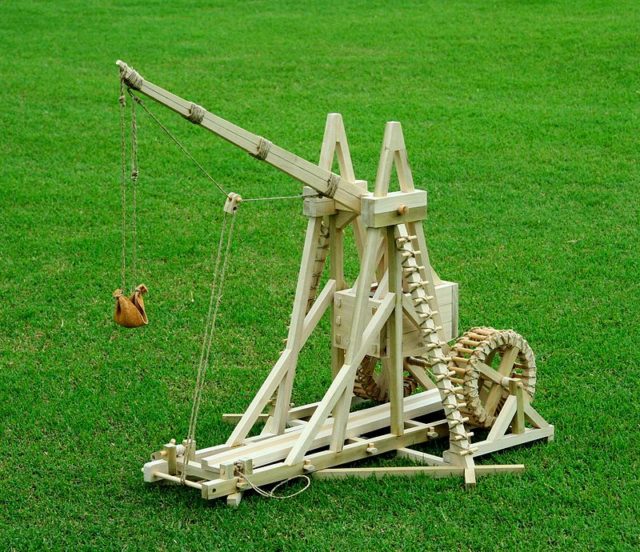
(Scale model of Warwolf)
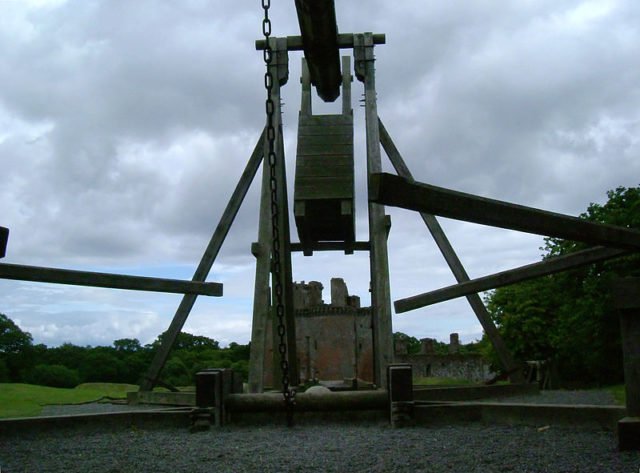
(Scale model of Warwolf in front of Caerlaverock Castle)
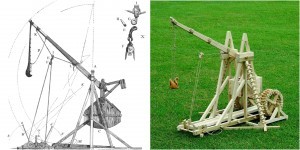
A trebuchet is a siege weapon that was used, most notably in the Middle Ages, to fling projectiles at or into enemy fortifications. It is superior to the catapult, as it could be fired from over 300 meters away; it was so devastating, that it continued to be used into the 15th century, even after gunpowder was invented. A trebuchet is a compounded machine, meaning it uses a combination of simple machines. It uses a lever, powered by gravity so that when it’s fired, the weight box drops. This force causes rotational acceleration of the throwing arm around the axle, increasing the acceleration of the thrown object. A sling is used to adjust the trajectory, so the correct angle and speed are acquired for the target to be hit with considerable force.
Stirling Castle is famous for being Scotland’s largest castle. It sits on top of Castle Hill, which is an intrusive crag surrounded by steep cliffs on three of its sides. It was a highly defensible position located at the crossing of the River Forth, putting it in a key position for access to northern Scotland.
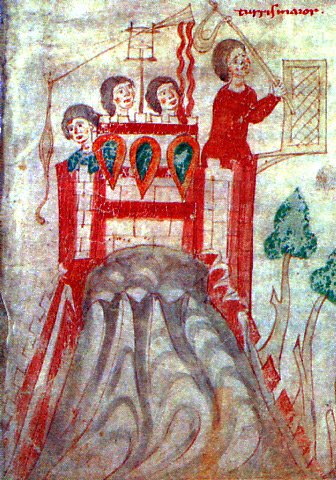
(Medieval traction trebuchet -also called a perrier- next to a staff slinger)
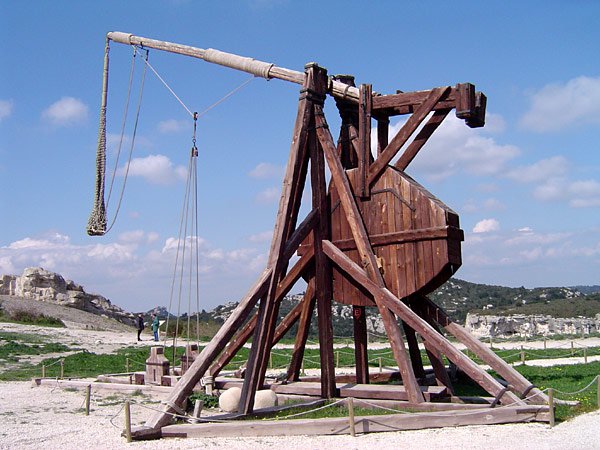
(Reconstruction of a trebuchet at Château des Baux, France)
The last stronghold of resistance against Edward I’s attempt to gain control of Scotland was at Stirling Castle. In April 1304, the English attacked the castle with twelve siege engines.
The castle was bombarded with lead balls, stone balls, Greek fire, and some kind of gunpowder mixture for four months. It had been six long years since the defeat of William Wallace and his Scot’s army, and Edward was impatient to smash down this last bastion of Scot resistance.
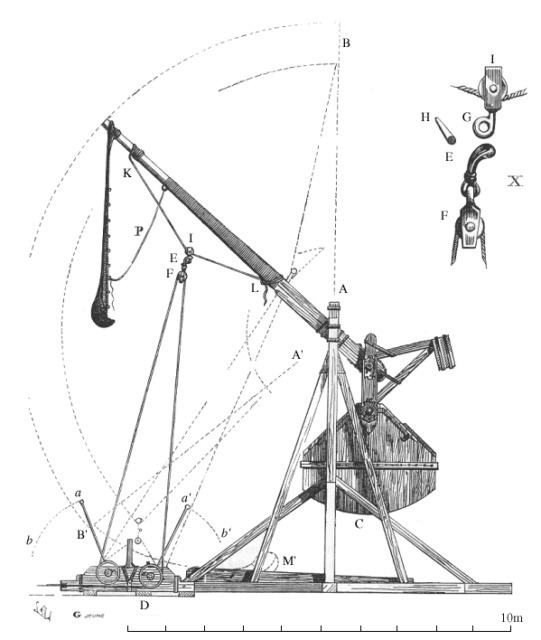
(Side view of counterweight trebuchet)
He ordered his chief engineer to make a bigger siege engine, so the Warwolf was designed and built by Master James of St. George. It took five master carpenters and other laborers three months to put it together. The Scots tried to surrender before the weapon was used, but Edward would have none of that until he had tested his new weapon.
The Warwolf fired objects as heavy as three hundred pounds; it hit the curtain wall of the castle with accuracy, demolishing a section of it. On July 20th, the thirty Scots and Sir William Oliphant were allowed to surrender. Even though he had threatened to kill them, King Edward did not do this. The only one killed in the battle was the Englishman who had let the Scots into the castle. Sir William Oliphant was taken the prisoner and locked in the Tower of London.
Ask me anything
Explore related questions