




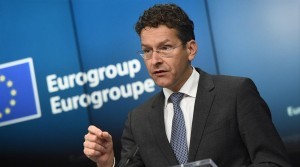
The head of the EuroGroup, Jeroen Dijsselbloem disclosed the content of the April 7 Malta EuroGroup agreement between Greece and its creditors. In a letter he sent to the EuroGroup members Mr. Dijsselbloem presented the results of the Malta meeting. With regards to Greece the official meeting covers the following:
4. Greece – State of play
The institutions and myself debriefed the Eurogroup on the state of play of the second review of the stability support programme, following the intensive talks on the main outstanding issues that have taken place following our last Eurogroup meeting. The institutions and the Greek authorities have reached an agreement on the main overarching elements of the post-programme policy package. In support of rebalancing Greece’s public finances in a growth-friendly manner, the Greek authorities have agreed to legislate a package of fiscal structural measures amounting to 2% of GDP: a pension reform amounting to 1% of GDP will be implemented in 2019, while the personal income tax reform amounting to 1% of GDP will be implemented in principle in 2020, unless a frontloaded implementation is needed in order to reach the agreed 3,5% primary surplus fiscal target in 2019. We also agreed that the Greek authorities can legislate a contingent expansionary package that will be implemented starting in 2019, provided that the agreed mediumterm targets are met. We invited the institutions and the Greek authorities to continue technical work in order to reach an agreement on a full policy package as soon as possible. Once this is reached, the Eurogroup will also come back to the issue of the medium-term fiscal path for the post-programme period and debt sustainability, based on the agreement reached in May 2016, in order to reach an overall political agreement.
Following is the complete Malta Agreement
Subject: Eurogroup of 7 April 2017
Dear colleagues,
I would like to share with you the main content and course of our discussions at the Eurogroup meeting of 7 April in Valletta (Malta). Our meeting was attended by Commissioners Pierre Moscovici and Valdis Dombrovskis, ECB President Mario Draghi and Executive Board Member Benoît Coeuré, and ESM Managing Director Klaus Regling. We were also joined by the Chair of the Supervisory Board of the Single Supervisory Mechanism (SSM) Danièle Nouy and Chair of the Single Resolution Board (SRB) Elke König for the Banking Union – euro area aspects discussion, and by Poul Thomsen, Director of the IMF’s European Department, for the discussions on Greece and Cyprus.
1. Thematic discussion on growth and jobs – Investment (common principles)
In the context of our regular thematic discussions on growth and jobs, we exchanged views on common principles to support investment in the euro area. Investment in the euro area still shows signs of weakness. Addressing these weaknesses can increase economic convergence and improve the resilience of the economic and monetary union. We adopted a Eurogroup statement (see annex) outlining three common principles to guide policy action. These cover (i) promoting private investment; (ii) prioritising productivity-enhancing public investment; and (iii) developing market-based sources of financing. We also considered that addressing investment weaknesses could also be further supported by initiatives at the European level. We asked the Commission to review this issue periodically and will revisit the question of the feasibility of developing appropriate benchmarking in this area once further progress has been achieved.
2. Banking Union – euro area aspects: Fifth hearing of the Chair of the ECB Supervisory Board and presentation by the SRB on its activities
Danièle Nouy reported on the execution of the supervisory tasks by the ECB Supervisory Board in 2016, the health of the banking sector, work on Less Significant Institutions and the supervisory priorities for 2017: (i) the further assessment of banks’ business models and profitability drivers, (ii) risk management and (iii) credit risks, with a special focus on non-performing loans (NPLs) and concentrations. Danièle Nouy indicated that the 2016 stress test had shown that the banking sector is more resilient and much better able to absorb economic shocks than in 2014. However, banks continued to face a number of structural challenges. Elke König, provided a general update on SRB activities. She informed us about progress on i) resolution planning, where the aim for 2017 is to extend resolution plans to approximately 130 banks within the SRB’s remit ii) MREL (minimum requirement for own funds and eligible liabilities) targets, where the SRB intends to set binding targets at consolidated level for major banking groups under its remit in 2017 and the general state of play regarding the SRF, which should reach EUR 17 bn in the course of 2017. All the Loan Facility Agreements (LFAs) have now been signed. The Chairs of the ECB Supervisory Board and the SRB as well as the Commission further clarified the interactions between supervision, resolution and the implementation of the single rule book (BRRD) and state-aid rules. Danièle Nouy called for a renewed ambition to reduce Options and National Discretions (ONDs). We thanked Danièle Nouy and Elke König for their presentations and the good work undertaken so far. We will take stock of the progress being made on these issues as part of the discussion on the Roadmap of the Banking Union at the June ECOFIN Council. We looked forward to our next exchange of views next autumn.
3. Preparation of international meetings: exchange rate developments
As customary, we took stock of recent exchange rate developments ahead of the IMF Spring meetings, on the basis of an assessment by the Commission and the ECB. The Commission explained that the euro has depreciated in nominal effective terms over the last six months. The depreciation has been relatively broad based, as the euro has weakened against the currencies of most of the euro area’s main trading partners. Changes in financial markets’ assessment of monetary and financial stances across regions and countries appear to have largely driven recent developments in the exchange rates of major currencies. We broadly concurred with the views of the Commission and the ECB on exchange rate matters in view of upcoming international meetings. As regards the euro exchange rate and the euro area’s external surplus, it was recalled that the euro exchange rate and euro area external balances are the result of market forces.
4. Greece – State of play
The institutions and myself debriefed the Eurogroup on the state of play of the second review of the stability support programme, following the intensive talks on the main outstanding issues that have taken place following our last Eurogroup meeting. The institutions and the Greek authorities have reached an agreement on the main overarching elements of the post-programme policy package. In support of rebalancing Greece’s public finances in a growth-friendly manner, the Greek authorities have agreed to legislate a package of fiscal structural measures amounting to 2% of GDP: a pension reform amounting to 1% of GDP will be implemented in 2019, while the personal income tax reform amounting to 1% of GDP will be implemented in principle in 2020, unless a frontloaded implementation is needed in order to reach the agreed 3,5% primary surplus fiscal target in 2019. We also agreed that the Greek authorities can legislate a contingent expansionary package that will be implemented starting in 2019, provided that the agreed mediumterm targets are met. We invited the institutions and the Greek authorities to continue technical work in order to reach an agreement on a full policy package as soon as possible. Once this is reached, the Eurogroup will also come back to the issue of the medium-term fiscal path for the post-programme period and debt sustainability, based on the agreement reached in May 2016, in order to reach an overall political agreement.
5. Miscellaneous
a. Cyprus – Post-programme surveillance – 2d review – oral debrief
We were debriefed by the institutions on the main findings of the 2d post-programme surveillance (PPS) mission in Cyprus, which took place at the end of March. We welcomed the institutions’ assessment that growth will remain robust in 2017 and that the fiscal performance in 2016 will likely be stronger than expected. However, these good results should not lead to a relaxation of efforts on the structural and fiscal fronts as uncertainty remains high. Regarding the financial sector, we noted the uneven progress in resolving NPLs. Sustained efforts are needed to improve NPL resolution.
Yours sincerely,
Jeroen DIJSSELBLOEM
Ask me anything
Explore related questions