





Their structures are still standing more than 1,500 years after the last centurion snuffed it: now the Romans’ secret of durable marine concrete has finally been cracked.
The Roman recipe – a mix of volcanic ash, lime (calcium oxide), seawater and lumps of volcanic rock – held together piers, breakwaters and harbours. Moreover, in contrast to modern materials, the ancient water-based structures became stronger over time.
Scientists say this is the result of seawater reacting with the volcanic material in the cement and creating new minerals that reinforced the concrete.
“They spent a tremendous amount of work [on developing] this – they were very, very intelligent people,” said Marie Jackson, a geologist at the University of Utah and co-author of a study into Roman structures.
As the authors note, the Romans were aware of the virtues of their concrete, with Pliny the Elder waxing lyrical in his Natural History that it is “impregnable to the waves and every day stronger”.
Now, they say, they’ve worked out why. Writing in the journal American Mineralogist, Jackson and colleagues describe how they analysed concrete cores from Roman piers, breakwaters and harbours.
Previous work had revealed lime particles within the cores that surprisingly contained the mineral aluminous tobermorite – a rare substance that is hard to make.
The mineral, said Jackson, formed early in the history of the concrete, as the lime, seawater and volcanic ash of the mortar reacted together in a way that generated heat.
But now Jackson and the team have made another discovery. “I went back to the concrete and found abundant tobermorite growing through the fabric of the concrete, often in association with phillipsite [another mineral],” she said.
She said this revealed another process that was also at play. Over time, seawater that seeped through the concrete dissolved the volcanic crystals and glasses, with aluminous tobermorite and phillipsite crystallising in their place.
These minerals, say the authors, helped to reinforce the concrete, preventing cracks from growing, with structures becoming stronger over time as the minerals grew.
By contrast, modern concrete, based on Portland cement, is not supposed to change after it hardens – meaning any reactions with the material cause damage.
Jackson said: “I think [the research] opens up a completely new perspective for how concrete can be made – that what we consider corrosion processes can actually produce extremely beneficial mineral cement and lead to continued resilience, in fact, enhanced perhaps resilience over time.”
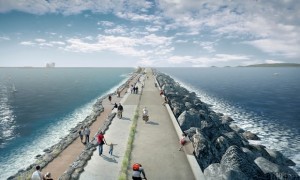
The findings offer clues for a concrete recipe that does not rely on the high temperatures and carbon dioxide production of modern cement, but also providing a blueprint for a durable construction material for use in marine environments. Jackson has previously argued Roman concrete should be used to build the seawall for the Swansea lagoon.
“There’s many applications but further work is needed to create those mixes. We’ve started but there is a lot of fine-tuning that needs to happen,” said Jackson. “The challenge is to develop methods that use common volcanic products – and that is actually what we are doing right now.”
Ask me anything
Explore related questions


