




By James Stavridis*
As the doomsday rhetoric intensifies between two untested and inexperienced leaders in Pyongyang and Washington, the risk of actual combat is rising.
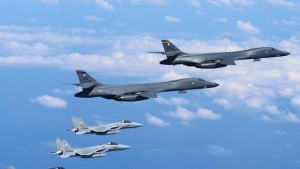
At the United Nations, President Donald Trump shocked most of the U.N. General Assembly by threatening to “totally destroy” North Korea to end the “suicide mission” of its “Rocket Man” leader. North Korea has threatened to create a “sea of fire” in both South Korea and the United States. On Saturday, U.S. B-1 bombers flew close to North Korea’s east coast on what the Pentagon said was a mission to demonstrate the military options available to Trump. The U.S. president commented that Kim Jong Un and his foreign minister Ri Yong Ho “won’t be around much longer” if they continue their rhetoric.F
So what are the military options that the Joint Chiefs of Staff of the U.S. military could put in front of the president?
First steps
At the lower end of the spectrum of force, the first set of options would dramatically increase missile defense, both in South Korea and on U.S. territories such as the western Pacific island of Guam. This would include three elements: greater deployment of the Terminal High Altitude Area Defense (THAAD) system, a U.S. anti-ballistic missile system for broad area coverage; more Patriot missile batteries ashore for defense of specific locations; and at-sea Aegis missile defense, which has the best overall kill ratio against incoming targets and extreme flexibility in positioning because it is based on ships that can move nearly a thousand miles a day at speed.
Beyond bolstering missile defense, the Pentagon will look at how to implement a full-blown naval blockade. This would reduce outgoing exports, helping choke the North Korean economy, prevent incoming shipments of oil and oil products, and stop exports of North Korean weapons, a source of cash for the regime. Such a blockade would require a couple of dozen smaller surface ships (destroyers, frigates, corvettes) as well as an aircraft carrier for air cover and a large command-and-control ship to run the complex operation.
Moving up the spectrum, next would be a focused offensive cyber campaign. This would be a non-lethal option, and could be used broadly against North Korean infrastructure (electricity, internet, hydroelectric dams) or specifically against the weapons program (both conventional and nuclear). While the U.S. has the best suite of offensive cyber tools globally, this is still a difficult option to execute. An interesting aspect of using cyber tools is that they could be used selectively in a way that leaves both the North Koreans and their potential partners and arms customers unsure of the quality and reliability of their systems — without fully expending all of the U.S. offensive cyber options.
Lethal options
Moving into classic options involving the use of lethal force, the most difficult but least violent would be to use special forces to conduct an attempted leadership “decapitation,” or a to conduct a mission to destroy a critical portion of the North Korean weapons program. The big challenge here is intelligence; knowing where the “young leader” is at any given moment is very difficult to impossible, and the U.S. is unsure that it has a complete picture of the entire North Korean weapons network, including storage, laboratories, and transportation grids to move them. Another worry here would be a sense on the part of Kim that such a mission was closing in on him, leading him to lash out and escalate significantly.
More realistically, a tactical airstrike directed against a variety of targets is the most likely option involving lethal force. This could come from tactical jets based on U.S. aircraft carriers; long-range, strategic aircraft based in Guam; or land-based aircraft from South Korea. The cleanest option would be to use the carriers, which carry about 80 planes each, and can create a fearsome advantage in air campaigns. Remotely piloted drones could be armed and used as well.
In ascending order of escalatory conventional air strike options, the planners would begin with North Korean military bases outside of the capital; North Korean naval vessels at sea or in port; known military transportation hubs; military communication stations and antennae; military targets in the capital; the nuclear facilities; or the leadership, e.g. Kim Jung Un. Moving higher and higher on that list is problematic as it gradually increases the chances (and eventually the certainty) of a counter-strike by Kim. Once such a pattern of escalation is underway, it will be difficult to control. These strikes would be precision guided and probably limited to 2,000 pound bombs.
At nearly the highest level of force would be the use of Massive Ordnance Air Blast (MOAB) munitions, more commonly known as the “mother of all bombs.” Used in Afghanistan against cave complexes and targets in the open, this is a weapon that can truly begin to degrade Kim’s deeply buried, highly hardened targets, including his nuclear forces, special command and control bunkers, and personal “safety locations.” Using this would be highly escalatory, and it is hard to imagine Kim not responding to such strikes with direct attacks against Seoul and the South Korean leadership.
Finally, of course, would be the use of tactical nuclear weapons. This would have huge political and humanitarian implications, even if used very carefully against only North Korean nuclear weapons facilities away from any potential collateral damage to civilians. The negative reaction from the global community would be extreme, and it is hard to estimate the final political cost the United States would pay for being the first to use nuclear weapons in this conflict. If deployed, they would probably only be used against either the nuclear weapons facilities or possibly the massed artillery that threaten Seoul. Both are highly risky given the political downside.
Quite a few caveats
It is worth pointing out that any of the options described above will probably be presented to the president and secretary of defense with quite a few caveats. Some of the key ones will include the inability of the U.S. military to control escalation once their use begins; the need to coordinate carefully with Washington’s South Korean allies; the possibility of unpredictable responses from China and Russia; and the risk to U.S. forces and citizens in South Korea. This will not be a set of options the U.S. military will want to execute, but their duty to the chain of command is absolute and they will certainly be ready to “fight tonight” if called upon.
While President Trump deliberately and somewhat shockingly talked about “destroying” North Korea, far more likely would be Secretary Mattis selecting from the list of options above while carefully moving up the spectrum of violence to try to change the behavior of the Kim regime without escalating to full-blown war. That will be a delicate dance indeed, and likely to fail. Once ordnance begins to fly, it is hard to predict outcomes with certainty.

* James Stavridis is a retired four-star U.S. Navy admiral and NATO supreme allied commander, and is now dean of the Fletcher School of Law and Diplomacy at Tufts University in Massachusetts. He spent over half of his naval career in the Western Pacific.
Source: asia.nikkei.com
Ask me anything
Explore related questions