




British news outlet “Guardian” correspondent Helena Smith writes of the growing fury among the residents of the Greek island of Lesbos over the central government’s inability to deal with the ongoing problem of the rising number of refugees and illegal migrants and the overpopulation. In an article titled “Anger rises in Lesbos overcrowded refugee camps”, Helena Smith points out that the island’s Mayor accuses the SYRIZA-led government of turning the island into a giant prison camp. From The Guardian:
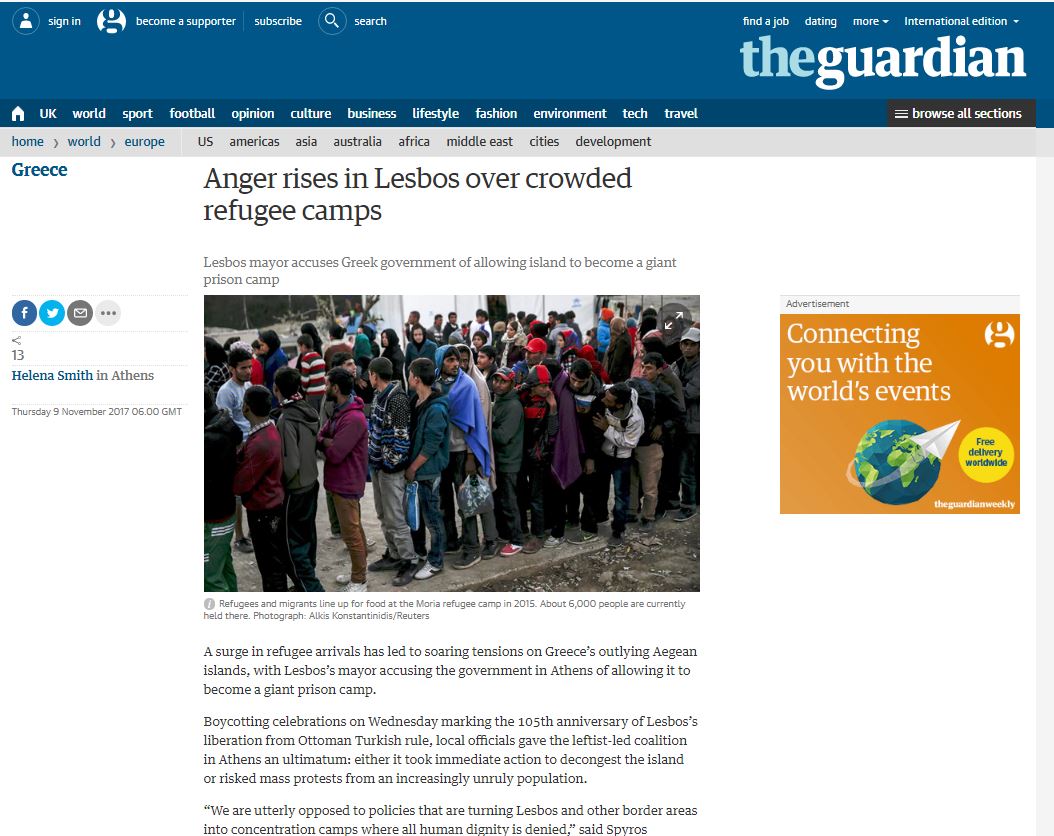
A surge in refugee arrivals has led to soaring tensions on Greece’s outlying Aegean islands, with Lesbos’s mayor accusing the government in Athens of allowing it to become a giant prison camp.
Boycotting celebrations on Wednesday marking the 105th anniversary of Lesbos’s liberation from Ottoman Turkish rule, local officials gave the leftist-led coalition in Athens an ultimatum: either it took immediate action to decongest the island or risked mass protests from an increasingly unruly population.
“We are utterly opposed to policies that are turning Lesbos and other border areas into concentration camps where all human dignity is denied,” said Spyros Galinos, the island’s mayor. “The government has failed to keep to its commitment to effectively deal with this problem and move people on.”
The explosive mood matches the rising number of asylum seekers on Lesbos, the gateway for the vast majority of refugees and migrants who entered Europe at the height of the crisis in 2015.
Close to 6,000 people are being held at the island’s main camp in Moria, which was initially established as a temporary measure to house no more than 2,000.
After a fourfold daily increase in arrivals nationwide over the past three months, the Greek immigration minister Ioannis Mouzalas said the government was considering renting hotels and dispatching cruise ships to the islands to house the growing numbers over the winter months. “The rise is concerning,” he told a recent news conference in Athens.
Under a landmark deal agreed between the EU and Turkey to stem the influx in March 2016, refugees reaching Greek islands are forbidden from travelling to the mainland pending completion of asylum requests.
As a result nearly 15,000 men, women and children are stranded on Lesbos, Chios, Kos, Samos and Leros, the Aegean islands closest to Turkey’s shores, according to figures released by Greece’s interior ministry. In Lesbos and Samos more than 8,300 asylum seekers and migrants are living in facilities meant for just 3,000.
The International Organization for Migration (IOM) estimates that refugee and migrant numbers jumped from 3,665 in August to 4,604 in September. “After the fall of Mosul there has been a discernible increase … and 98% of those who come request asylum,” said Daniel Esdras, the IOM’s Greece office director. “Any change in a conflict zone will automatically have a huge impact on migratory flows.”
The containment policy has been denounced by human rights groups. In a letter last month to the prime minister, Alexis Tsipras, 18 organisations said the abysmal conditions in which people were being made to live – including the elderly, infirm and vulnerable – were placing lives at risk.
Municipal authorities have reacted furiously to suggestions that camps be enlarged and new ones established, arguing that expansion in any form will only lure more refugees and migrants.
At the height of the refugee crisis before countries along the Balkan corridor closed their frontiers and shut off entry to Europe, locals on Lesbos exhibited extraordinary compassion, rushing to greet refugees and offering aid.
But the failure to effectively decongest the islands since the EU-Turkey deal was signed has prompted growing anger with residents blaming overcrowding for almost every ill, including the rise in crime.
Alleviation was necessary not only to maintain the dignity of people fleeing poverty and war but to “protect social cohesion in a border area that is of national significance to Greece”, its town hall said.
Officials in Athens have been reluctant to criticise Ankara for the increase in numbers, instead attributing the rise to a reflection of Turkey’s strained relations with the EU before a visit to Greece in early December by the Turkish president, Recep Tayyip Erdoğan.
“We are Turkey’s neighbour, we are not Luxembourg and so we are careful about what we say,” said Ioannis Balafas, the deputy migration minister. “What we are seeing is a political game. Whenever Turkey wants to put the pressure on Europe it turns on the tap and lets more [people] through.”
Giorgos Koumoutsakos, the shadow minister of foreign affairs in the main opposition New Democracy party, agreed. “If it really wanted to, Turkey could more effectively control the flows,” he said. “What we are seeing, it would seem, is a reflection of Turkey’s problematic relationship with the EU.” In the meantime, Greece’s easternmost islands were paying the price.
Ask me anything
Explore related questions