

×
GreekEnglish

×
  • Politics
  • Diaspora
  • World
  • Lifestyle
  • Travel
  • Culture
  • Sports
  • Cooking
Monday
12
Jan 2026
weather symbol
Athens 6°C
  • Home
  • Politics
  • Economy
  • World
  • Diaspora
  • Lifestyle
  • Travel
  • Culture
  • Sports
  • Mediterranean Cooking
  • Weather
Contact follow Protothema:
Powered by Cloudevo
> technology

The Mystery of the missing mass under the Indian Ocean might have been solved

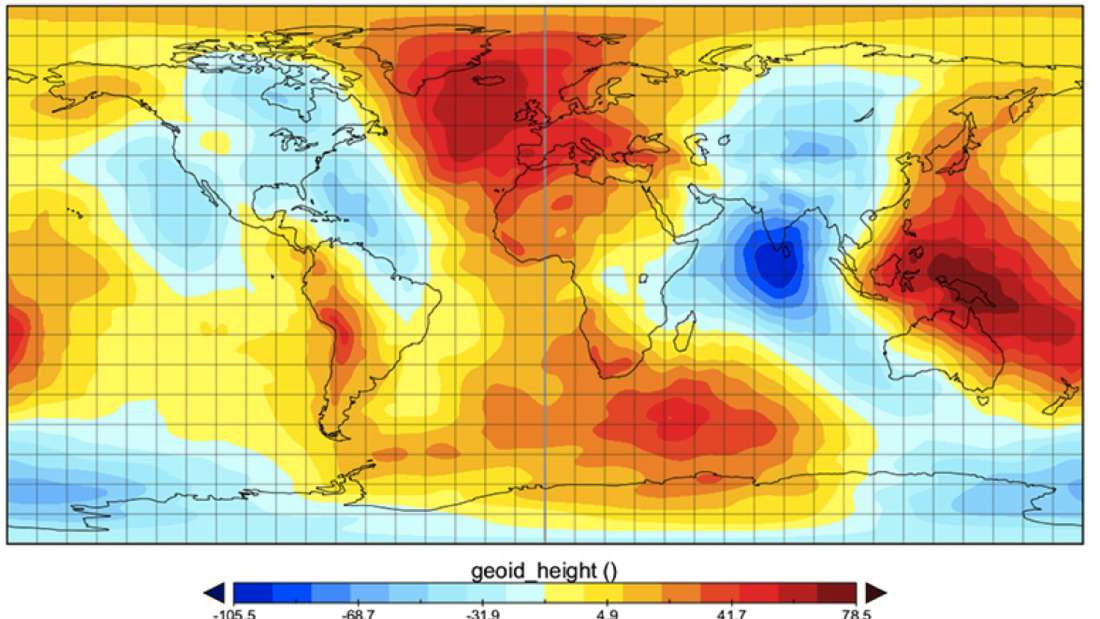
A map referred as a "geoid" has long found that there's a massive piece of mass –more than 100 meters in depth– missing from under the Indian Ocean

Newsroom February 1 10:32

No matter what you might have learned in physics lessons, the Earth is not a perfect sphere. The gravitational potential across its surface can vary quite a bit, due to the density of the material under your feet. Whether you’re in Melbourne or Montreal, you might have different material below you.

The map of this gravitational potential is called the “geoid” and it reveals something quite peculiar – there’s a big chunk of mass missing underneath the Indian Ocean. Its cause has been an enduring mystery, however researchers now suggest that the mantle beneath the Indian subcontinent has a lot more hot and light material than expected. The new research is reported in Geophysical Research Letters.

“The existence of the Indian Ocean geoid low is one of the most outstanding problems in Earth Sciences,” lead author Professor Attreyee Ghosh, from the Indian Institute of Science, said in a statement. “It is the lowest geoid/gravity anomaly on Earth and so far no consensus existed regarding its source. It is remarkable as it means that there is some mass deficit in the deep mantle that’s causing the low.”

If the ideal geoid is seen as a perfect sphere, the Indian Ocean geoid low (IOGL) would be equivalent to a depression of over 100 meters (328 feet). Scientists had previously suggested that beneath the cause of the anomaly was an ancient oceanic plate that sunk below the Indian plate millions of years ago. This explanation left many unconvinced and the team searched for alternative ideas. They looked at how seismic waves propagate through the Earth’s interior and found that there seemed to be low-density material under the IOGL. But where does that material come from?

They believe it comes from the African superplume, a large upwelling in the mantle that is literally (but slowly) splitting Africa apart. The hot material from the superplume appears to be getting deflected eastward and stopping at the IGLO.

>Related articles

Research: The BBC’s “first Black Briton” from the Roman era was ultimately…white and originated from southern England

The Greeks of Silicon Valley

Voyager 1 ready to make history again: in 2026 it will reach a distance of “one light-day” from Earth

“Most of the existing theories have tried to explain this negative anomaly with the help of cold, dense oceanic plates that sank into the mantle in the past,” says Professor Ghosh. “Our study explains this low with hotter, lighter material stretching from a depth of 300 kilometers (186 miles), up to ~900 kilometers (~559 miles), in the northern Indian Ocean, most likely stemming from the African superplume.”

The team plans to study how the IOGL has evolved over time in the hopes that this will provide more supporting evidence for their hypothesis.

Source: iflscience.com

Ask me anything

Explore related questions

#continent#gap#Indian ocean#map#science#technology
> More technology

Follow en.protothema.gr on Google News and be the first to know all the news

See all the latest News from Greece and the World, the moment they happen, at en.protothema.gr

> Latest Stories

Feeding the Homeless: Sunday, January 18

January 12, 2026

Who is Maria Grasia, the right hand of Maria Karystianou

January 12, 2026

Rent reimbursement: On 15 January, the money is credited to the beneficiaries

January 12, 2026

The report on the blackout, the Papastavrou–Eric Trump meeting in Riyadh, Jumbo will also sell cigarettes, the One and Only and the permits

January 12, 2026

Passports: Deadline until January 31 for the old process — Which documents are being abolished

January 12, 2026

Iran responds to Trump: “You incite terrorists to protest for intervention” — Chaos continues with over 500 dead

January 12, 2026

Ecumenical Patriarch comments on ‘bad omen’ after knife mishap at pie-cutting ceremony

January 12, 2026

Maria Karystianou’s political move divides opinion — Criticisms after early acclaim

January 12, 2026
All News

> Lifestyle

Stefanos Kasselakis: The family “jewel” in Ekali is up for rent at €20,000 per month

Shipowner Haris Vafeias, who purchased it, completely renovated the impressive three-storey villa a year and a half ago. It is one of the most beautiful homes in Athens’ northern suburbs

January 10, 2026

Emily Ratajkowski in Athens with Romain Gavras

January 2, 2026

Sakkari on the marriage proposal from Konstantinos Mitsotakis: “I am a very lucky girl”

January 2, 2026

Konstantinos Mitsotakis proposed to Maria Sakkari

January 1, 2026

Chiara Ferragni: A photo album from her trip to Colombia

December 30, 2025
Homepage
PERSONAL DATA PROTECTION POLICY COOKIES POLICY TERM OF USE
Powered by Cloudevo
Copyright © 2026 Πρώτο Θέμα