





The word “souvlaki” is synonymous with Greek food, whether the term refers to pieces of grilled meat on a small wooden skewer or the full-meal of pieces of meat inside pita bread along with tomatoes, onions, tzatziki and potatoes.
Many would think that souvlaki is fast food originating from the many years of Ottoman rule, but this is not true. Archaeological findings and writings show that today’s souvlaki comes from the ancient Greeks. After all, the seat of the Ottoman Empire was on land that was Greek in ancient times.
The origins of souvlaki as pieces of meat grilled on a spit date back to ancient Greece. It was known as obeliskos (the diminutive of obelos – spit), mentioned in the works of Aristophanes, Xenophon, Aristotle and others. A meat and bread recipe which resembles the way pita souvlaki is served today with pita bread was also attested by Athenaeus in his “Deipnosophistae”.

Researcher George Katsos, managing director of doitinAthens start-up company with the motto “experience ancient Greek life”, says: “According to archaeological finds, the inhabitants of Greece are one of the first people in the world who cut and baked several meats almost four millennia ago, applying a new cooking method to the traditional boiling process of the Neolithic Age.”
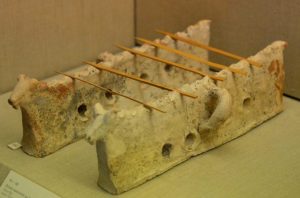
The skewered meat recipe existed as a favorite in ancient Greece during Archaic times, with the earliest references in Homer. However, excavations held in Akrotiri on Santorini by professor Christos G. Doumas, unearthed stone sets of barbecues for skewers (Greek: krateutai) used before the 17th century BC and were popular before the disastrous eruption of the island’s volcano. Even later on, during the Byzantine era, references describe street vendors selling souvlaki with pita in Constantinople.
The krateutai finds show that ancient Greeks were applying new meat-cooking methods almost four millennia ago, different from the traditional boiling process of the Neolithic Age.
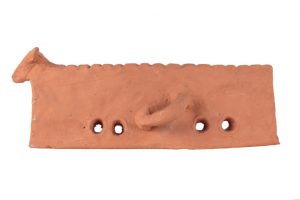
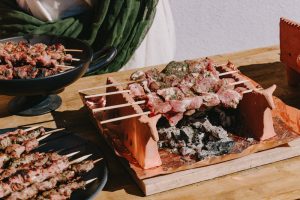
The predominant obelisk cooking utensils were simple ceramic bases placed right and left, a technique used in our time for portable hobs. Low to their base and in a row parallel to the ground, they had holes that serve to oxygenate the coal to limit large fluctuations in temperature.
According to writings found on plaques, in ancient Greece there were festive events focusing on roast meat dishes, usually sliced. The preparation of necessary accompanying baked breads was assigned to sitopoioi, literally wheatmakers, indicating that there were people specializing in making dough, the early bakers.
According to Athenaeus, the skewered pieces of meat and other goods were sold in thermopolia, cart-like stands with hot coals operating in markets. Along with the meats, the carts were like today’s cantinas or street vendors, essentially selling fast food of the time, such as chestnuts, doughs, salted coldcuts and so on. The clay pottery found indicates that the cooking utensils were transportable, indicating that they were used by street vendors.
The importance of condiments and the origin of tzatziki
Athenaeus, in describing eating habits in different regions, wrote about the importance of kandaulos, a creamy accompanying sauce. Kandaulos was also found in references as being based on a particularly expensive type of cheese produced from mixed donkey and mare milk (half and half). Later the particular cheese was replaced by goat cheese, and later on, the soft goat cheese put in the souvlaki pita was replaced by low-cost yogurt that eventually became tzatziki.
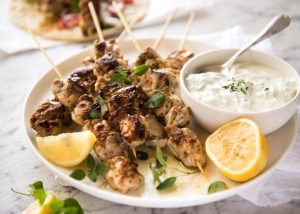
“The kandaulos appears in various texts as kandylos or kandyli, with at least 17 references from various sources from the 5th century BC to the 10th century AD, when it is now described as a white sauce with basic ingredients goat milk, honey and avyrtaki, a salty, sour and acidly sauce, made from chopped leeks and sour pomegranates, with added salt and white vinegar,” Katsos says.
And he continues: “Archaeological finds from Sardis confirm that the cream is initially integral to ritual sacred meals where the faithful symbolically consume the flesh and blood of the deity at a supper of thanksgiving, observing a tradition that several centuries later is transferred to Christianity. The cream, as pointed out by nutritionist and gourmand Egisippos, accompanies boiled or roasted small pieces of pork.”
Another important condiment ancient Greeks used was mustard. It was used for marinating as well as a condiment for consuming meats. Byzantine sophist Ierophilos of the 7th century AD presented a recipe for mustard that is almost identical to today’s yellow mustard. His recipe uses mustard seeds, white vinegar, garlic and olive oil, to make a creamy sauce.
Source: Philip Chrysopoulos/greekreporter
Ask me anything
Explore related questions