




Concrete steps over the past three years have set the foundations of an Eastern Mediterranean Alliance (EMA) comprising Israel, Greece, and Cyprus. The convergence of the three nations is the natural outcome of close democratic similarities and a joint desire for stability and progress in a region tormented by perennial Middle East strife, radical Islamism, and the morphing of Turkey into a fundamentalist Islamic autocracy.
The EMA is emerging at a time of increasing global instability. American retrenchment from traditional postwar strategic arrangements, the resurgence of Russia, a troubled EU, the illegal migration crisis, China’s rise as a global power, and much else leave little room for complacency.
Israel, Greece, and the Republic of Cyprus are the only Eastern Mediterranean actors that are firm democracies. As such, they do not only see a common interest in promoting peace, security, and environmental stability in the region, but also seek to promote strong economic bonds following the discovery of rich hydrocarbon deposits in their respective Exclusive Economic Zones.
While each of the EMA partners faces individual challenges, all three are united against the regional spoiler and strutting Islamic “superpower” of Recep Tayyip Erdoğan’s Turkey. The Turkish president misses no opportunity to vow that Ankara will “take what is rightfully hers” – and is just a step away from declaring the international treaties that settled Turkey’s fate after WWI null and void.
From the Greek perspective, the EMA initiative is indispensable. Greece’s sovereign debt crisis and its bankruptcy in 2010 put its relationship with the northern EU members under severe strain. At present, Athens faces the unpalatable prospect of long-term foreign fiscal “monitoring” and significant limitations placed upon its economic policies. Because present and future Greek governments must function while in the vise of EU “monitoring,” Athens seeks to promote alternative bilateral and multilateral initiatives outside the narrow Brussels-dominated space – and the EMA fits this bill perfectly.
Greece’s most pressing strategic concern is Ankara’s expressed purpose of “re-Turkifying” space once in Ottoman possession. Erdoğan’s incursion into Syria, his plans for militarily “stabilizing” northern Iraq, his expanding subversive and Islamicizing activities in the Balkans, and the daily violations by Turkey of Greek sovereign air and sea space leave little hope for a peaceful future. Greece also faces an impasse with the philo-Turkism of many of its “allies” despite waning Turkish fortunes in Europe and Ankara’s dead-in-the-water application to join the EU.
Thus, the EMA has emerged as the most strategically significant anchor of Greek security and economic progress. The discovery of hydrocarbons in Israeli and Cypriot waters has literally put the EMA on the map, stimulating strong interest in the politics, economics, and security of the region from the US and Russia as well as from countries that had been neutral towards the Eastern Mediterranean.
Athens needs to tread a delicate path vis-à-vis Jerusalem and Cairo, the latter of which is gravitating towards the tripartite EMA. Both Israel and Egypt are involved in ongoing disputes in the Middle East, a factor that traditionally “pro-Arab” Greece will need to handle with political and diplomatic finesse.
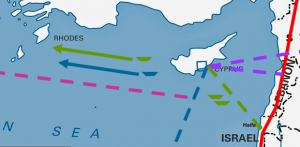
In any case, recent EMA summit meetings have concluded with optimistic declarations of purpose stressing the developing geopolitical cooperation of Jerusalem, Athens, and Nicosia. Central to these positive developments is the planned construction of the EastMed pipeline, which will bypass Turkey, despite increased cost, and thus enhance security in the Eastern Mediterranean by removing Turkey’s control over the EMA centerpiece.
Erdoğan’s electoral victory on June 24, 2018 strengthened his sultanic and Islamist aspirations and gives added urgency to the promotion of the EMA strategic project. A stronger Erdoğan means a faster transition for Turkey to Islamic fundamentalism. This in turn threatens to bring radical Islam to Europe’s doorstep while exponentially increasing the danger posed by Turkey to the EMA partners. With Erdoğan confirming, with every passing day, his rejection and condemnation of Western values, his hatred for the Jewish state, and his elevation of fundamentalist Islamism as the driving force behind the neo-Ottoman Türkiye, there is little room for compromise with Turkey’s emerging Islamic republic.
In the final analysis, it is not the EMA’s purpose to resolve the issue of Turkey, which is the thorniest security problem for the Western alliance in the Eastern Mediterranean and the Middle East. The EMA’s core mission is to promote and secure the collective interests of its partners, to encourage the primacy of international law over irredentist and aggressive policies irrespective of their source, and to create and strengthen a superstructure of economic initiatives of irrefutable strategic value to Europe and the US. In the meantime, as Federiga Bingi of Johns Hopkins put it, “Europe and NATO cannot afford to be checkmated by Erdoğan.” They should act accordingly.
Source: John M. Nomikos/besacenter
Ask me anything
Explore related questions