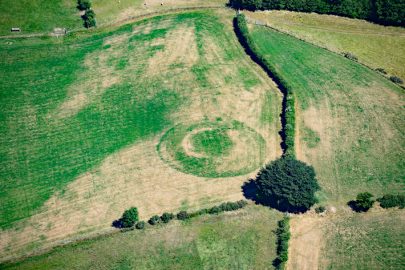
On very rare occasions, during unusually hot, dry summers, normally hidden features can appear on the landscape. This can occur in two ways. Areas where the remains of buildings lie just underground or where a stretch of land has been repeatedly walked upon are always drier. During a heat wave, vegetation there will wither more quickly, creating brown parch marks that contrast with the surrounding grassy areas. Most of the sites here follow this pattern. By contrast, more moisture collects in areas that in antiquity were taken up with ditches or were dug in other ways. In a heat wave, those areas will remain greener than the surrounding landscape. Such is the case with the Neolithic monument in Ireland’s Boyne Valley and the medieval castle in Wales.
As these conditions persisted this past summer, archaeologists, with the help of aerial photography, drones, and the eyes of the public and scholars alike, were able to document evidence of buildings and human behavior that have rarely, if ever, been seen before. The heat wave is over and the rain has come again. At least for now, many of these traces of the past are no longer visible.
Late Neolithic Monument
Boyne Valley, Ireland
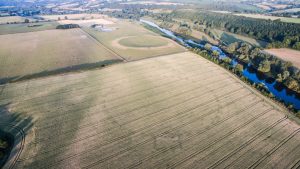
Brú na Bóinne, or the Palace of the Boyne, on Ireland’s east coast, features an astounding concentration of prehistoric monuments. More than 90 are known in all, and summer 2018’s scorching weather has added yet another—only traces of which were seen in a previous lidar survey. Located just north of the River Boyne, the new monument dates to 2900–2500 B.C. and became visible in pits, postholes, and sections of ditch.
The monument, which likely served as a site for rituals, features a circular double ditch broken up into sections. The entire complex is surrounded by a double ring of timber posts. “The posts may have been connected in some way to create a wall or fence,” says archaeologist Stephen Davis of University College Dublin. Sectioned ditches are nearly unknown in the late Neolithic, according to Davis, and while double rings of posts dating to the period have been found in Scotland, they had never before been found in Ireland. A box-shaped structure on the monument’s western side once had particularly large posts, and may have served as an entrance. Davis notes that the newly discovered monument probably had some relationship to another one just to its southeast, which also appeared this summer as a wide, desiccated ring marking what was once an earthen or stone bank.
WWI Military Camp
Hawick, Scotland
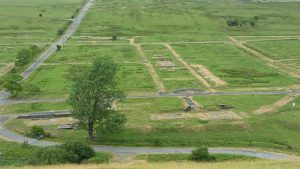
In the very early years of the twentieth century, the Stobs Military Camp served as a training ground and living quarters. Just before World War I, it was the place where Scotland readied for combat. And during the war, it became a POW camp where both civilian and military prisoners were housed in 80 wooden huts that each measured 120 by 20 feet and were surrounded by barbed wire. Stobs eventually closed in 1957, and its layout is reasonably well known from the master plan drawn up in 1917. According to Andrew Jepson of Archaeology Scotland, however, parts of the camp that hadn’t been seen in many years became evident during summer 2018’s heat wave. “We clearly knew that the building foundations and networks of paths were there, but over the decades they had become difficult to identify in some areas as nature began to reclaim the land,” says Jepson. “An attempt to locate precisely some of the corners of the barracks hut foundations last year proved relatively unsuccessful,” he adds, “so we were excited to see so much of the camp appear before our eyes.”
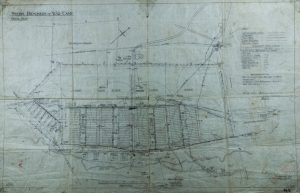
(From the collection of Scottish Borders Council. Administered by Live Borders, Hawick Museum) 1917 Royal Engineers Plan for Stobs Military Camp
Read more HERE
Ask me anything
Explore related questions