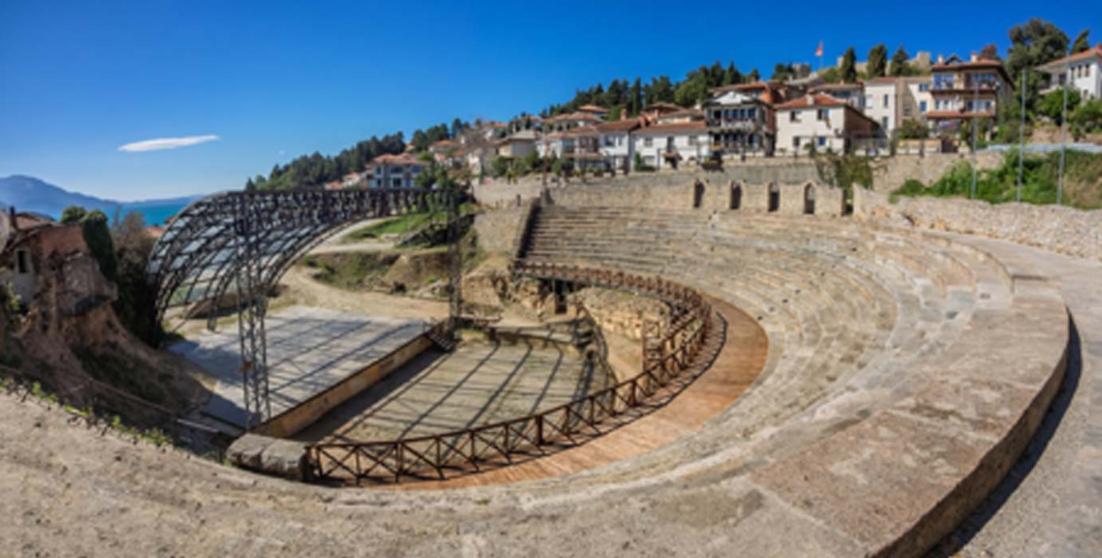
The Ancient Greeks are known for their incredible, long-lasting innovations such as the water mill, the alarm clock, the Olympics and the theatre! They built a great many theatres in the lands they ruled and one that is still in use today, is to be found in the historic town of Ohrid in the Republic of North Macedonia.
The Turbulent History of the Theatre of Ohrid
The modern-day town of Ohrid was once known as Lychnidos. This region was inhabited by Illyrian tribes and a Macedonian town existed there by the time of Phillip II, the father of Alexander the Great. The Macedonians as Greeks were carriers of the Hellenic culture.
Lychnidos was strategically important and Phillip II built a major fortress. The theatre was built during the end of 3rd or the beginning of 2nd century BC, possibly by local wealthy citizens, and was an expression of the growing Hellenization of the region. The theatre was used to stage tragedies, comedies and recitals.
During the mid-2 nd century BC the Romans conquered the town after they defeated the Macedonian monarch, Phillip V. Naturally, they adapted the theatre to their own cultural needs and held gladiatorial games and perhaps used it for continued performance of Greek dramas. It is alleged that Christians were executed in the theatre in the 4 th century AD, during the Diocletian Persecution.
When the area was Christianized by the 5 th century AD, a bishop ordered that all theatrical performances and gladiatorial games would cease as they were considered sinful.
Lychnidos was occupied by Slavic tribes in the 7 th century and later by the Bulgars in the 9 th century. The theatre fell into a state of disrepair and was eventually buried. It was only in the early twentieth century that the structure was re-discovered by workmen during a building project. In the 1910s a team of Russian archaeologists excavated the theatre and it was later restored and opened to the public.
The Ancient Theatre of Ohrid
The theatre was based on late Hellenistic models, built in the form of a semi-circle composed of three areas – the stage area, an open space in front of the stage, and the rows of seating. At one time the theatre was decorated with marble friezes, adorned with scenes from the life of the god Dionysus and other scenes from Greek mythology. Some of these marbles can still be seen in a local museum.
In typical of Hellenistic tradition, the theatre was built into a hill, located not far from the famous medieval Samuel’s fortress. The site was selected because of its excellent acoustics.
The Romans re-developed the theatre to suit the needs of staging large-scale gladiatorial games by removing some of the lower seating and adding more seats at a higher level. In its heyday the theatre could hold 5000 people. Seating was based on an audience member’s social status with the best seats reserved for the elite. A few names can still be seen inscribed into the stone.
Stairs enable visitors to walk from the seating area to the stage area, yet little of the original Hellenistic era stage remains. What remains of the original theatre is only its lower section and all the upper seating have been destroyed as the modern town has long encroached into the heritage site, but some of the original outer wall and entrances are still standing.
The theatre is located in the old town of Ohrid which contains many amazing historical sites from the Middle Ages and later. The theatre is also near the magnificent Lake Ohrid and Samuel’s Fortress. There is no entrance fee to the theatre and visitors can walk around the Hellenistic site.
Unfortunately, there is little information at the site and no guides, and the heritage site is somewhat neglected, but every summer it is used for performances during the Ohrid Summer Festival.
Source: ancient origins
Ask me anything
Explore related questions