×
GreekEnglish

×
  • Politics
  • Diaspora
  • World
  • Lifestyle
  • Travel
  • Culture
  • Sports
  • Cooking
Sunday
18
Jan 2026
weather symbol
Athens 7°C
  • Home
  • Politics
  • Economy
  • World
  • Diaspora
  • Lifestyle
  • Travel
  • Culture
  • Sports
  • Mediterranean Cooking
  • Weather
Contact follow Protothema:
Powered by Cloudevo
> World

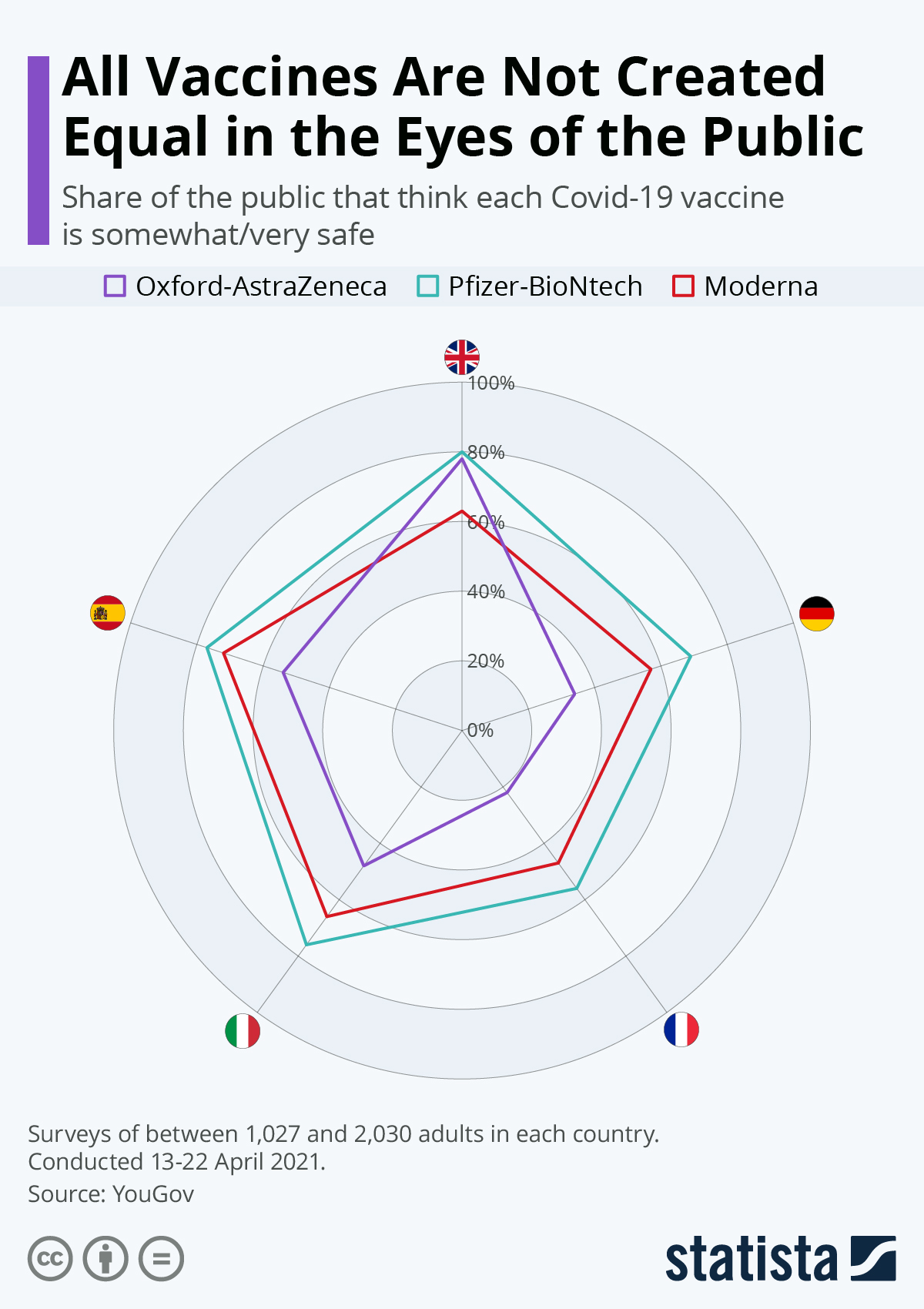
All Vaccines Are Not Created Equal in the Eyes of the Public (infographic)

A recent YouGov survey showed that up to a quarter of people say they would not accept a shot of a particular vaccine

Newsroom March 13 11:36

As countries continue the push to inoculate their populations against Covid-19, problems with vaccine hesitancy are emerging to varying degrees. While this is not a new phenomenon, having a variety of vaccines available has led to some being viewed more favourably than others. A recent YouGov survey showed that up to a quarter of people say they would not accept a shot of a particular vaccine, in the hope they will be offered a different one in the future.

This not only hampers efforts to halt the spread of the pandemic but also throws up an array of questions as to how governments and the media should deal with the information surrounding each of the vaccines once they have been approved for use. For an example of all these factors coming together we only need to look as far as Germany. According to YouGov, 27 percent of respondents there said they would not take the Oxford-AstraZeneca vaccine, instead choosing to wait for an alternative.

The background to this is somewhat complex, but it essentially stems from the decision of the German government to not recommend the Oxford vaccine for those over 65 as the number of people tested in this age group during stage 3 trials was considered too small. This decision has since been reversed, but the damage to public perception was already done. On top of this, a reporting error in one of the country’s most respected newspapers stated that the effectiveness of the vaccine for the age group 56-69 was just 8%. In actual fact, this figure referred to the share of AstraZeneca’s test subjects in this age group, not the efficacy of the vaccine.

In the UK conversely, the AstraZeneca shot was rated better than both the Moderna and the Pfizer-BioNtech products in terms of perceived safety, as this infographic illustrates. As well as the differing perceptions from country to country, overall differences in levels of trust can be observed, with France especially low across the board.

>Related articles

The vaccine that protects against dementia – Reduces the risk by 20% over seven years

Scientists’ alert on avian flu – Could cause a pandemic worse than COVID-19

High transmissibility and more severe illness expected from this year’s flu – Vaccination essential, experts warn

source statista

Infographic: All Vaccines Are Not Created Equal in the Eyes of the Public | Statista

You will find more infographics at Statista

Ask me anything

Explore related questions

#COVID-19#inoculation#vaccination#vaccine
> More World

Follow en.protothema.gr on Google News and be the first to know all the news

See all the latest News from Greece and the World, the moment they happen, at en.protothema.gr

> Latest Stories

War, diplomacy, or insurrection: What’s next in Iran

January 17, 2026

New tensions in the Middle East as Trump invites regional leaders to the Gaza Peace Council

January 17, 2026

Weather: A return to winter in the coming days – Cold and strong northerly winds – Kolydas’ post

January 17, 2026

A view of Nikolaos Stasinopoulos of Viohalco – The “enduring imprint” of Greece’s greatest industrialist

January 17, 2026

The horror of the “Tariff of the Dead”: how the Iranian regime prices the bodies of protesters

January 17, 2026

Mitsotakis on the Karystianou party: “There is a long distance between being the parent of a tragedy victim and being the leader of a political party”

January 17, 2026

Patras in carnival mode – This evening, the city’s official opening ceremony

January 17, 2026

Greenland as the first line ofdefense for the U.S. and NATO:

January 17, 2026
All News

> World

War, diplomacy, or insurrection: What’s next in Iran

The Iranian regime faces the most serious threat to its survival, despite the repression of protests - The possibility of a US strike remains on the table - The landscape for the next day is blurred

January 17, 2026

New tensions in the Middle East as Trump invites regional leaders to the Gaza Peace Council

January 17, 2026

The horror of the “Tariff of the Dead”: how the Iranian regime prices the bodies of protesters

January 17, 2026

Greenland as the first line ofdefense for the U.S. and NATO:

January 17, 2026

Changes at top universities: Oxford abolishes the term ‘doctores’ for inclusion reasons

January 17, 2026
Homepage
PERSONAL DATA PROTECTION POLICY COOKIES POLICY TERM OF USE
Powered by Cloudevo
Copyright © 2026 Πρώτο Θέμα