




The British news outlet covers the horrific train crash in Greece, the worst in the last decade on Europe’s rail network, attempting to shed light on the causes of the
The images that have been going around the world in the last few hours, with the dozens of dead, after the severe head-on collision between the passenger train running the Athens – Thessaloniki route and the freight train, outside Larissa, are awakening sad memories of past railway accidents in the European Continent, notes the Guardian.
As the publication states, a similar tragedy in Europe with many similarities to that of Tempe occurred in 2016 in Germany, when after a head-on collision of two trains in Bad Aibling, 12 people were killed. In this incident, a careless train master allowed two trains to travel in opposite directions on a single track.
From The Guardian:
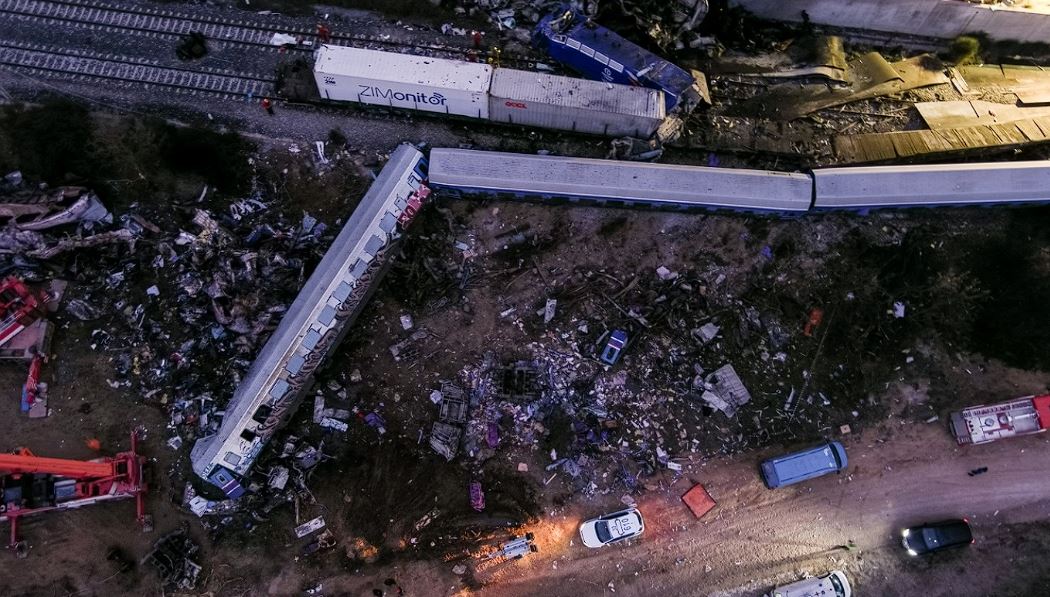
The horrific crash involving a passenger train and a freight train in Greece is the worst in a decade on Europe’s railways, with dozens killed in a high-speed, head-on collision.
Initial pictures seem to make clear that both trains were travelling on the same track, crashing head-on just after the passenger train from Athens to Thessaloniki passed under a road bridge.
A standard speed for trains on the lines would be up to 125mph, less for freight trains, and one witness said the northbound passenger train was travelling at about 100mph. The damage from a head-on collision at such speeds is clear – while several carriages were visibly burned and derailed, the leading two, the regional governor said, “no longer exist”.
At time of writing, there was no evidence made public as to what caused the crash, but a clear question for investigators will be whether the signalling was functioning properly, or whether human error or other circumstances left two trains on the same tracks on a double-tracked line.
Although much of Greece’s small railway network has been closed, it has invested in the major rail artery between Athens and Thessaloniki, and the trains were travelling on what appears to be a well-maintained stretch of the electrified mainline.
The arrest of a station manager in Larissa who, according to some reports, could have wrongly directed one of the trains, suggests human error is an initial line of inquiry.
The last comparable tragedy in Europe was in 2016, when a head-on collision in Bad Aibling in Germany killed 12 people. In that incident, a distracted signaller, who allowed two trains to travel in opposite directions down the single-track line, was found responsible.
The last railway accident in Europe to cause such fatalities was a high-speed derailment in Spain in 2013, when 80 people died after a train overturned near Santiago de Compostela.
more at theguardian.com
Ask me anything
Explore related questions