




Yesterday, the Greek Pavilion at the 60th Venice Biennale was inaugurated, with opening remarks from Deputy Minister of Culture Christos Dimas, the artistic director of EMST Katerina Gregos, the curator of the Greek representation Panos Giannakopoulos, and the team of artists. The exhibition will open to the public on Saturday, April 20, and will remain open until November 24.
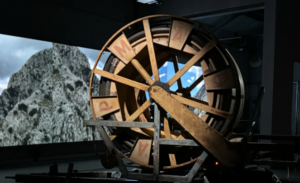
Xirómero/Dryland is representing Greece at this year’s International Art Exhibition, is an interdisciplinary collective work conceived by Thanasis Deligiannis and Giannis Michalopoulos, with contributions from Elias Kalogiannis, George Kyvernitakis, Kostas Chaikalis, and Fotis Sagonas. Curated by Panos Giannakopoulos, it consists of a rural irrigation machine that synchronises sound, moving images, and lighting environment in real-time. The Greek representation explores the experience of a festival, tracing a path from the village square to the outskirts of the surrounding agricultural landscape. Specifically, it draws inspiration from the folklore festivals of mainland Greece, Thessaly, and the region of Xirómero in Western Greece, which lends its name to the artwork.
The artists refer to water as a prism—a means to see and think—focusing on its absence or surplus, the need and its wastefulness as well as its social connotations. The depletion of resources is linked to both physical and economic exhaustion. The artwork explores the political possibilities of sound and music, the impact of technology on rural landscapes, and cultural diversity.
The celebration of the festival conveys information and meaning as both ritual and entertainment. It is connected to agricultural tasks, produced by—and produces—the internal transience of the community through irrigation and rural responsibilities. It helps each community create its own image. However, opposing concepts are also intertwined: spectators become participants, shifting from the stage to offstage, from preformative action to daily activity.
Greek PM Kyriakos Mitsotakis met with Turkish tourists in Mytilene
This continuous interaction between “performance” and reality is reflected in the artwork. Xirómero/Dryland utilising the architectural features of the Greek Pavilion to highlight correlations with agricultural warehouses and religious architecture, which usually serve as the backdrop for folklore festivals. Additionally, the irrigation system at the center of the pavilion circumscribes the environment of the installation. The artwork also transfers the community gathering space—the square, the public assembly—from the exterior to the interior. As the watering system is activated, it creates a rhythm, delineating time like a clock or an unfolding cassette, prompting visitors to follow paths and change perspectives. Xirómero/Dryland avoids an aesthetic approach and emphasises the emotional immediacy of contact with objects, sounds, and images.
As gender relationships at the festival are observed, the possibilities of self-presentation, the different versions of femininity and the revelation or concealment of the female body are examined, as well as the ambiguity of the subject’s gesture, which withdraws by choosing absence and exclusion from the celebration.
Xirómero/Dryland attempts correlations between the geographically expanded experience with the global condition, a shift between dominant and marginalised cultural objects, which seems to create the intermediate space of forming new meanings.
Research for the Xirómero/Dryland project was conducted within the framework of the Margaroni Residency commissioned by Onassis Culture, by interdisciplinary artist and composer Thanasis Deligiannis and playwright and philologist Giannis Michalopoulos as Onassis AiR Fellows, who formed the artistic team with visual and cinematographer Elia Kalogianni, photographer and documentarist Giorgos Kyvernitis, sound engineer and sound designer Kostas Haikalis, and visual artist and architect Fotis Sagonas.
Ask me anything
Explore related questions