





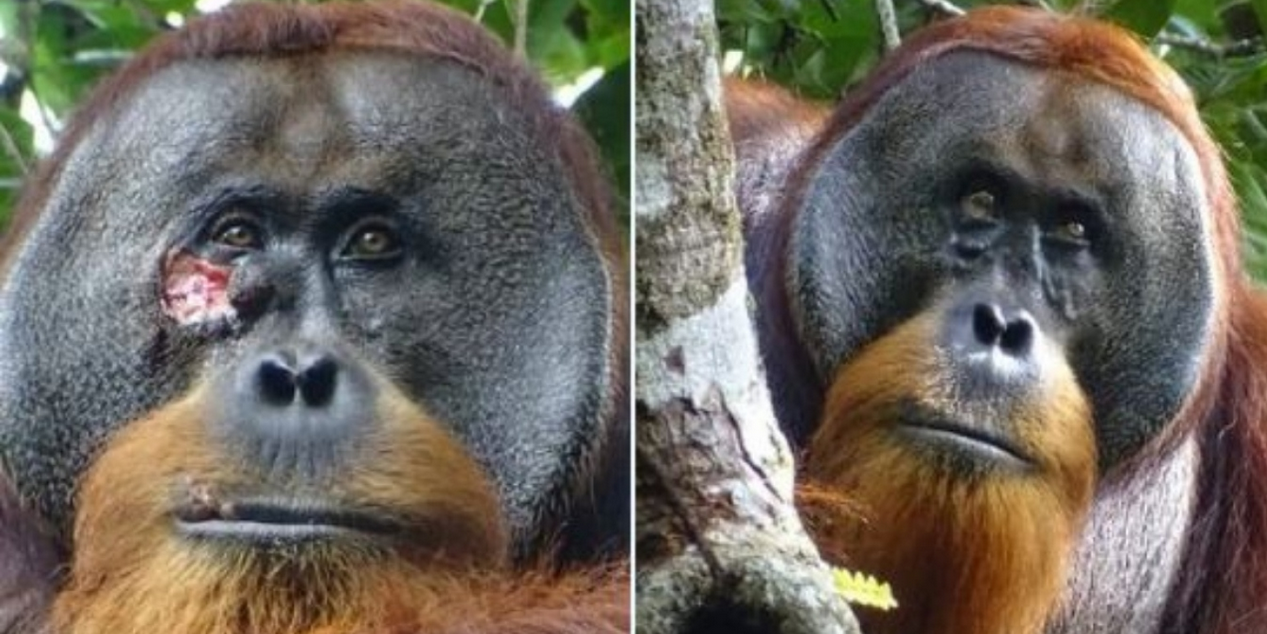
An orangutan named Rakus hit a rough patch in the summer of 2022.
Researchers heard a fight between male orangutans in the treetops of a rainforest in Sumatra, Indonesia; a day later, they spotted Rakus sporting a pink wound below his right eyelid.
A chunk of flesh about the size and shape of a puzzle piece was missing. When Rakus, who is most likely in his 30s, belted out a long call, the researchers noticed another wound inside his mouth.
Over the next several days, researchers followed Rakus at a distance — and saw something so surprising they wound up reporting it in great detail in the journal Scientific Reports.
According to their study, published Thursday, Rakus was observed repeatedly chewing on the leaves of a particular liana plant over several days. The climbing vine is not a typical food for orangutans, but it is known to humans as a pain reliever.
On at least one occasion, Rakus made a paste from the chewed leaves and applied it to his face. It’s the first time an animal has been seen applying medicine to a skin wound.
“It’s the first documentation of external self-medication — the application of leaves, I would argue, as a poultice, like humans do to treat wounds and pains,” said Michael Huffman, an associate professor at the Wildlife Research Center at Kyoto University in Japan, who was not involved in the new study.
Rakus’ wound never showed signs of becoming infected, and it closed up within a week.
The discovery is new evidence that orangutans are able to identify and use pain-relieving plants. A growing body of research suggests other animal species also self-medicate, with varying levels of sophistication.
The researchers behind the study think that great apes’ ability to identify medicines and treat wounds could trace back to a shared ancestor with humans.
AI voice analysis gives suicide hotline workers an emotional dashboard
New evidence that orangutans self-medicate
The discovery was possible only because Rakus spends his days in a protected area of rainforest called the Suaq Balimbing research area, in Indonesia’s Gunung Leuser National Park.
Researchers have been observing orangutans there since 1994. Today, about 150 call the area home. Rakus, who was first observed there in 2009, is either a resident or a frequent visitor.
Scientists often follow an individual orangutan in the area from early morning — when it leaves its night nest — until it builds a new night nest about 12 hours later.
“We don’t disturb the orangutan,” said an author of the new study, Isabelle Laumer, a primatologist and cognitive biologist at the Max Planck Institute of Animal Behavior in Germany. “They completely tolerate us following them.”
Laumer said that researchers had never before observed orangutans in the area self-medicating like Rakus did and that it was not clear how he developed the behavior.
Continue here: NBC
Ask me anything
Explore related questions