





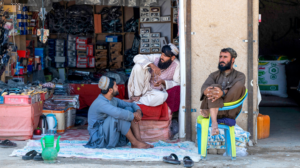
First, it was women – or, rather, it was always women. Draconian measures against them, restrictions on their appearance, education, social life, terror… Now, the… absurd, in many cases, laws imposed by the Taliban regime in Afghanistan are beginning to touch men, forcing them to ask themselves: should they have spoken up earlier is the question.
For three years ever since the Taliban seized power in Afghanistan, women have faced every kind of restriction on their individual rights and personal freedom, starting with their dress. On the contrary, men, especially in the country’s urban centers, continued to enjoy the privileges of a free life.
For the past month, however, as the Washington Post notes, the regime has resorted to enforcing laws that now affect men’s free lives as well. The new laws require men to … grow a beard the length of a fist, prohibit them from imitating non-Muslims in appearance or behavior – something widely interpreted as a ban on jeans – and put a “brake” on haircuts that go against Islamic law – essentially, this means an end to the short or Western-style haircut. As if all this wasn’t enough, men are now even banned from… to look at other women, other than their wives or relatives.
As a result, more and more people are growing beards, carrying prayer mats and leaving their jeans at home.
These first severe restrictions on men came as a surprise to many in Afghanistan. In a society where a man’s voice is clearly considered far more powerful than a woman’s, some now wonder if they should have spoken up earlier to defend the freedoms of their wives and daughters-and, by extension, their own.
“If the men had raised their voices, we might be in a different situation now,” said a resident of the capital Kabul, who, like others who spoke by telephone to The Washington Post, was interviewed on condition of anonymity. “Now, everyone is growing a beard because we don’t want to be challenged, humiliated,” he said.
The Taliban’s new rules for men, of course, pale in comparison to the restrictions the government has placed on girls and women, who are still banned from going to school above the sixth grade, barred from universities, and recently banned from raising their voices in public, among many other rules.
But newly empowered “religious ethics officers”, known for their white robes, have been knocking on the doors of men in some parts of Kabul for the past four weeks, who do not have… regular mosque attendance, to pray. Government officials say they fear they will be fired for failing to let their beards grow, and some barbers are now refusing to cut their beards. Increasingly, male taxi drivers are being forced to stop in the middle of the road for violating gender segregation rules by carrying women in their vehicles unaccompanied, or for playing music.
The new laws give vice police the power to detain suspects for up to three days. In serious cases, such as repeatedly failing to pray at the mosque, suspects can be handed over to courts for trial and sentencing based on their interpretation of Islamic Sharia law. Violations of the new rules are expected to be punishable by fines or prison sentences. However, people found guilty of certain violations, such as adultery, could be sentenced to flogging or death by stoning.
Amir, a resident living in eastern Afghanistan, said he had supported the Taliban until the latest restrictions. But now he feels intimidated by the “vice police”. “All of us are practicing Muslims and we know what is compulsory and what is not. But it is unacceptable that we are being subjected to violence,” he says, adding: “Even people who have supported the Taliban are now trying to leave the country.”
Most of the men who spoke about this issue live in Kabul or other urban areas. Residents of Afghanistan’s more conservative and traditional areas, on,the other hand, say they have noticed almost no change. One man, a resident of rural Helmand in southern Afghanistan, said no one in his village has any concerns and that such rules have long been commonplace there. “So far no vice police have appeared here. They are concentrating on the cities,” he said.
The new restrictions appear to reflect a broader shift in the balance of power within the Taliban, with more conservative elements either gaining influence or seeking to impose themselves more “aggressively” in urban areas, according to Western officials and Afghan critics of the Taliban.
Repression by the “vice police” in urban areas, where some religious rules were rarely enforced, has heightened women’s concerns. For men, again, as the Washington Post concludes, it was a shock…
Ask me anything
Explore related questions


