





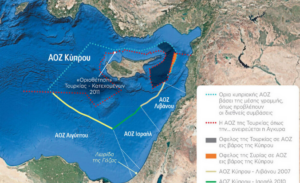
The dynamic entry of Turkey into the developments in Syria creates new challenges for Nicosia and Athens, as Turkey’s effort to establish faits accomplis by enforcing its own “law in the Eastern Mediterranean” has certainly not concluded with the signing of the illegal Turkey-Libya Memorandum in 2019 and the unilateral submission of its Exclusive Economic Zone (EEZ) boundary map to the UN on March 18, 2020.
The proponents of the “Blue Homeland” doctrine and the unilateral, arbitrary, and unlawful “delimitations” under international maritime law, led by retired admiral-commentators such as Cihat Yaycı, consistently reappear in Turkey’s public discourse. They thereby exert pressure on the government for Turkey’s delimitations—sometimes with the Palestinian Authority, at other times with Israel or Lebanon—while effectively erasing the Republic of Cyprus from the map with the familiar claim that islands do not possess maritime zones.
In recent days, television commentators in Ankara have been promoting the potential advantages of overthrowing Assad and Turkey’s strengthened role in Damascus. One benefit highlighted is the possibility of applying the same approach as in Libya to delineate maritime zones with Syria. This would involve not only adjacent coastlines but also opposite coasts of the two countries, effectively erasing Cyprus from the map.
This method would grant Turkey a “tongue” of Exclusive Economic Zone (EEZ) extending southward east of Cyprus, along with a small additional portion of continental shelf near Syria—more than it would be entitled to in a delimitation with the Republic of Cyprus. Hulusi Akar, the former Defense Minister and now Chairman of the National Defense Committee in the Turkish Grand National Assembly, has endorsed this perspective. Akar was also instrumental in initial talks with the Libyan government regarding the Turkey-Libya Memorandum.
A Real Threat
This threat is real, and Nicosia and Athens are closely monitoring Turkey’s actions and initiatives, as they did when Ankara approached the Palestinian Authority with a similar unconventional and illegal delimitation proposal—a move Mahmoud Abbas ultimately did not pursue.
Athens and Nicosia are taking proactive measures to prevent another surprise like in 2019. After the European Council Summit, Greek Prime Minister Kyriakos Mitsotakis reminded the public that the Turkey-Libya Memorandum is invalid. While there are only journalistic reports about a potential Turkey-Syria agreement, both he and Cypriot President Nikos Christodoulides have informed their counterparts.
According to sources, Nicosia has engaged in preventive diplomacy and raised the issue with entities in direct contact with HTS (Hay’at Tahrir al-Sham) and the emerging power in Damascus.
Transitional Period in Syria
It is evident that Syria faces a prolonged transitional period before stability and legitimacy are restored, and a government recognized by the UN can engage in agreements with third parties. Even then, a legitimized Syrian government would likely prioritize other pressing issues over accommodating Turkey’s demand for a delimitation as proposed by retired Admiral Cihat Yaycı.
Such an initiative would place Damascus in direct conflict with the EU, as it would represent an attempt to seize part of the EEZ of an EU member state. This would lead to sanctions and jeopardize the vital aid the new regime will need for survival.
According to Yaycı’s calculations, the area to be claimed as “Turkish EEZ” is a small section of Cyprus’s EEZ not currently under the Republic of Cyprus’s control. At the same time, it would nullify the “maritime zones” claimed by the unrecognized Turkish Republic of Northern Cyprus, which Turkey ostensibly supports. Notably, when the TRNC illegally allocated exploration blocks to Turkey’s TPAO a decade ago, it excluded the disputed area from its plans—an area Turkey now seeks to appropriate.
If Turkey and Syria were to move forward with such an initiative, the primary goal would be to lend legitimacy to the Turkey-Libya Memorandum, creating a second agreement of this type in the Eastern Mediterranean. This would establish a “special” reality in the region, providing Turkey with leverage for its proposal of a “fair sharing” of maritime zones in the Eastern Mediterranean through an international conference of all coastal nations. Such a scenario would undermine the established principles of the Law of the Sea.
Additionally, collaboration with Damascus on these issues would be beneficial for Turkey, as Syria had previously condemned the Turkey-Libya Memorandum as illegal in a letter to the UN on April 29, 2020 (A/74/831). The letter described the memorandum as a blatant attack on the sovereign economic rights of Greece, Cyprus, and Egypt and as detrimental to the EEZ among these states.
Energy and Geopolitical Concerns
Turkey’s strategic role in Syria has opened opportunities to advance its broader regional ambitions. However, it is critical to avoid spreading panic about potential moves that have not yet materialized. Constant vigilance is required by both Athens and Nicosia to prevent a repeat of the 2019 scenario and to send timely messages to the evolving regime in Damascus and Ankara.
A potential Turkey-Syria deal could lead to a return to EU sanctions against Turkey, disrupting rapprochement efforts with the EU that President Erdoğan himself acknowledges as strategically vital. Developments in Syria are reshaping Turkey’s plans in energy and maritime delimitation.
Turkey continues to oppose the Greece-Cyprus-Israel electrical interconnection project, as it seeks to prevent alternative energy routes to Europe. Ankara aspires to strengthen its position as an energy transit hub, particularly after recent developments in Syria.
Plans under consideration include a gas pipeline through western Syria that would connect to the Arab Gas Pipeline linking Syria, Jordan, and Egypt. This pipeline would facilitate cost-effective gas exports from Egypt and Israel to Europe. However, political obstacles persist, such as Turkey’s strained relations with Israel due to the Gaza conflict.
Another revived proposal involves a pipeline transporting Qatari gas through Saudi Arabia, Jordan, Syria, and Turkey to Europe. This would offer an alternative to Russian gas, furthering European energy independence. Turkey’s Energy Minister, Alparslan Bayraktar, expressed openness to reviving this project just two days after Assad’s overthrow.
Greece-Cyprus-Israel Electrical Interconnection
Meanwhile, concerns persist about the electrical interconnection project, with disagreements among Greece, Cyprus, and related stakeholders exacerbated by Turkey’s opposition. Prolonged delays and unresolved business and regulatory issues create further uncertainty.
The Bloomberg report that French company Meridiam acquired a 49.9% stake in the Greece-Cyprus-Israel interconnection project (CSI) with ADMIE retaining 50.1% offers hope. However, challenges remain, including potential Turkish actions to hinder or disrupt the project.
To mitigate these risks, Greek authorities must resolve differences with Cypriot stakeholders and ensure the smooth continuation of critical work, such as laying cables for the electrical interconnection. Political intervention may be necessary to avoid jeopardizing this high-stakes geopolitical and economic project.
Ask me anything
Explore related questions


