





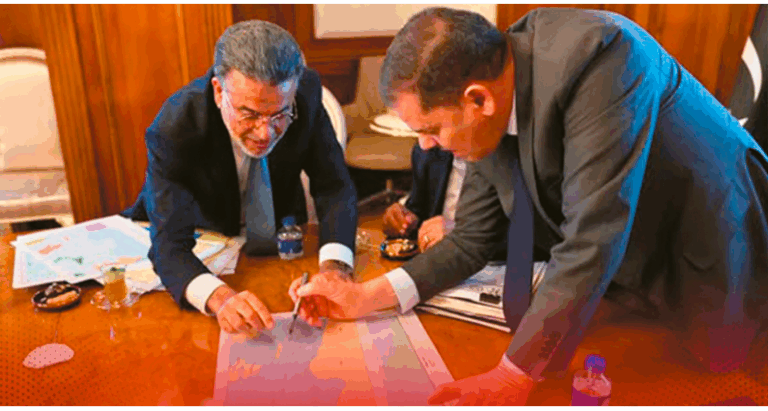
In recent weeks, the Tripoli-based government, led by Dbeibah, has been on high alert due to possible reactions to its latest actions, including the publication of the Maritime Spatial Planning map and the announcement of hydrocarbon exploration licenses in areas south of Crete. In 2019, Tripoli had protested to Athens regarding exploration licenses in regions near western Crete, and a few months later, the Turkish-Libyan Memorandum was signed.
So far, according to diplomatic sources, Libya has not issued any formal protests to Athens concerning the blocks south of Crete, which have attracted interest from Chevron, nor regarding the maritime map, although it is premature to draw definitive conclusions.
Concern and Monitoring
It is noteworthy that with the recent licensing of Libyan offshore blocks for hydrocarbon exploration, Libya appears to be fully aligning with the median line unilaterally adopted by Greece under Law 4001/2011, which it had contested in 2019. This median line also questions any potential “demarcation” of Libya’s EEZ as a continuation of the Turkey-Libya Memorandum, which sought to usurp large parts of Greek continental shelf.
While the situation in Libya remains fluid, Athens continues to monitor developments, especially since Turkey maintains strong influence over the Nbeibah government and does not wish to see the Turkey-Libya Memorandum formally annulled on Libya’s side of the boundary line.
Last week, official Tripoli media reported that the interim Prime Minister, Abdulhamid Dbeibah, held a comprehensive meeting on recent developments concerning Libya’s maritime borders, emphasizing that “this is a matter of national sovereignty.” The meeting was attended by the head of the Land and Maritime Borders Committee of the Foreign Ministry, Mohamed Al-Harari, and the head of the National Oil Corporation, Masoud Suleiman.
Photo and Map
A key point of interest was a photograph published showing Mr. Dbeibah pointing and annotating a map laid out on the conference table, focusing on the area south of Crete—where the Greek offshore licenses are located and of interest to Chevron. The map also shows the line representing Libya’s outer EEZ boundary based on the Turkey-Libya Memorandum, which is located far to the north and overlaps a significant part of Greece’s continental shelf. The decisions made during the meeting were not disclosed, but the Greek embassy in Tripoli is closely following the developments.
Dbeibah stressed that the issue of maritime borders is a matter of sovereignty that cannot be addressed solely through “technical logic” detached from political decisions.
Problems and Strategic Outlook
The meeting focused on obstacles delaying the delimitation and control of maritime zones, as well as the importance of coordination between technical services and authorities to ensure Libya’s stable stance on future regional disputes or agreements. The head of the National Oil Corporation highlighted the consequences of any legal or geographical confusion on offshore exploration and production activities, emphasizing the need for full legal coverage of concession areas to protect Libya’s resources from external conflicts.
At the end of the meeting, the importance was underlined of establishing a technical team to coordinate among stakeholders, monitor delimitation and border surveillance plans, and strengthen Libya’s position in the regional context, in accordance with the Law of the Sea and international agreements.
These statements can also be interpreted as a critique of Libya’s recent licensing of exploration blocks that accept the Greek median line, potentially opening the way for future negotiations, possibly through The Hague (as Libya has already done with Tunisia and Malta).
Greece continues to closely observe developments in Tripoli. The presence of major American companies such as ExxonMobil and Chevron on Greek offshore blocks, along with the approved map for the maritime zones, significantly undermines the credibility of the Turkey-Libya Memorandum, which is central to the “Blue Homeland” doctrine.
Finally, Turkey’s Energy Minister, Alparslan Bayraktar, recently announced interest in cooperation with Libya on hydrocarbon exploration, both in the Mediterranean and on the mainland, following Libya’s recent licensing rounds.
Internal developments in Libya are also closely watched, as the international community—through European countries like Italy and the US—aims to restore stability and unity between the eastern institutions and the interim government of Dbeibah. The goal is to reach agreements that prevent tensions and conflict, and to facilitate elections to resolve the ongoing political deadlock threatening the stability of this key North African country.
Hafez Hifter’s Outreach
In this context, the US diplomacy’s outreach to General Haftar, who controls eastern Libya and was previously considered aligned with Russia, is notable. On April 28, Haftar’s son, Saddam, commander of the Libyan National Army (LNA), visited the State Department for talks with the US special envoy for Libya, Mansfield Boules, and the US special envoy and ambassador to Libya, Richard Norland. This was the first high-level US visit from representatives of eastern Libya.
According to the State Department, the meeting agreed that a united, prosperous Libya with strong technocratic institutions—including the National Oil Corporation and the Central Bank—would be better positioned to engage with the US and American companies. The goal is also the unification of military institutions.
Saddam Haftar was invited to Ankara on April 4, shortly after Greece announced Chevron’s interest in offshore blocks south of Crete. He held talks with Turkey’s military leadership, marking a further opening of Ankara toward eastern Libya, which had been in conflict with Turkey during the civil war.
Alarm over Maritime Zones: Libya’s Movements on Athens’ Radar
General Khalifa Haftar, the key figure in eastern Libya, and the Tobruk-based Parliament’s President, Aguila Saleh, were the main opponents of the Turkey-Libya Memorandum in 2019, viewing it as a bargain by Tripoli to secure Turkish military support and fend off Haftar’s advances toward Tripoli.
Over recent years, Greece’s contacts with eastern Libya authorities have diminished, as they now maintain direct relations with Turkey, the US, and European countries. It remains uncertain whether they still adhere to the invalidity of the Turkey-Libya Memorandum.
Ask me anything
Explore related questions