





Scene 1: On the “Great Alexandrian”
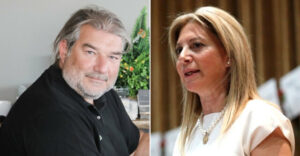
Panagiotis Roilos was born in mountainous Arcadia and studied at the School of Philosophy in Athens. At just 21 and a half years old, he went to Harvard for his PhD in Classical Studies. As is common in the U.S., by his third year he was already teaching as a teaching assistant. His main academic focus was Comparative Literature.

Comparative Literature, he explains, means comparing different literary traditions on an aesthetic level, or studying literary theory — like the concept of what makes something poetic.
He gives the example of Cavafy. Cavafy began as a romantic poet, publishing poems that he later rejected — and rightly so, Roilos says, because they were indistinct from the mass of romantic poetry at the time. In the late 1890s, Cavafy developed an allegorical writing style closer to symbolism. This shift, according to Roilos, shows Cavafy’s intelligence more than natural poetic talent. Unlike poets like Ritsos, Palamas, or Sikelianos, who had a spontaneous poetic gift, Cavafy was more of a craftsman — and very cerebral.

And yet, Roilos agrees, Cavafy was also deeply sensual.
Scene 2: Intellect and Sensuality
Danikas asks how intellect and sensuality coexist. Roilos says they complement each other. Sensuality is a way of seeing things, while intellect is the way one expresses that vision. Sensuality, he adds, relates not just to the body, but to the soul and the whole person.

Cavafy’s mature poetry no longer reflects his romantic beginnings. Instead, it uses allegory and personification without much metaphor, to the point where some in his time thought his poetry was too “prosaic.” But that was part of his genius — he was completely original and didn’t belong to any school of thought, nor did he have imitators.
Cavafy’s sexuality, Roilos says, played a significant role in shaping a broader ideological framework. Despite being personally conservative, his work stood against core principles of capitalism — such as profit, capital accumulation, and interest. This ideological stance, combined with his aesthetics, gave his poetry a unique depth. Roilos also points out that Cavafy worked for years at the Alexandria Stock Exchange, so he understood economics well.
Cavafy was influenced by aestheticism and dandyism — a style of life and presentation, like Oscar Wilde, who had a strong impact on him.
When Danikas brings up the idea that Wilde was both homosexual and courageous, Roilos agrees, noting there is no contradiction. In fact, during that time, facing such prejudice, it took great bravery. One of Cavafy’s early defenders was Nicolas Calas (also known as N. Calas), who praised Cavafy’s heroism and masculinity — especially when others mocked him for his sexuality.
Scene 3: Self-Exhaustion and Desire
Roilos makes clear he has never used the term “hedonism” to describe Cavafy. What he has said is that Cavafy viewed desire as something that causes self-consumption — even self-sacrifice.
Continuous desire leads to the self being consumed, he explains. The more one desires, the more the self moves from one point to another until it becomes exhausted. This idea appears in many of Cavafy’s texts. According to Cavafy, the highest form of pleasure leads to self-exhaustion. That was revolutionary for his time.
Roilos connects this idea to Georges Bataille, who later defined poetry as the ultimate form of self-sacrifice. In Cavafy’s poem “The Passage,” for example, a young man sacrifices himself to become a poet — he gives himself over to pleasure, in the way Cavafy defined it. This kind of desire resists capitalism’s ideals of productivity and utility.
That’s why Roilos titled his book in English “C.P. Cavafy: The Economics of Metonymy.” In Greek, it was translated as “K.P. Kavafis: The Economy of Eroticism.” The erotic, he says, operates in opposition to capitalist principles.
Scene 4: Greece at Harvard
Roilos has been at Harvard for 33 years — first as a student, and for the past 26 years, as a professor in the “George Seferis” Chair of Modern Greek Studies. This is the oldest and most important Modern Greek Studies chair in the Americas, established in 1977. But the teaching of Modern Greek at Harvard dates back to 1828, when Alexandros Negris came to Boston and published a Greek grammar. Around the same time, Sophocles Evangelinos taught Greek and Arabic.
Today, under Roilos’s leadership, Harvard has the largest number of PhD candidates in Modern Greek Studies. When he became a full professor in 2006, he asked the university to fund a yearly doctoral candidate focused on Modern Greek, and to create a lectureship for teaching the language or basic literature. Harvard agreed — even though it could have affected his own salary. For that, Roilos says, he is deeply grateful.
When asked if they teach contemporary poetry, Roilos says that depends on students’ research interests. But the field of Modern Greek Studies at Harvard spans from the late 15th century to today.
Scene 5: AI and the Poet
In the final part of the conversation, the title makes full sense: Roilos reflects on how artificial intelligence could, in theory, “create” a Cavafy — not necessarily with originality, but by imitating the structure, tone, and style of his poems.
However, Roilos warns, this kind of technological replication should not define our cultural or creative future. He emphasizes that while AI can be useful, we must not allow it to shape our world uncritically.
He also mentions ongoing experiments exploring how brain data might one day be transferred to computers — a prospect that demands serious ethical reflection.
Ask me anything
Explore related questions