

Following reports that tourism development is imminent on the island—which has been declared an area of outstanding natural beauty and included in the Natura 2000 network—the Hellenic Society for the Environment and Cultural Heritage of Milos has denounced procedures that foreshadow construction on Polyaigos, the uniquely beautiful, uninhabited island protected for its natural beauty. This has put authorities and residents of Kimolos and Milos “on a war footing.”
“We will not allow any construction activity that goes against the protective status of the island,” says Kimolos mayor Kostas Ventouris, calling on all competent authorities to safeguard the legal framework that protects Polyaigos. So, are the activist residents right to be concerned that a “cementification” of this pristine islet is being prepared?
Everything started after the transfer of 27 acres on the famous Mersini beach of Polyaigos to a company controlled by George Logothetis’s Libra Group. According to protothema.gr, the company, named Consolina SA, requested a building permit to repair an existing structure on the beach. (“This is how it always begins—one building leads to giant hotels,” point out members of ELLET.) Subsequently, the shoreline was officially demarcated and an archaeologist was sent to the island for inspection, but the Cyclades Ephorate of Antiquities did not approve the request. “The construction of buildings is not allowed on Polyaigos, and no permit for repairs of existing ones has been granted by us, therefore there is no issue,” clarifies the Ephorate’s director, Dimitris Athanasoulis.
The Island
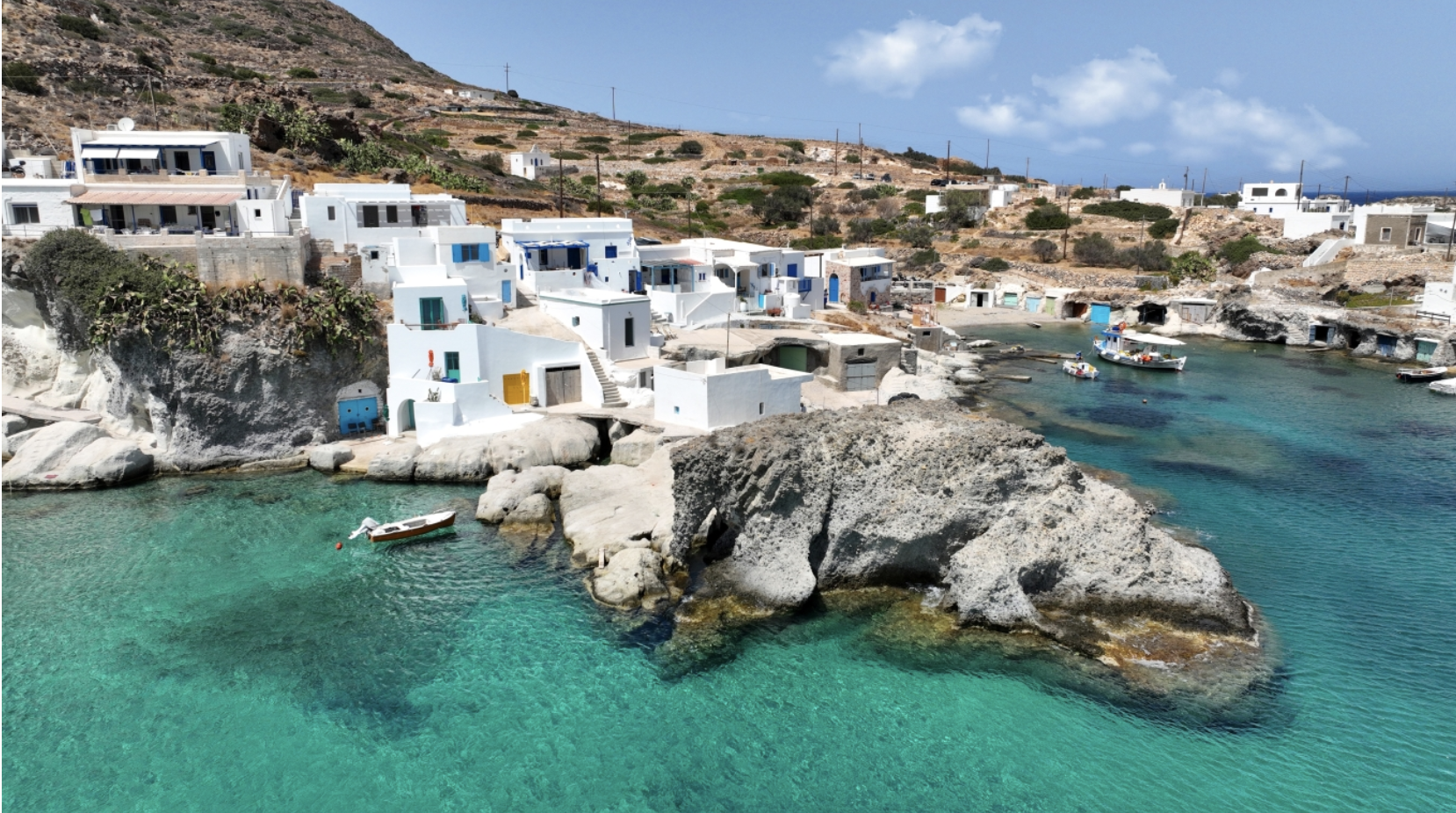
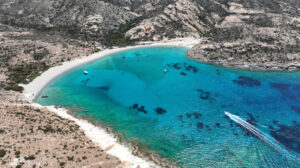
Let’s start with some background: Polyaigos—its name means “many goats”—is the largest uninhabited island in the Aegean. It is famous for its unrivaled beauty: turquoise crystal-clear waters, dazzling white rocks sculpted by nature, and silver beaches where the yachts of the world’s wealthiest and most famous anchor each summer. Its “residents” include the Mediterranean monk seal (Monachus monachus), which uses the island to give birth away from threats and disturbance, wild goats, Eleonora’s falcon, and other species.
Covering about 18.1 sq. km, Polyaigos is a unique natural and cultural treasure of the Aegean. It has been designated a Landscape of Outstanding Natural Beauty (Ministerial Decision DPA/9389/2000 – Government Gazette 1176/B/22.09.2000), is part of the Natura 2000 network, a Special Protection Zone for rare fauna, and a habitat for the monk seal. Because of archaeological finds (such as a Classical-era shipwreck on its shores), the Cyclades Ephorate of Antiquities has requested that the entire island be declared an archaeological site, although the request has not yet been reviewed by the Central Archaeological Council. Still, it is adequately protected since any building work requires approval from the archaeological services.
The island had around 170 inhabitants until the mid-1970s, when it was abandoned. Until last June, the only residents were Petros Marianos and his wife Eleftheria. After Petros’s death, Mrs. Eleftheria moved to Kimolos, and the municipality even organized an operation to transfer their goats and cats from Polyaigos to Kimolos.
Ownership of its 18.1 sq. km has long been contentious. During the Peloponnesian War (431–404 BC), disputes arose between Kimolos and Milos over Polyaigos’s ownership, which was resolved nearly a century later (338 BC) in favor of Kimolos by a court in Argos. Administratively, Polyaigos still belongs to Kimolos.
Today, 17.374 sq. km belong to the private legal entity “Ioannis–Stavros Logothetis Bequest,” a monastic-ecclesiastical foundation managed since 1933 as grazing land. Another 329 acres belong to private individuals who maintain the few remaining houses. Among them is the 27-acre plot near the famous Mersini beach, recently transferred from Nikolaos and Maria Melas to Consolina SA—a company linked to the Libra Group.
“No cement on the island”
Consolina SA, which acquired the 27-acre plot, is described as a tourism and hotel company engaged also in real estate. Its sole shareholder is Aria Hotels, a subsidiary of the Libra Group, with Gerasimos Pantazatos as chairman.
In April, as published in the Government Gazette, the Decentralized Administration of the Aegean approved the shoreline boundaries at Mersini beach. That same month, the Cyclades Ephorate of Antiquities authorized an archaeologist’s inspection of the site “in the context of a building request.”
These developments alarmed ELLET’s local Milos committee, which denounced the planned activity as “unacceptable and dangerous.” ELLET stressed that Polyaigos cannot be treated as “a plot of land for exploitation” since “any tourist construction would irreparably destroy the environment and cancel decades of conservation efforts.” It called on the Milos Town Planning Department to deny all permits, noting the absence of recognized access roads, and urged the Ministries of Environment and Culture to take responsibility and block all construction. “Polyaigos must not be lost. No more cement in the Cyclades, no more destruction of our natural and cultural heritage,” ELLET declared.
It is recalled that in 2016 George Logothetis had founded Tampa SA with the aim of tourism development and hotel construction on Polyaigos. However, the plan met opposition and was shelved, leading to Tampa’s suspension.
From the owner’s side, what is said to be pursued now is only a permit to restore one of the few existing houses on the island for use as a private residence—not for tourism.
The Cyclades Ephorate of Antiquities insists: “Only repairs of existing structures are allowed. In this case, the archaeologist requested additional data which were not provided, and the process stopped there. No permit has been issued, so the matter is closed.”
Towards archaeological designation
Polyaigos, with its 18.1 sq. km, is a Landscape of Outstanding Natural Beauty, part of Natura 2000, a Special Protection Zone, and a habitat for the monk seal. Based on the protection framework, only traditional rural activities, restoration of existing buildings without change of use, and new infrastructure strictly for defense, archaeology, scientific research, or environmental management—with official approval—are permitted.
According to protothema.gr, the island is on the verge of being officially declared an archaeological site in its entirety, pending only the Central Archaeological Council’s formal decision.
The Foundation
According to land registry records, most of Polyaigos (17.37 sq. km) belongs to the “Ioannis St. Logothetis Bequest, Church of Odigitria Kimolos,” a charitable foundation managing property donated in 1933. This includes cultivable and uncultivable land, pastures, and mines totaling 25,000 acres, along with chapels and farmhouses on Polyaigos and a church on Kimolos. The foundation’s purposes include leasing land to Kimolians for grazing and maintaining the region’s churches.
Ask me anything
Explore related questions