





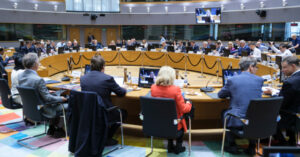
Athens is now fighting the “Brussels battle” to secure a 10-year exemption from taxes on shipping and aviation fuels, as well as a permanent exemption for fuel used in agricultural production, against the Commission’s proposal to overhaul energy taxes.
In his intervention yesterday at the Ecofin Council, Kyriakos Pierrakakis, the Minister of National Economy, has drawn a “red line”, arguing that a ten-year exemption of our country from taxes in these sectors is required: “Any shorter period we would not be willing to discuss. And I would add that, taking into account the above, if we do not apply this 10-year exemption, there will be a negative impact on the territorial cohesion of the European Union as a whole,”
He stressed.
He stressed.
What it means for Greece – The Athens Strategy
Behind the words, the strong reaction and resistance, to the point of threatening a veto on the prospect of increasing fuel taxes in the three critical sectors raised by the minister, is based on four key reasons that make the Greek position non-negotiable: Insularity, competitiveness, food security, and territorial cohesion of the European Union.
In his intervention at Ecofin, Kyriakos Pierrakakis presented a clear argument, starting from the recognition of the objectives of the green transition, but ultimately rejecting the “one-size-fits-all” approach. Firstly, he said, “We fully share the objectives of the energy transition. We, as Greece, are at the forefront of the green transition, with the largest development of renewable energy sources in Europe”, before continuing that “we have to look at sustainability, competitiveness, social cohesion, territorial cohesion”.
Insularity: The weak point threatened by taxation
The Greek minister’s dominant argument is the fragmented geographic topography and the islandness of the country:
“Particularly for shipping and aviation, this is an important issue for us, given our geography, our position on the European map and the length of our coastlines,” Pierrakakis said, stressing that the tax on fuel in coastal shipping is not just about more expensive tickets for tourists, but a dramatic increase in transport costs for island residents and for all goods and essentials.
If the EU proposal is implemented “across the board” without exceptions, obviously the cost of passenger tickets and business transport is expected to rise significantly, with a proportionately greater impact on consumers and businesses already experiencing the challenge of insularity.
Competitiveness: A risk in transport
Athens’ second main argument concerns the loss of competitiveness vis-à-vis third countries. “If taxes were imposed on the shipping and aviation sectors, this would create a comparative disadvantage against other Mediterranean countries that do not have similar taxation,” the finance minister pointed out.
As the maritime industry has also expressed concerns, the imposition of a tax on marine fuel is estimated to hurt the competitiveness of the Greek-owned fleet, especially against third countries that do not have similar charges. The kerosene tax will automatically translate into more expensive airline tickets, making Greece’s tourist package less attractive in a highly competitive international market.
Tourist security: the impact on the agricultural sector
.
Pierrakakis extends the argument to the agricultural sector, linking the issue of transport to the broader question of food security.
“For the agricultural sector in particular, I would say that we have another existential goal: food security,” the Minister of Finance pointed out, proposing “a permanent exemption from taxation on energy products and electricity used in the agricultural sector.”
And in this case, the combination of increasing taxes on the production and transport of agricultural products would mean that every product arriving on the islands by ship – from food and medicine to building materials – would incorporate the increased transport costs, leading to a new wave of inflation – and local inflation at that, increasing inequality within the EU and the country itself.
Pierrakakis’ most politicized argument to his foreign counterparts, however, is perhaps about the territorial cohesion of the European Union. “If we do not apply this 10-year exemption, there will be a negative impact on the territorial cohesion of the European Union as a whole,” the minister said, placing the Greek request in a broader logic of a balanced energy transition that respects geographical specificities.
Athens is demanding the recognition that the “green transition” cannot be achieved by ignoring the geographical and economic specificities of the European South and the Greek islands.
The cost to households and the economy
The EU proposal being discussed in Brussels calls for the abolition of historic fuel tax exemptions for sea shipping and aviation. For a country like Greece, with an extensive island network and critical dependence on sea and air links, the consequences are expected to be immediate and cascading.
The cost of transporting containers to and from Piraeus, as well as internal transport, will increase, reducing the competitiveness of Greek businesses. The double blow to tourism and shipping amounts to a direct threat to the country’s GDP.
Yesterday’s battle at Ecofin, however, was just the beginning. Athens is entering the negotiations with the aim of “softening” the harshest aspects of the proposal, demanding multi-year exemption periods and recognition of specific geographical conditions.
Among other things, another of Kyriakos Pierrakakis’ arguments concerns the technological readiness of these industries and that “alternative fuels” do not yet exist for shipping and aviation.
“Given that alternative fuels have not yet been developed at scale in these sectors, we fully support the extension of the 10-year exemption from taxation in these sectors,” the minister said, stressing that without available technological alternatives, taxation will be a blow and not an incentive for transition.
According to European texts, the revision of the Energy Taxation Directive allows for targeted tax reductions for heating/electricity based on social criteria, and exceptionally full exemption for vulnerable households for up to ten years. The Greek side claims the same logic for transport, where dependence on ships and planes is not a choice, but a geographical and social necessity.
Ask me anything
Explore related questions