





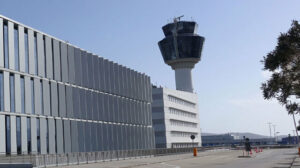
A complex web of technical failures, obsolete telecommunications infrastructure and insufficient operational coordination lies, according to the official findings, behind the unprecedented suspension of operations in the Athens FIR on Sunday, January 4, 2026. The incident, which led to a complete restriction of air traffic (zero rate) for hours, was not attributed to a cyberattack or external interference, but to an internal technical malfunction of critical communication systems of the Hellenic Civil Aviation Authority (HCAA).
The report refers to “digital noise,” which was caused by the desynchronization of multiple transmitters simultaneously, ultimately resulting in the degradation or even interruption of critical telecommunications links. The committee formed specifically to investigate the January 4 incident notes that the existing Voice Communications system of the HCAA and the critical telecommunications infrastructure used to support it rely on outdated technology that is no longer supported by the manufacturer, without the ability to provide meaningful operational guarantees, and it proceeds to make specific recommendations.
The moment of the crisis
At 08:58 in the morning, air traffic controllers at the Athens and Macedonia Area Control Centers detected a massive blockage of radio frequencies. Intense, continuous noise overwhelmed the main, backup and emergency frequencies alike, making air-to-ground communication extremely difficult or even impossible. At the same time, critical ground-to-ground telecommunications links collapsed, with disruptions to telephone services and data exchange with neighboring FIRs and foreign airports.
Within minutes, the disruption spread nationwide, with no clear indication of the cause. With approximately 80 aircraft already inside the FIR and dozens more expected, the HCAA activated emergency procedures and, for flight safety reasons, initially suspended departures and subsequently imposed zero capacity on the airspace.
What caused the blackout
The Investigation Committee concludes that the incident was caused by “digital noise” — a desynchronization phenomenon affecting a multitude of heterogeneous telecommunications devices and interfaces terminating at the installations of the ACCs (Area Control Centers) in Elliniko.
This desynchronization resulted in the unintentional and continuous activation of a large number of HCAA transmitters, which effectively “jammed” the electromagnetic spectrum and occupied critical aeronautical frequencies.
The problem was exacerbated by the nature of the existing technological infrastructure: the voice communication systems (VCS) and telecommunications circuits are based on outdated SDH technology and analog circuits that have been out of manufacturer support for years. According to the report, OTE had already warned the HCAA as early as 2019 that these systems were no longer supported by the manufacturer and could not provide reliability guarantees.
Delayed diagnosis and institutional frictions
Special mention is made of the delay in identifying the true cause. The Committee highlights the absence of end-to-end telemetry and error logging mechanisms (log files), which makes both real-time diagnosis and post-incident technical analysis almost impossible. At the same time, OTE’s operations center viewed the circuits as operational, while in reality they were experiencing serious malfunctions.
Moreover, the report clearly points to shortcomings in HCAA–OTE cooperation, describing it as “far from optimal.” The lack of a joint rapid-response mechanism and standardized crisis procedures contributed to the prolonged duration of the problem, which was ultimately resolved abruptly after restarts and rerouting of traffic within OTE’s core network at 16:53 local time.
Neither cyberattack nor flight safety risk
In an environment of heightened concern over hybrid threats, the Committee is categorical: no traces of a cyberattack, unauthorized access or external radio-frequency interference were detected. Ground and airborne checks by the Hellenic Telecommunications and Post Commission (EETT) ruled out deliberate emissions from a third source.
As for flight safety, the incident was classified by the Civil Aviation Authority as belonging to the “green zone” of low risk. No violations of minimum separation were recorded, and the zero-rate procedures operated preventively, ensuring that no aircraft was exposed to immediate danger.
The recommendations: a clear message for the future
In its report, the Special Committee concludes with the following recommendations:
a) acceleration of the transition to VoIP (Voice over IP) technology, with completion of procurement, installation and operational deployment of the new VCS/RCS (Voice Communication System / Radio Communication System) and the 495 new transceivers,
b) establishment of a permanent joint rapid-response mechanism between the HCAA and OTE, along with standardized crisis procedures including testing and training under the supervision of the Civil Aviation Authority,
c) enhancement with telemetry, remote control and the capability to conduct end-to-end diagnostic checks at critical points,
d) strengthening radio-spectrum monitoring by the EETT for early detection of interference or anomalies, and
e) relocation of the ACC installations to a more suitable environment, aiming to reduce systemic operational risks and dependencies, in order to ensure uninterrupted and safe provision of air navigation services.
Ask me anything
Explore related questions