




Beaked whales are among the least known and hardest-to-study mammals on Earth. They are rarely seen, dive deeper and for longer than any other mammal, and in some cases have been recorded reaching nearly 3 kilometers below the sea surface. Today, however, scientists are beginning to unlock their secrets not by seeing them, but by listening to them.
In early June 2024, scientist Elizabeth Henderson was aboard a research vessel off Baja California. Despite calm seas and hours of observation with powerful binoculars, she and her team saw nothing. Beaked whales are difficult to spot even when they surface: their bodies are small, gray, and can easily be mistaken for a wave.
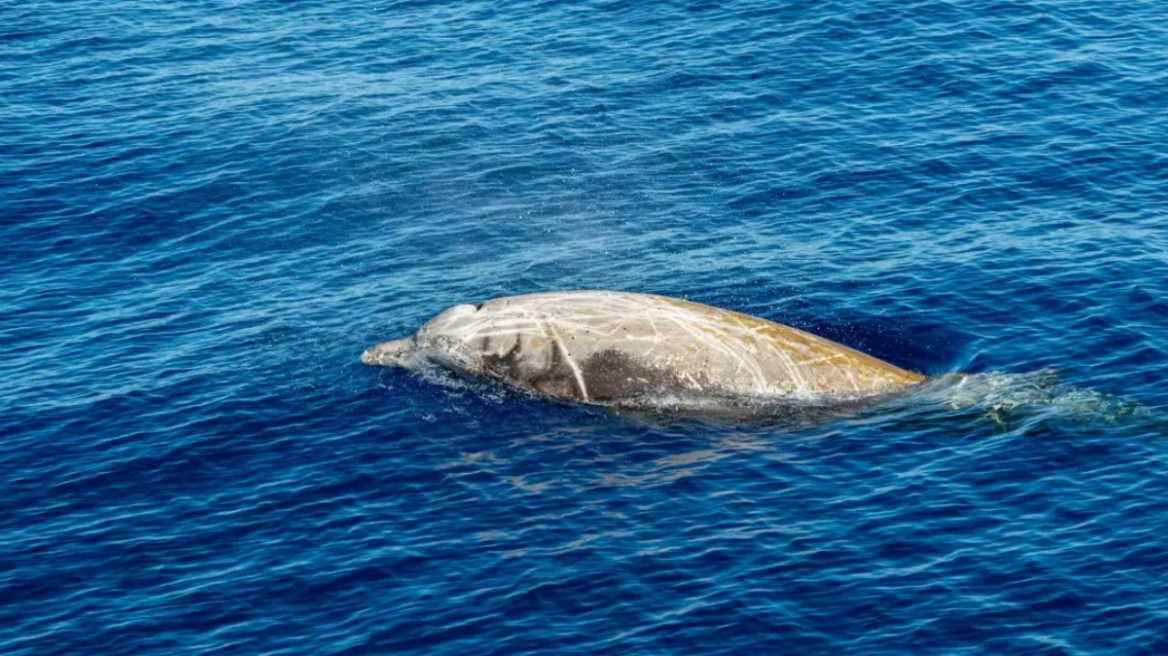
A few days into the mission, things changed. The ship’s captain shouted that there were whales alongside the vessel. In fact, two young whales were swimming next to the ship. “There has always been a belief that beaked whales avoid boats,” explains Henderson, a bioacoustics scientist with the U.S. Navy Marine Mammal Program. “But they didn’t seem scared at all. They were just curious.”
Whales, we know very little about
Scientists currently recognize 24 species of beaked whales, making up about 25% of all whale and dolphin species. Some have never been observed alive in the wild and are known only from stranded animals. New methods—especially underwater sound recordings—are now gradually shedding light on their lives.
This encounter brought a surprise. Based on the sounds recorded, researchers initially believed the whales belonged to the endangered Perrin’s beaked whale species. A specific sound pulse (BW43), peaking at 43 kHz, had been linked to that species. However, laboratory analysis of a biopsy revealed a different species: the ginkgo-toothed beaked whale, named after the shape of its teeth.
“It was incredible,” says Henderson. “A species that had never been seen alive in its natural environment was swimming right next to us.”
Sound instead of sight
The deep and long dives of beaked whales make them extremely difficult to study. “Traditionally, these whales were overlooked,” says Oliver Boisseau, senior researcher at Marine Conservation Research. “They live far from shore, are hard to access, and are very difficult to observe.”
Even today, new species continue to be discovered. Ramari’s beaked whale was identified only in 2021. “It’s remarkable that we are still discovering mammals the size of a car,” Boisseau notes.
Threats and protection
Growing scientific interest is also linked to conservation concerns. Mass strandings have been associated with military sonar, which may cause whales to surface too rapidly, leading to effects similar to decompression sickness. Although the exact mechanism is not fully understood, sonar use has been restricted or banned in some areas, such as the Canary Islands.
Ironically, sound is both the problem and the solution. Beaked whales rely on echolocation to feed, navigate, and communicate. Using underwater microphones placed at depths ranging from 10 to nearly 5,000 meters, scientists record the clicks and pulses produced by each species. Every species has its own unique acoustic “signature.”
Genetics and ethics
Genetic analysis remains essential for confirming species identification. Small skin samples are collected, and environmental DNA from seawater is also analyzed. While effective, the process requires strict ethical standards due to the small risk of injuring the animal.
By contrast, passive acoustic monitoring does not affect the whales. “Once we link each sound pattern to a species, we can simply listen,” Henderson explains. “In many cases, we don’t even need to see them.”
Why their protection matters
Mapping the distribution and population size of beaked whales remains crucial. Without reliable data, it is difficult to know which species are most at risk. Additional threats include entanglement in fishing nets and plastic pollution, which can sound like prey to these animals.
Protecting beaked whales benefits more than just the whales themselves. Through the so-called “whale pump,” they move nutrients from deep waters to the surface, supporting phytoplankton that absorbs carbon dioxide. A single whale is estimated to capture an average of 33 tons of CO₂ over its lifetime.
“They are extraordinary creatures,” says Boisseau. “And the more we understand them, the clearer it becomes how important it is to protect them—not only for their sake, but for the planet as well.”
Ask me anything
Explore related questions