





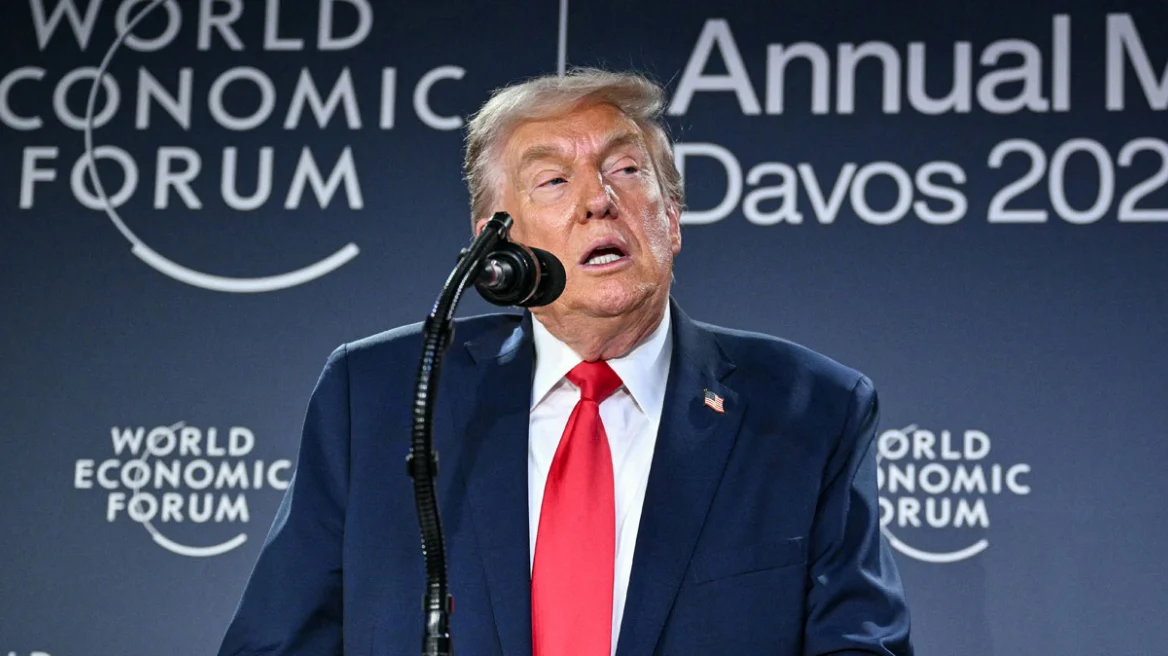
The lengthy and confrontational speech delivered by U.S. President Donald Trump to business giants and government officials in the Swiss Alps on Wednesday could hardly have eased concerns that the Western Alliance – and not only the North Atlantic one – is on the brink of disintegration.
Trump complained dozens of times that the United States is being “exploited” by Europe and questioned, with visible distrust, why his effort to gain control of Greenland is meeting resistance.
He criticized European leaders for having made their continent unrecognizable due to – as he said – uncontrolled migration and radical economic policies. And he publicly questioned NATO’s willingness to defend the United States, without mentioning that the only time the Alliance’s collective defense article was ever invoked was at Washington’s request, following the attacks of September 11, 2001…
Nevertheless, for European officials searching for some roadmap toward de-escalation, there was a glimmer of dialogue when Trump stated that he would not use force to acquire Greenland. And at a moment of crisis for transatlantic relations, that alone mattered.
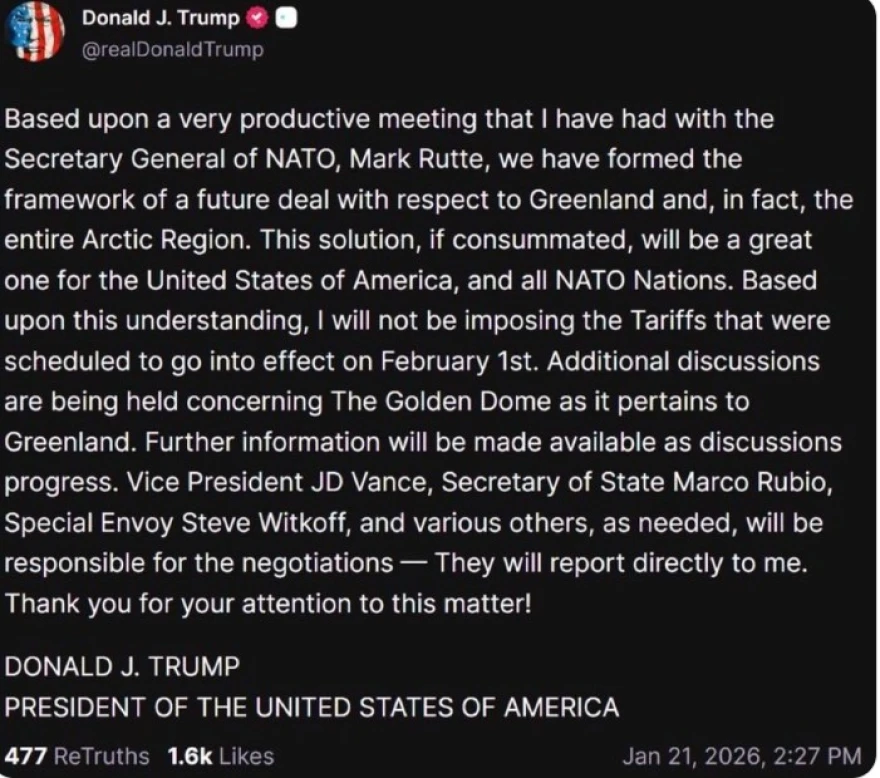
A few hours after the speech, there was potentially better news for Europe. Trump announced that he had reached a “framework for a future agreement” on Greenland after a meeting with the NATO Secretary General, and that the tariffs he had threatened to impose next month were being withdrawn. “This solution, if completed, will be excellent for the United States and for all NATO countries,” he wrote on Truth Social, without providing details.
Asked by CNN as he was leaving the summit whether the agreement satisfies his desire to “own” Greenland, Trump paused briefly and replied: “It is a long-term agreement.”
Even so, his speech in Davos – filled with complaints and insults toward his European counterparts – left a strong imprint.
He will not take Greenland by force
For European leaders listening anxiously, four words carried particular weight: “I will not use force.”
It was the clearest statement to date that Trump does not intend to seize Greenland through military means. Until Wednesday, the president had refused to rule out this possibility, while the White House had left military options on the table. With the American president nothing is a given, but if one assumes that his word carries weight for him, then this is at least some kind of development.
The removal of this scenario brought relief to officials who were preparing for harsh diplomatic confrontations. Markets also reacted positively, rebounding after Tuesday’s heavy losses.
However, the problems do not disappear. Trump insisted that he would accept nothing less than full ownership of Greenland – a semi-autonomous territory of Denmark. “This vast, unprotected island is actually part of North America,” he said. “It is our land.” And he warned: “You can say no, and we will remember it.”
The historical argument
Repeating his demand – and mistakenly referring to Greenland as “Iceland” four times – Trump argued that “no country or group of countries is capable of securing Greenland other than the United States.”
He accused Denmark of being “ungrateful,” claiming it owes its defense in World War II to the U.S., since it “collapsed within six hours” before Germany.
“How foolish were we to give it back?” he asked.
A barrage of complaints
Trump did not limit himself to Greenland. He even belittled host Switzerland, saying it is “only good because of the United States.” He mocked Emmanuel Macron for his “beautiful sunglasses” and threatened Canadian Prime Minister Mark Carney.
At the same time, he revisited domestic obsessions, attacking Fed Chair Jerome Powell and Democratic Congresswoman Ilhan Omar, using rhetoric with clear xenophobic undertones.
A subdued president – a frozen audience
Although the audience initially showed tolerance, as the speech dragged on the discomfort grew. Applause at the end was lukewarm. Some left early. References to Greenland caused visible concern, while digressions about wind turbines even provoked nervous laughter.
A Europe he does not recognize
The core of the speech was one thing: Trump believes Europe has “gone off the rails.” Although he declared himself “100% Scottish and German,” he spoke with contempt about the management of migration, security, and the economy. “Some parts of Europe are no longer recognizable,” he said. And he concluded with a blunt reminder of dependence: “Without us, most countries don’t even function.”
The most problematic issue
The most problematic issue arising from Trump’s speech at the Davos Economic Forum, however, concerns – paradoxically – not the American president but Europe itself, from whose territory once again the United States reserved only pain and minimal sympathy. Europe, within a year and with Trump’s first term as a given and the clear indications since early 2024 pointing to a “Donny comeback,” has done absolutely nothing to shield itself from what was obvious to everyone – even the most uninformed.
Europe, one year after Trump’s full return to the Oval Office, is “searching”: it has only increased emergency meetings and alerts, while even greater questions are raised by the fact that, at European altitude, it was a Californian who stood on Swiss soil…
Trump’s threats are not “empty,” and anyone who claims otherwise demonstrably lacks an understanding of reality. The American president is clear, and most importantly he is consistent; he fully means what he announces. Europe is ailing, Europe is unable to mobilize, and the tragedy is that it is now in the crosshairs not only of its declared enemies but also of its own closest – most longstanding and strongest – allies.
There are no magic formulas, nor political personnel as an answer or counterweight, but no one can claim that the “Old Continent” lacks weapons… The question today is how quickly, effectively, and without distraction it will choose to place them on the table that Trump from the West and China and Russia from the East have had openly laid out for 365 days now.
Ask me anything
Explore related questions


