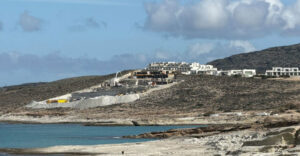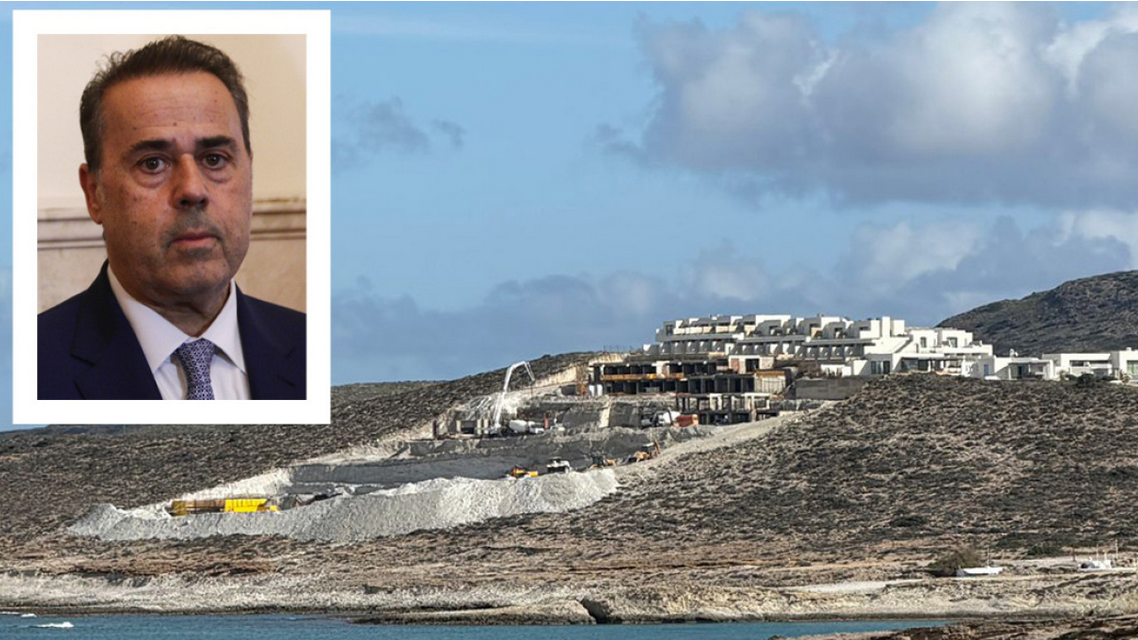
With three measures, the Minister of Environment and Energy, Mr. St. Papastavrou, is halting an investment irregularity that threatens the Cycladic landscape of Milos, suspending construction work on the expansion of Prodea’s five-star White Coast hotel.
Specifically, according to sources:
- He sends a document to the Milos Urban Planning Office requesting the immediate suspension of the works.
- An on-site investigation is ordered by the Transparency Authority.
- A letter is sent to the Municipality of Milos, emphasizing that although a suspension appeal was filed, it was not officially communicated to the island’s Urban Planning Directorate, so the appeal did not proceed and is effectively treated as if it never happened.
For this reason, it will be requested that the appeal be resubmitted in full compliance with all necessary legal and procedural requirements so that it becomes effective.
The unauthorized expansion and the environmental impact of the intervention have sparked strong reactions in the local community. This is one of two large hotel projects currently under construction on the island, triggering a cascade of protests.
While concrete continues to flow unabated and photos show the spectacular progress of the works within just nine months, serious questions are raised about the stance of the Milos municipal authorities toward this tourism giant.
The Municipality filed a challenge against the project’s licensing back in October, requesting its annulment and assigning the case to a law firm. However, the process appears to have proceeded only partially, as the suspension request was ultimately submitted on New Year’s Eve. However, it was not communicated as required to the island’s Urban Planning Directorate, so the suspension procedure did not advance. It is unknown whether this omission was deliberate, but what matters is that the legal suspension of the works did not proceed.
The White Coast building permit was revised twice, in 2021 and 2024, in order for the hotel to expand into two adjacent plots and increase its capacity by 167 beds, i.e., 75 additional rooms. As a result, the project needed to be re-licensed, now as a large hotel. According to the Environmental Terms Approval decision, issued in August 2024, the expansion covers a total area of 29.4 acres, raising the five-star unit’s capacity to 271 beds.
Prodea’s 2024 annual financial statement notes that the second construction phase has been completed, with the delivery of 20 additional rooms, while the third phase of the project is planned for the next year, with another 72 rooms to be delivered. If the plan is fully realized, the hotel will ultimately reach 122 rooms.
It is recalled that since February 2025, the Ministry of Environment and Energy has suspended the issuance of new building permits in Milos, attempting to curb the uncontrolled investment frenzy, which includes plans for more than 50 luxury hotels on the island. Nevertheless, works at White Coast have continued as if the Ministry’s suspension decision did not exist.
The tangle of urban planning violations began last year with the Sarakiniko tourist unit case, which left behind an open wound in the landscape—a three-meter-deep hole. Today, local residents and organizations express serious concern about Milos’ carrying capacity, both in terms of the natural environment and infrastructure. Water supply, sewage, road networks, and waste management are already under strain, while plans for new large tourist units appear to disregard the island’s limits.
The Ministry of Environment and Energy’s decision to “freeze” the White Coast expansion is considered by many as a first but crucial signal that uncontrolled tourism development in the Cyclades cannot continue under the same conditions. According to official sources, the Ministry is reassessing the overall licensing framework for large tourism investments in Milos as part of a broader plan to protect the Cycladic landscape.
At the same time, questions remain about the role of local authorities. The delayed and incomplete legal response of the Municipality to the hotel’s expansion raises doubts, while the construction works proceeded at a rapid pace.
Against the backdrop of the Sarakiniko case, which acted as a catalyst for discussion about uncontrolled construction and environmental violations, Milos now stands at a critical crossroads. The issue is not only the fate of a five-star hotel but the development model that will shape the island’s future: a model of mass and uncontrolled tourism, or a more moderate, balanced approach that preserves the island’s unique character and landscape.
Ask me anything
Explore related questions