





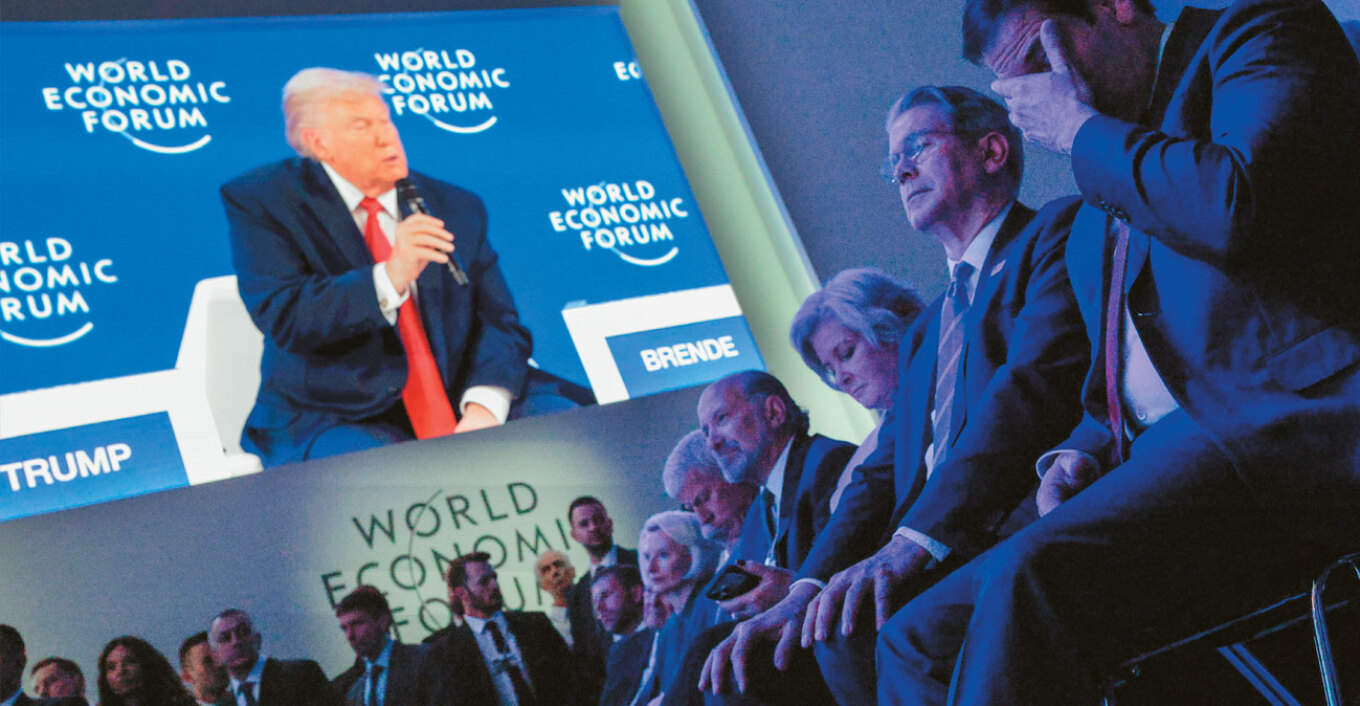
Donald Trump’s appearance at the World Economic Forum in Davos did not have the character of reintegrating Washington into the multilateral system, and probably no one expected such a thing from the other side of the “great magnificent ocean,” as the American president likes to point out at every opportunity. Nevertheless, his presence again had the character of a show of power and, above all, a warning to allies. The Greenland affair was not presented as a geopolitical discussion but as an ultimatum with the wrapper of “I will not exercise military force”…
Once again, the American president did not “deviate” from what he has stated. He stayed on his own line and publicly expressed his positions and doctrine without hesitation. Trump did not go to Davos to listen. He went to impose an agenda. And he did so using a tool that Europeans know well from his first term: the threat of destabilization as leverage for compliance. His statements about Greenland were not vague. They were deliberately formulated to act as strategic blackmail. He did not refuse the use of pressure, only the use of military power. However, we must clarify that when an American president speaks of “full access” to the territory of an ally without explicitly recognizing sovereignty, he is not negotiating.
The Raw Message
For Europe, the shock was not legal. It was political. For the first time since the Cold War, an American president appeared at a global forum and directly questioned the concept of allied security as a common good. The message was blunt: the United States does not protect—or if it does, it is not free, nor for everyone.
Greenland was not chosen randomly. It is territory connected to an EU member state, it is a critical hub for American strategy in the Arctic Circle, and it is a region that Europe cannot defend militarily without the United States. With a single move, Trump reminded Europeans of what they try or want to hide: the security of the continent remains primarily an American matter.
International media analyses converge on one conclusion: Greenland is not about the region itself but about the “discipline” of allies. Trump used the issue to show that he is willing to open fronts even within NATO if it serves what he considers “American” interests.
Agreement or Submission
In Davos, European leaders tried publicly to downplay the conflict. Privately, however, the concern was clear and widespread. Because Trump’s move does not fit into a framework of negotiation but is coercive diplomacy. The goal is not agreement. It is submission under the “America First” framework.
The critical element is that this pressure does not concern only Greenland but the entirety of European choices: defense, trade, energy, and especially Ukraine. The logic is clear: if Europe wants American support, it must accept American terms.
This is why international analysts spoke of the dangerous normalization of threats among allies. Trump does not differentiate between opponents and partners. He only distinguishes between those who comply and those who resist. And Europe at this stage—or more accurately, at this specific moment—appears weak—or, to some, provocatively indecisive—in responding.
The concept of “strategic autonomy” collapsed within a few hours in Davos. Not because it lacks a theoretical basis, but because it is not accompanied by power. And without power, any strategy is merely a wish when Trump sits at the table as a negotiator.
Greenland was the first test, not the last. Trump showed that he is ready to exploit every European weakness to extract benefits exclusively for the United States. No allied romanticism. No pretense. Only terms of power.
Blackmail with Ukraine
If Greenland was the instrument of blackmail, Ukraine is the field where the blackmail acquires existential significance for Europe. In Davos, the Ukrainian conflict was not discussed as a matter of law or international order but as a problem to manage. And this shift is revealing. Trump appeared determined to impose a new framework. He spoke of a “close agreement,” a “window of peace,” “realism.” But he did not present a map, a guarantees mechanism, or a clear timeline. This ambiguity is not accidental. It is a method of pressure.
According to international media analyses, Trump uses the promise of peace as leverage in three directions simultaneously: towards Russia, to test the limits of concessions; towards Kyiv, to bring it face-to-face with the dilemma of accepting faits accomplis; and above all towards Europe, to burden it with implementing a solution it did not design or in which it will play the role of guarantor, bearing the enormous economic and political cost.
Volodymyr Zelensky’s presence in Davos had exactly this background. His interventions were not appeals for help but warnings. Europe, he said clearly, risks finding itself in the role of guarantor of a peace that would cement the loss of Ukrainian territory and transfer the cost of deterrence entirely onto European shoulders.
The Trump-Zelensky meeting, despite positive statements, again does not provide tangible results. By themselves, the quotas in agreements and positive statements do not answer the fundamental question of what happens with the occupied territories. Trump once again avoided committing. Because ambiguity works as pressure from his side. As long as there is no clear framework, Kyiv is on the defensive, and Europe is under extreme pressure.
Europe Alone
The scenario emerging from Davos is far more concerning than some believed: an agreement that freezes the front line without substantial security guarantees, while simultaneously requiring massive European involvement. Military presence, funding, political management—all without the United States themselves. The latter will have set the terms but will withdraw from the daily responsibility of implementation—and along with that, the “containment” of Moscow. This is exactly what Kyiv fears, not only the loss of territory but the transformation of Ukraine into a European security protectorate, without an American umbrella and with a permanent threat of re-escalation. In this framework, “peace” is not stability. It is postponement of conflict.
Europe, on its part, appears deeply divided. Rhetorically it supports Ukraine. In practice, however, it is preparing for a scenario in which it will have to manage the consequences alone. Governments fear two things simultaneously: the withdrawal of the United States and direct confrontation with Russia. This dual fear leads to paralysis.
At the same time, intensified contacts with Moscow through third countries reinforce the sense that a parallel diplomatic channel is forming, in which Europe is not a central player. This directly undermines European credibility as a geopolitical actor. The common thread with Greenland is clear. In both cases, Trump uses U.S. power to restore hierarchies. He does not seek consent, only compliance. Those who do not adjust are pressured. Those who resist are bypassed.
For Europe, the stakes are historic. If it accepts a role as financier and guarantor without strategic control, it will cement its dependence. If it tries to react without power, it will be exposed. The choice is not easy, but postponement is equivalent to a decision. Davos recorded this transition bluntly. The era of European waiting ends not because Europe chose it, but because the United States imposed it. And Ukraine is at the center of this realignment, not as a recipient of solidarity but as a field on which the new, harder order of things is tested.
Front with Iran
Behind the noise of Greenland and the tension with Europe, international analyses identify another level of American strategy, this time more silent. This does not concern the Arctic but Iran and the next stage of American engagement in the Middle East. Greenland in this context does not function only as leverage over allies, but primarily as a diversion. The Trump administration never hid that it considers Iran the main destabilizing factor in the region. What is changing now is not the target but the method.
Washington seeks to reapply pressure on Tehran, not necessarily through direct military confrontation, but with a multi-level escalation strategy in which the attention of allies and markets is distracted. Elevating Greenland to a global issue serves exactly this. While Europe consumes itself with internal consultations, legal analyses, and political reactions to American pressure, Washington gains time and freedom of action elsewhere. And elsewhere is primarily the Middle East.
According to international analyses, the next stage of American policy towards Iran rests on three pillars: first, intensification of pressure through allies and regional players; second, weakening Iranian influence networks in Lebanon, Syria, and Iraq; third, restoring deterrence logic through the threat of force, without directly taking responsibility.
In this context, Europe is again treated not as a strategic partner, but as a passive observer. The conflict around Greenland has already absorbed political capital, diplomatic time, and attention. And this reduces both the capacity and reflexes of Europeans to respond in a coordinated way to a new phase of tension with Iran.
The critical element is that Washington does not need European consent to apply pressure. What it wants is only to ensure that Europe will not act as a brake. And this is exactly achieved through the parallel crisis on the northern front. Greenland is not an isolated episode but part of priority management.
The War in Ukraine
At the same time, the American rhetoric of peace in Ukraine works complementarily. If Washington can appear as a force that closes fronts in Europe, it gains greater legitimacy to open or escalate fronts in the Middle East—not because Trump will ever ask for consent, but mainly because what he does not want is noise and criticism from politicians and the media. The image of a peacemaking power is used to cover the reality of power redistribution.
For Iran, this scenario is extremely dangerous. Tehran sees a Washington less committed to multilateral balances, more willing to act unilaterally, and more tolerant of low-intensity regional conflicts. The arrival of a U.S. aircraft carrier in the region, along with the peak of massive protests in Iran, has provided all the necessary elements for the U.S. to act at Trump’s discretion.
Greenland, therefore, looks like—but is not—the center of global strategy. It is the stage. A stage that allows Washington to redeploy forces, gauge reactions, and prepare the ground for the next phase on all or any fronts that the American president considers important. Not with noise, but with calculated intensity.
Ask me anything
Explore related questions


