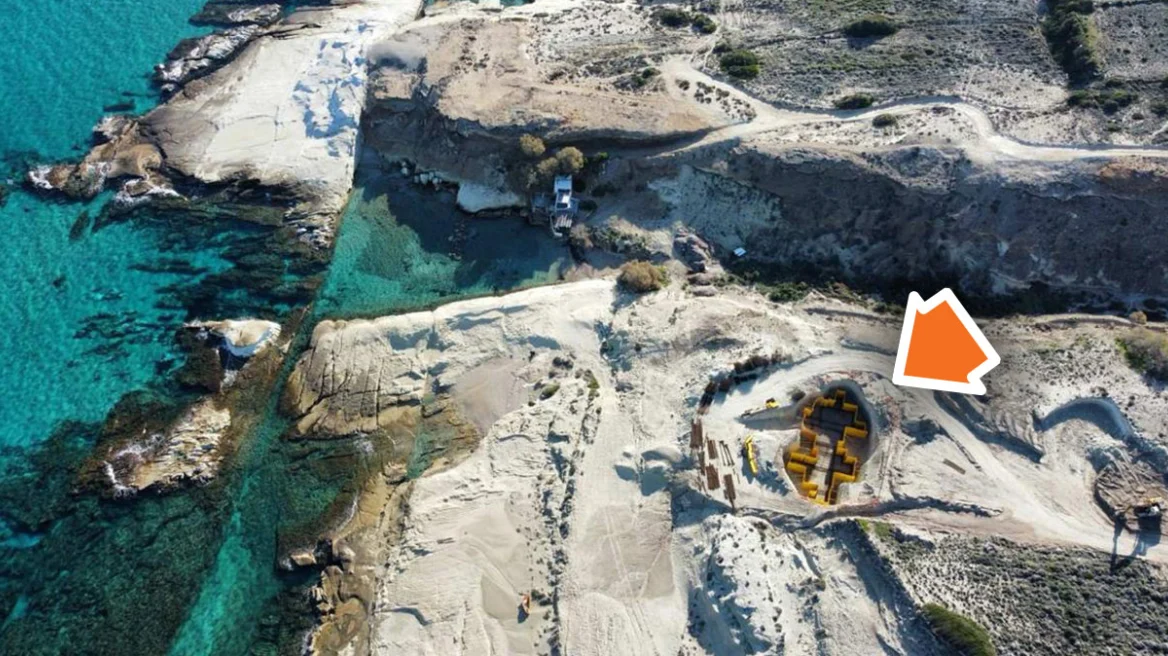
A one-month deadline to restore Sarakiniko to its original condition has been given by the Ministry of Environment and Energy to the company Unique Development A.T.E.E., which dug into the volcanic rocks in order to build a grotesque five-star hotel in the area of unparalleled natural beauty on Milos.
This is the case that was revealed by protothema.gr 11 months ago and triggered a domino effect of developments, ultimately leading to the suspension of works at the site.
Today, the Ministry of Environment and the competent minister, Stavros Papastavrou, issued a decision calling on the company to restore the heavily excavated site to its original state and to remove all construction materials.
Unique Development A.T.E.E., holding a building permit that was ultimately deemed illegal, had attempted to erect the hotel on one of the most famous and most photographed beaches in Greece, which has even been voted the seventh most beautiful place on the planet by Condé Nast Traveller. According to the plans, the project involved a two-storey hotel complex with a basement and swimming pools at the location “Kaminia” on Milos, covering a total area of 19,000 square meters.
Following the revelations by protothema.gr, construction works were halted and the permit for the grotesque hotel was revoked.
After conducting inspections, the Ministry determined that there was an immediate threat of environmental damage and decided that the company must, within one month of receiving the decision, fully restore the site. Specifically, it is required to remove formwork and reinforcement, fill the excavated foundation area with the excavation materials deposited on the adjacent plot, restore the natural relief of the land, and remove any construction materials or installations that have been placed there.
Supervision of the implementation of these measures is assigned to the Milos Building Authority (YDOM), which is required to inform the Coordinating Office for Environmental Damage Response of the Ministry of Environment and Energy.
Decision of the Ministry of Environment and Energy
“UNIQUE DEVELOPMENTS A.T.E.E., within one (1) month from receipt of the present decision, must restore the area to its original condition, namely remove the formwork and reinforcement, fill the foundation area with the excavation materials deposited within the plot, and restore the landform of the area so as to prevent any potential risk of accidents to visitors. In addition, all construction materials or any other installations (e.g. prefabricated structures) placed within the plot must be removed.
The Milos Building Authority (YDOM) is called upon to supervise the implementation of the above preventive measures and to inform accordingly the Coordinating Office for Environmental Damage Response of the Ministry of Environment and Energy.”
Findings that led to the decision
According to the report of the Environmental Inspectors, the company’s plot lies within an area designated as a Wildlife Refuge (KAZ) “Gournado–Fylakoti”, which entails heightened obligations for the protection of the natural environment. During the inspection, it was found that access to the property is via a narrow dirt road, without clear designation as an approved road.
Inspectors recorded alteration of the natural landscape, destruction of local natural vegetation, degradation of the area’s aesthetic value, and increased risk of erosion from wind and rainwater. Special reference is made to the volcanic rocks (whitish tuffs), which form the characteristic relief of Sarakiniko and give the landscape its uniqueness.
The excavation site, approximately 30 meters long and 20 meters wide, with a depth reaching up to 10 meters, remained open and accessible, with partially destroyed fencing, posing risks to the safety of visitors and hikers. Inside the excavation, reinforcement bars and formwork had been installed, while piles of excavation materials were located around the site.
The necessity of a legally approved road
At the same time, the Ministry’s decision indicates that, according to the National Transparency Authority, in applying the legal framework for out-of-plan development, competent services and planners must take into account the established case law of the Council of State, which states that a prerequisite for the buildability of an out-of-plan plot is frontage on an approved road.
In this specific project, access is reported to be via a dirt road described in the topographic plan as an “agricultural road,” without evidence that it is approved. The report of the National Transparency Authority notes that agricultural roads, under the current framework, do not in principle render plots buildable, except in special cases, which—according to the report—do not include tourist accommodation use.
In the same context, it is stated that the Milos Building Authority allowed the issuance of an administrative act for a plot fronting an agricultural road, without ensuring that it was an approved road, a factor directly linked to the legality of the building permit.
Urban-planning and institutional omissions
In parallel, the audit by the National Transparency Authority revealed that the building permit had been issued without prior critical approvals and studies. Among other findings, it was determined that the project was examined as Category B, whereas due to its nature—a hotel combined with special tourist infrastructure (spa)—it should have been classified as Category A2 and accompanied by an Environmental Impact Assessment.
Furthermore, no decisions had been issued delineating a watercourse, the demarcation of the shoreline and beach had not been completed, there was no water-use permit for the borehole planned to supply the project, and there was no geotechnical study of the soil’s load-bearing capacity. The National Transparency Authority concluded that the building permit suffered from legality defects, leading to its revocation by the Milos Building Authority.
Blame game over the cementing of Milos after the Council of State intervention
It is recalled that, in a second case on Milos, following protothema.gr publications and the mobilization of institutional authorities to stop the ecological crime at the protected Mytakas beach, the case of the under-construction White Coast hotel complex entered the familiar phase of a “blame game.”
The Municipality of Milos, the Ministry of Environment and Energy, urban-planning services, and others, directly and indirectly, are accusing one another over delays in taking the necessary measures. Meanwhile, the sluggish response of the competent authorities allowed the owning company of White Coast to proceed, at a frenetic pace, with the expansion of its existing facilities.
Yesterday, Tuesday, 27 January 2026, the Council of State intervened, issuing a temporary order for the immediate cessation of works at Mytakas on Milos.
This action followed the initiative of the Minister of Environment and Energy, Stavros Papastavrou, who was the first to respond to the revealing reports of protothema.gr, announcing a trio of decisive actions to immediately halt the destruction of the natural environment at Mytakas.
At the same time, the Municipality of Milos, through a statement by the mayor on Tuesday, 27 January, released a timeline of its actions to date regarding White Coast. Among other points, it states that the municipality had timely informed the local Building Authority, which was required to impose an immediate ban on operations at the Mytakas construction site, initially on a temporary basis for at least 60 days, as stipulated by law, and until the Council of State ruled. The mayor of Milos also attributes responsibility to the Ministry of Environment and Energy, claiming that for months it ignored his repeated requests for meetings, planning, and coordination of actions, etc.
Ask me anything
Explore related questions