




For more than five decades, the United States and the Soviet Union – and after 1991, Russia – maintained a web of agreements that limited the number and configuration of their strategic nuclear forces.
This framework included numerical limits, inspection mechanisms and systematic data sharing – and yes, it is not a conspiracy theory that 18 times each year the two nuclear giants inspected each other’s arsenals.
With the expiration of New START from today onwards, this system ceases to exist, leaving the two major nuclear powers without binding constraints and in the midst of a global instability the likes of which the world has not seen since World War II.
The agreements before New Start
The first phase of nuclear testing began in the early 1970s. The SALT I of 1972 capped the number of strategic launchers – intercontinental ballistic missiles (ICBMs) and submarine-launched ballistic missiles (SLBMs) – without requiring reductions. The same package included the ABM Treaty, which limited missile defense systems. This limitation prevented the development of extensive defensive shields that could push the other side to further increase its offensive capabilities.
SALT II, signed in 1979, sought to impose stricter limits and restrict the use of missiles with multiple independent warheads (MIRVs). Although not ratified by the US Congress, it was largely implemented by the mid-1980s.
The substantial change came after the end of the Cold War. START I of 1991 provided for significant reductions in strategic nuclear weapons and introduced extensive verification mechanisms. On-site inspections, telemetric data exchange and test alerts were key implementation tools. This agreement is considered the most comprehensive nuclear verification regime ever implemented.
START II, which provided for the elimination of MIRVs on land-based ICBMs, never entered into force. The Russian side withdrew its commitment after the US withdrew from the ABM Treaty in 2002. At the same time, the SORT (also known as the Moscow Treaty) limited the number of deployed warheads, but without inspection or verification mechanisms, reducing its practical significance.
New START, signed in 2010, was designed to replace START I and restore transparency. The agreement capped deployed strategic nuclear warheads at 1,550, deployed launchers at 700 and the total number of launchers at 800. It provided for on-site inspections, twice-yearly data exchanges and permanent notification channels. In 2021, the two sides agreed to a five-year extension; the framework began to dismantle after 2022. Inspections were suspended and in 2023 Russia announced a unilateral suspension of participation. New START ultimately expires today, with no replacement agreement, leaving not only the US and Russia but also the planet after more than 50 years without even a basic “safety net” of protection or consistency.
US – Russia but also China’s emerging third pole
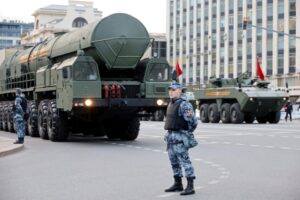
Today, the US and Russia still possess the vast majority of the world’s nuclear weapons. According to open estimates by research institutes, Russia possesses about 5,500 nuclear warheads, of which about 1,600 are believed to be deployed in ICBMs, SLBMs and strategic bombers. The US has about 5,200 warheads, with about 1,700 deployed. The remainder are in reserve or in the process of being retired.
In addition to the two major powers, China has about 500 warheads and is rapidly expanding its ICBM infrastructure. France and the UK maintain smaller, stable deterrent arsenals, while India, Pakistan, Israel and North Korea are outside any binding control framework.
Now what?
After New START expires, there is no active, legally binding agreement limiting US and Russian strategic nuclear weapons. Data exchanges have ceased and inspections have been halted, leaving both sides to rely solely on national means of monitoring. This gap coincides with modernization of the nuclear triad in both countries and the emergence of China as a third nuclear pole. Without a new framework, the international nuclear verification system is entering a period of increased uncertainty, with fewer constraints and less transparency than at any time since the end of the Cold War, at a time when the war in Ukraine, in addition to turning four years old in a few days, has also brought the nuclear threat back to the forefront from the Russian side.
It is clear that treaties and agreements even in times of normalcy – albeit relative – and peace have not and will not ensure balance, but at a time when global confidence is at an all-time low not only in Moscow but also in Trump’s US two – maybe even three – signatures on a new document might send a realistically positive global message for the first time in a long time.
Ask me anything
Explore related questions