




Recent advances in biomolecular archaeology reveal that ancient objects can preserve molecular “fingerprints” of past aromatic practices. These molecules provide unprecedented insight into ancient perfumery, medicine, rituals, and everyday life.
An interdisciplinary research team led by chemist and antiquity specialist Barbara Huber, from the Max Planck Institute of Geoanthropology and the University of Tübingen, describes in a study published in Frontiers in Environmental Archaeology how museums can use this molecular evidence to help the public experience the scents of the past.
Drawing on the research data, perfumer Karol Kalvez developed a series of formulations that translated ancient chemical traces into a fragrance suitable for museum spaces. “The real challenge lies in imagining the scent as a whole. Biomolecular data provide essential clues, but the perfumer must translate chemical information into a complete and coherent olfactory experience that conveys the complexity of the original material, rather than merely its individual components,” she explains.
The researchers then developed two ways of presenting ancient scents in public spaces. Starting with the “Scent of the Afterlife,” a reconstruction of the aromas associated with embalming in ancient Egypt, they created a portable scented card and a fixed scent-diffusion station.
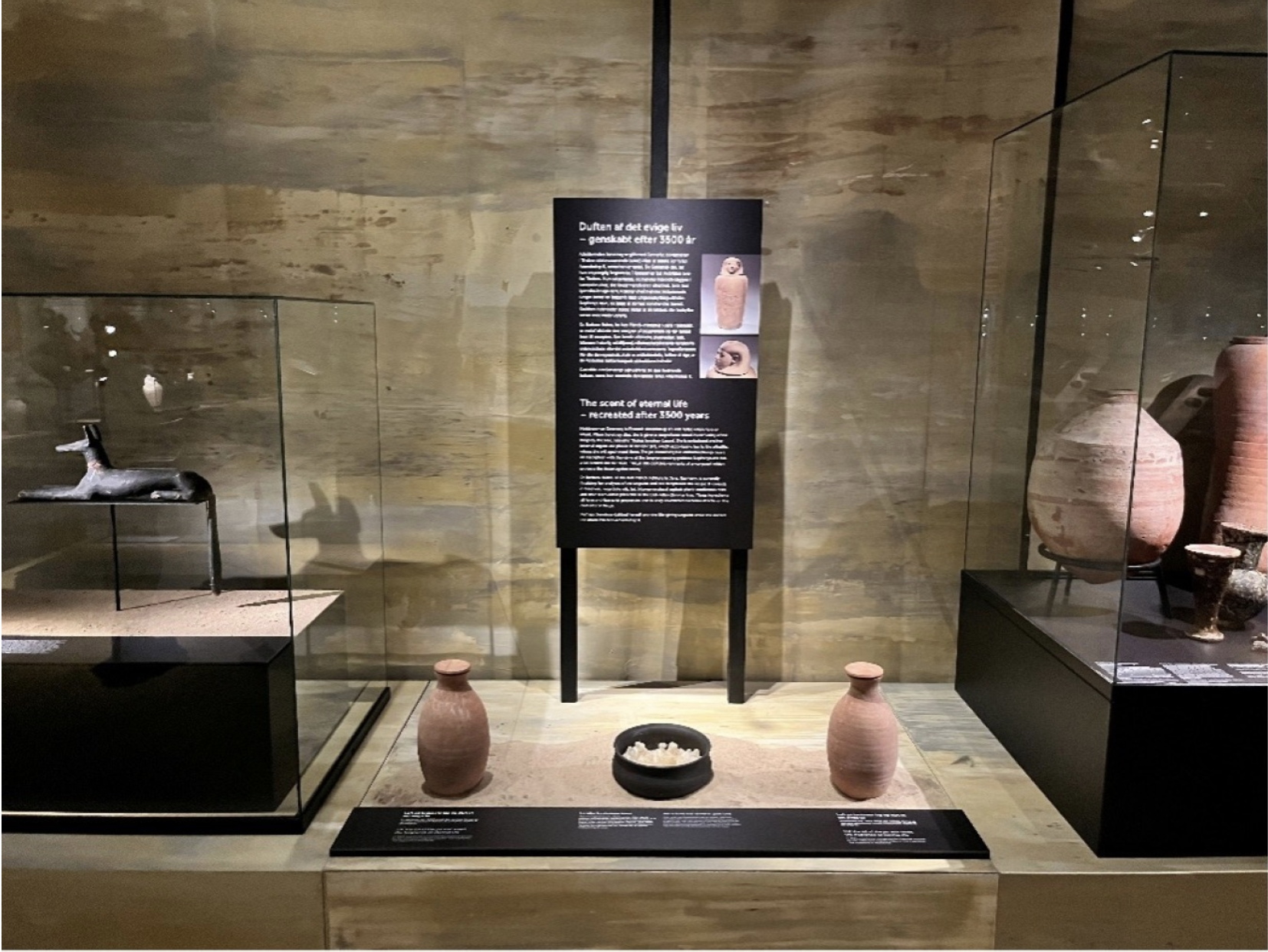
At the August Kestner Museum in Hanover, where the objects that inspired the project are displayed, the scented card was incorporated as a core element of guided tours. The fixed station was installed in the exhibition “Ancient Egypt – Obsession with Life” at the Moesgaard Museum in Aarhus, Denmark. As Moesgaard curator Steffen Terp Laursen notes, “the scent station transformed the way visitors perceived embalming. Smell added an emotional and sensory depth that explanatory panels alone could never provide.”
Ask me anything
Explore related questions