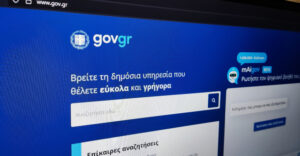
Gov.gr, the Unified Digital Portal of the Greek public administration, began as an urgent and demanding project in a time of pandemic and within a few years, it has evolved into the central digital hub of the state. From the beta version, with 500 services, to today, hosting over 2,230 services of central administration, supervised agencies, independent authorities and regions, gov.gr has gained the trust of citizens – over 2.5 million visits per month – and is now turning to a new phase: moving from a large list of services to a single, personalised point of contact between citizens and the state and adopting a decentralised model of governance that empowers institutions. The new gov.gr is here – through the implementation of the CRM (“Single Digital Infrastructure for Citizen and Business Services”) project – ready to bring simplification and speed to everyday contact with the state, offering personalised access to services and appointments and giving agencies management tools within a controlled, interoperable ecosystem.
“The digital transformation of the state has been at the top of the priorities of the government of Prime Minister Kyriakos Mitsotakis since 2019. We are proceeding daily with systematic planning, investments in digital infrastructure, utilization of Artificial Intelligence and emphasis on reducing bureaucracy, modernizing the state by creating a new model of service for citizens and businesses. We are moving to the next day of gov.gr, taking the decisive step from the provision of digital services to an integrated service experience”, Dimitris Papastergiou, referring to the Single Digital Portal of the Greek public administration and explains:
“With the implementation of the CRM project “Single Digital Infrastructure for Citizen and Business Services”, the citizen will be able to interact with the state in a uniform, personalized and stable way, regardless of services, institutions or communication channels. For the first time, they will have a centralised view of all their transactions, requests and affairs in one place, through a targeted service environment. A reform equally important for the public administration. For the first time, it has the ability to see citizens’ requests in a comprehensive way, so that it can respond faster, more efficiently and more consistently. We are substantially improving the quality of services, speeding up the processing of requests, enhancing interoperability and equipping officials with better digital tools. At the same time, we are increasing transparency and making the public sector more productive and efficient. We are moving forward with a clear goal: citizens and businesses to be served digitally from everywhere, anytime and for everything related to their relationship with the Public Administration.”
The new gov.gr
What is radically changing is the character of gov.gr: it is no longer just a list of services but an intelligent, integrated system with clear goals of quality, scalability, scalability, ecosystem support and maintaining a single government voice. Designed with lessons learned over the past six years, the new system is geared towards personalizing service, modernizing architecture, enhancing interoperability and enhancing the user experience.
Personalization means that gov.gr “knows” the citizen and can provide a personalized service, tailored to profiles, choices and needs. The Citizen Area acts as a digital mailbox where favourite services, documents, cases and appointments are collected, transforming the citizen from a passive visitor to an active and informed participant in his/her relationship with the public sector.
The modernization of the architecture brings new modeling, corrected and expanded taxonomy and new interoperability, allowing gov.gr to support more complex service delivery scenarios and integrate entities with different profiles, such as universities, hospitals and local government organizations.
The interoperability creates coherent data flows and paves the way for features such as Citizen Area and targeted information through the mailbox, as well as linking to support systems and tools, enhancing service satisfaction and efficiency.
The user experience is enhanced with features that simplify navigation and make it easier to access services. Citizens gain a centralised view of their documents, cases and appointments; can evaluate and comment on services so that improvement is based on real experience data; and receive guidance through the enhanced mAIgov digital guide, which helps to choose the right service and simplify processes such as issuing a declaration of responsibility.
The localisation of services is significantly improved, both in terms of finding the service itself and in terms of accessing institutional and administrative information accompanying its provision. The new service model extends the possibilities for agencies of specific categories to provide digital services within the EPPS.
At the administrative level, the EPSP management environment provides unified operational oversight and enables operational operations from a backoffice that digitizes flows and decentralizes service production to agencies and their implementers, under the coordination and control of the Ministry of Digital Governance. This shifts responsibility to where knowledge exists, reduces issue resolution time, facilitates communication and provides an active role for agencies to create and update services, while the Ministry acts as an institutional controller of quality, consistency and compliance, ensuring scalability without loss of consistency.
An immediately noticeable change for the citizen is the consolidation of appointments into a single view on gov.gr. We are moving from fragmented appointments by agency and system to a coherent view where all public sector appointments are displayed, linked to the Personal Citizen Number for secure identification, with clear information on where, when and with which agency. This step creates conditions for timely updates and better service. At the same time, personalised information means that agencies can send targeted messages to the citizen mailbox, tailored to their choices and affairs, while the gradual interconnection with the Gov.gr Messenger platform aims to reduce the multiplicity of communication tools used by agencies.
The progress of gov.gr to date reflects success in terms of acceptance and rapid development of functionalities. The transition to the new model promises a better experience for citizens through personalization and collection of appointments and documents, more flexible and quality service delivery by the public administration, as well as scalability and scalability with assured consistency and quality control.
The real test of the next phase will be the implementation and widespread adoption of the Citizen Area, targeted alerts, unified appointment management and enhanced backoffice tools, which will judge how quickly and smoothly this transition from a catalogue of services to an ongoing, personalised, trusting relationship between citizen and state is made.
Ask me anything
Explore related questions