





In the documents related to the Jeffrey Epstein case there are more than 1,500 references to Greece and to individuals from our country. Although at first glance the number seems large, in substance none of these references points to illegal or even suspicious activity.
In most cases, they involve business dealings, attempts at business, or efforts at social networking. There are, of course, a few strange references, such as that of a woman who informs Epstein that she gave birth to a “Greek boy” (implying that she met the child’s father, who is Greek, through him), as well as another woman who sends Epstein a message in 2018 titled “Don’t tell anyone,” describing how she met “an older man,” mentioning the name of a Greek tycoon with whom she has entered into a relationship. The names of the correspondents here are redacted, meaning erased by the U.S. authorities.
This is not the case in all instances, however. For example, in an exchange of messages with the Greek-American journalist Thomas Landon, the latter asks Epstein for the contact details of a Greek tycoon (the reference to his name has been removed) in order to speak with him about the crisis in Greece. There are references to the Goulandris, Niarchos, and Livanos families, to Pavlos and Marie-Chantal, among others. There are also messages from Greek-Americans, such as Dimitris Katsimatis, who informs Epstein that he met with the then Greek minister Dimitris Avramopoulos and asks for his support in the race for the mayoralty of New York.
The trip to Patmos
Among other things, the files include an exchange of messages regarding a trip to Turkey and Greece. These messages contain references to Greek individuals, specifically to hospitality/an invitation to Patmos in 2012, with named references to Kalliopi Karellas, Giorgos Votis, and Olga Geroulanou-Votis, as well as to a meeting with a “Greek foreign diplomat” (without a full name).
Since nothing illegal or even unethical emerges from these conversations, in this particular case what is recorded is a correspondence between Epstein’s associate, Peggy Siegal, an executive of a Greek airline company, and Olga Geroulanou-Votis. She is a cousin of former PASOK minister Pavlos Geroulanos and the daughter of the renowned cardiologist Theodoros Geroulanos, who is related by family ties to the family of the great mathematician Konstantinos St. Carathéodory.
Ms. Geroulanou is treasurer and an active member of the Society Against Child Abuse – the ELIZA Association, which was founded by Marina Karellas together with her late husband, Michael de Grece. In the email exchange, Epstein’s associate describes holidays on Karellas’s yacht and then addresses Miltos Mouzakis as well as Olga Geroulanou regarding the transfer from Turkey to Patmos, posing a series of questions about the practical arrangements.
So what exactly was Epstein looking for in Greece? The answer is not one-dimensional. There is, however, clearly a purely financial perspective: banks, recapitalizations, government bonds, debt swaps, and bets on the crisis by an Epstein who cynically admitted in one of his emails that he was not… long on Greece.
In the files, Greece appears mainly in material focused on the 2010–2015 period. At the center is how Epstein and his associates interpreted the Greek crisis. There are references from March 2012 about how Epstein learned of the Greek debt swaps, while in 2013 a window appears onto an investment opportunity in illiquid five-month Greek government bonds, as short-term sovereign debt.
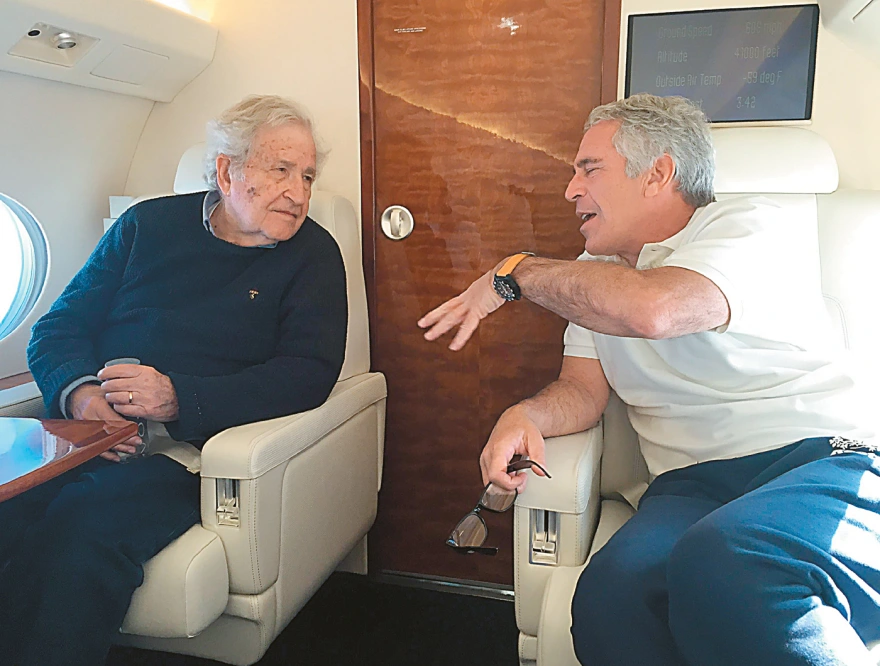
(Epstein was discussing Greece with Noam Chomsky)
Talking with Chomsky
In an email dated July 31, 2015, to Noam Chomsky, Epstein attempts an extensive deconstruction of banking accounting, describing it as “paradoxical.” Chomsky, for his part, traces the flow of the money: Greece, he says, functioned as a conduit, while the real beneficiaries were mainly French and German banks. The essence of this argument is that the bailout package does not necessarily rescue a country, but rather the European banking system that is exposed to it. Epstein agrees.
In another email exchange with Chomsky (June 29, 2015), the core of the argument concerning “odious debt” is highlighted: Chomsky notes that, according to economists, around 90% of the payments to Greece actually end up with German and French banks that had made risky investments and are now seeking repayment. He concludes that these debts, in his view, should be considered odious and be radically restructured or canceled.
Varoufakis’s head
The files include an exchange of emails with Ariane de Rothschild, Chairwoman and CEO of the Edmond de Rothschild Group, regarding the impending dismissal of then Finance Minister Yanis Varoufakis, dated July 6, 2015—one day after the referendum. On the same day, Varoufakis indeed announces his resignation with a sharply worded statement.
The communication
In the correspondence, Rothschild writes that “Tsipras wanted Varoufakis’s head and he got it,” that he would be replaced by Euclid Tsakalotos, and that in this way “Tsipras will gain time” ahead of the Eurozone Summit, where “they expect a solution to be found.” Other documents record Epstein’s communication with Giorgos Mantzavinos, a former Eurobank and National Bank executive and real-estate professional who passed away in 2023, regarding investments and opportunities in Greece and Central-Eastern Europe. The assessment was that Greece would most likely reach an agreement with the EU and the IMF by the end of June 2015, securing temporary stability until September, when an additional €35–40 billion would be required. It is there that the proposal to Epstein appears: to consider entering the Greek market, particularly in the banking sector.
In another exchange, Epstein asks Mantzavinos directly (March 2016): “Do you think Greece will leave the euro?” Mantzavinos replies with data on the systemic banks and non-performing loans (NPLs) at 42%–45%, adding that if Kyriakos Mitsotakis becomes prime minister, the probability of Grexit would decrease significantly. Particularly revealing is a document showing Epstein moving in circles seeking “inside information” on the Eurozone. According to messages, Bill Gates and Epstein wanted to organize a meeting in 2012 with leading economists and institutional figures, and the first name proposed for an invitation was that of Lucas Papademos.
Another document, purportedly from a Deutsche Bank archive, describes an internal briefing on Greek bonds with very high yields, which the bank believed would not be included in the “haircut.” In other words, while the haircut and the crisis were sweeping away the weakest, a multimillion-euro game was being played in the secondary market for a few select investors—among whom Epstein is also said to have been included.
Ask me anything
Explore related questions