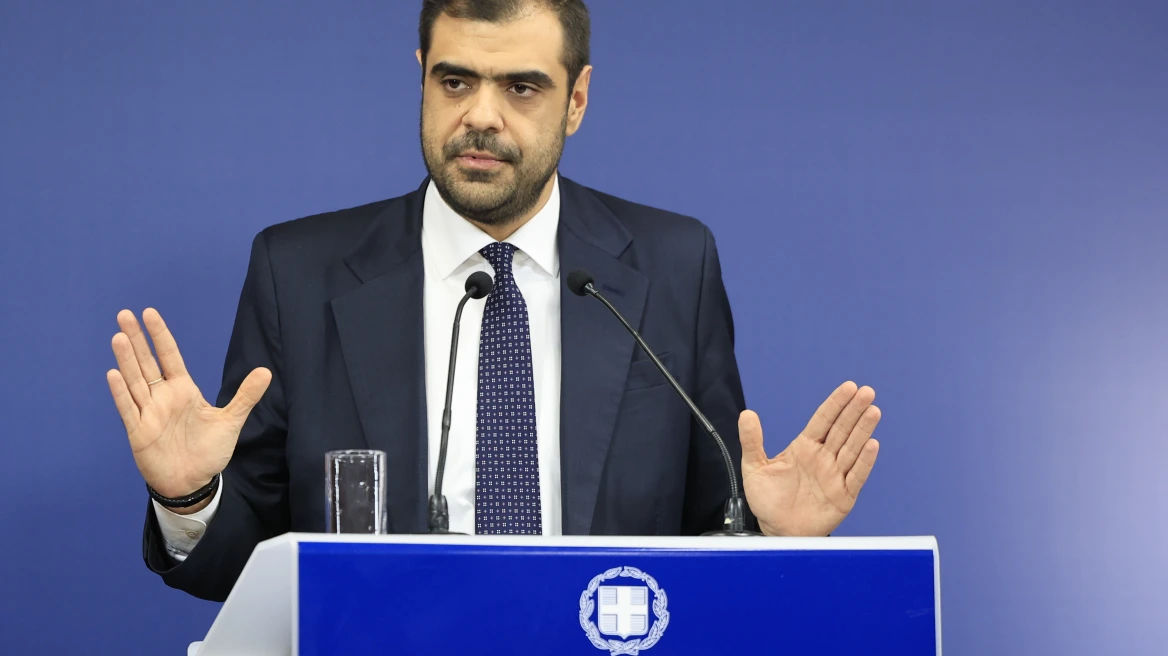
“The 6th meeting of the Supreme Cooperation Council between Greece and Turkey took place yesterday, along with the bilateral meeting between Prime Minister Kyriakos Mitsotakis and the President of Turkey, Recep Tayyip Erdogan,” government spokesperson Pavlos Marinakis said at the start of the political editors’ briefing.
“The Greek Prime Minister, during his contacts with the Turkish side, raised Greece’s longstanding position on resolving the issue of delimiting the EEZ and the continental shelf — the only dispute that can be brought before international jurisdiction on the basis of international law, and specifically the law of the sea — while stressing that it is now time to remove any threat in relations between the two countries.”
“Our country’s stance shows the path of responsible patriotism, without pompous rhetoric but with confidence and commitment to international law.”
He added that “Kyriakos Mitsotakis also referred to the Cyprus issue, stressing Greece’s clear position as well as the opportunity created by the initiatives of the UN Secretary-General, and at the same time reiterated Greece’s position, as reflected in the Treaty of Lausanne, regarding the Muslim minority of Thrace.”
At this point, he referred to the Prime Minister’s statement about the three pillars on which, in 2023, the strategic choice was made for a structured approach to Greece–Turkey bilateral contacts: political dialogue, the positive agenda, and confidence-building measures. “We cannot change geography, but we can make it an ally by choosing convergence, dialogue, and faith in International Law,” Kyriakos Mitsotakis said after the meeting.
During the Supreme Cooperation Council, the competent ministers had the opportunity to discuss with their Turkish counterparts all the issues on the agenda, concerning trade, migration, civil protection, culture, and to sign seven joint texts.
Mr. Marinakis added that the Prime Minister “is in Belgium for the informal meeting of European leaders. The competitiveness of the European economy in a context of geopolitical upheavals and uncertainties, which make the integration of the single market more urgent than ever, is the main topic on the agenda of the informal meeting.
‘Europe must improve its competitiveness if it wants to support its social model, invest in defense, and shield itself against the climate crisis. Greece enters this discussion having submitted very specific proposals in order to reduce European bureaucracy, make the single market function better, and ultimately ensure that competitiveness benefits both businesses and European consumers. I will have the opportunity to focus more on energy market issues. It is clear that today the energy market in the European Union does not function satisfactorily. We need greater integration in the energy market so that we ultimately have lower energy prices across Europe, for both European consumers and European businesses,’ the Prime Minister said, among other things.”
He also stated that before the start of the informal summit of European leaders, Prime Minister Kyriakos Mitsotakis participated in a leaders’ meeting organized by Germany, Italy, and Belgium. The goal is to achieve progress in completing the Single Market, strengthening cross-border energy infrastructure, ensuring the resilience of supply chains in critical raw materials, and advancing the Capital Markets Union.
The next topic of the briefing concerned Greece’s position based on Transparency International’s Corruption Perceptions Index. “Greece’s position improved with regard to combating corruption phenomena, as reflected in Transparency International’s annual report for 2025.
Specifically, Greece ranked 56th out of 182 countries evaluated, gaining three positions compared to last year’s measurement. It scored 50 out of 100, while the global average fell to 42, a decade low. It is recalled that in 2018 Greece had scored 45 points, ranking 67th. Over a period of seven years, therefore, it improved by 11 places in the global ranking. Meanwhile, an integral element of tackling corruption is the protection of the rule of law. In this area, our country has recorded significant progress in recent years, as reflected in the European Commission’s annual reports,” the government spokesperson said.
Subsequently, Mr. Marinakis stated that “over the past four years Greece reduced the Commission’s recommendations from seven to four and was one of the 12 Member States that made progress on all recommendations in the latest report.
With the full transition to the ‘ERGANI II’ Information System — which replaces ‘ERGANI I’ — next Monday, February 16, business operations are further facilitated through a drastic reduction of bureaucratic procedures and easing of administrative burdens.”
At this point, he specifically mentioned the benefits it offers for business operations, including: the abolition of the obligation to submit certain forms (e.g., E4 Annual Personnel Table, E9 for part-time employment, etc.), new possibilities for modifying submitted declarations, a unified process for monitoring all types of employment relationships and their changes, recording total weekly working hours for all employment relationships (including employees with multiple jobs), the availability of a “Monthly Employment Status” per employment relationship, a redesigned navigation environment in line with gov.gr standards, and a new guided declaration environment depending on the type and form of employment.
He added that “ERGANI II” also offers employees, through the upgraded myErgani app on their mobile phones and the myErgani.gov.gr platform: immediate notification and real-time monitoring of all elements of their employment relationship, as well as the ability to accept or reject essential employment terms.
He further noted that the Public Administration also benefits from the ERGANI upgrade.
Concluding, Mr. Marinakis stressed that 138 new SUV-category vehicles, suitable for operational use both in urban and semi-urban environments as well as off-road conditions, were delivered to the Hellenic Coast Guard.
Additionally, “a new contract was signed for the procurement of 81 pick-up type vehicles, while new tenders are being planned for additional land operational means, such as motorcycles and personnel transport vans. The total budget for upgrading land assets exceeds €17 million, aiming at the continuous strengthening of operational readiness and the effectiveness of Coast Guard Authorities throughout the country.”
Ask me anything
Explore related questions