




Greek–Turkish relations have evolved through multiple phases, ranging from periods of crisis and tension to intervals of relative calm and enhanced cooperation.
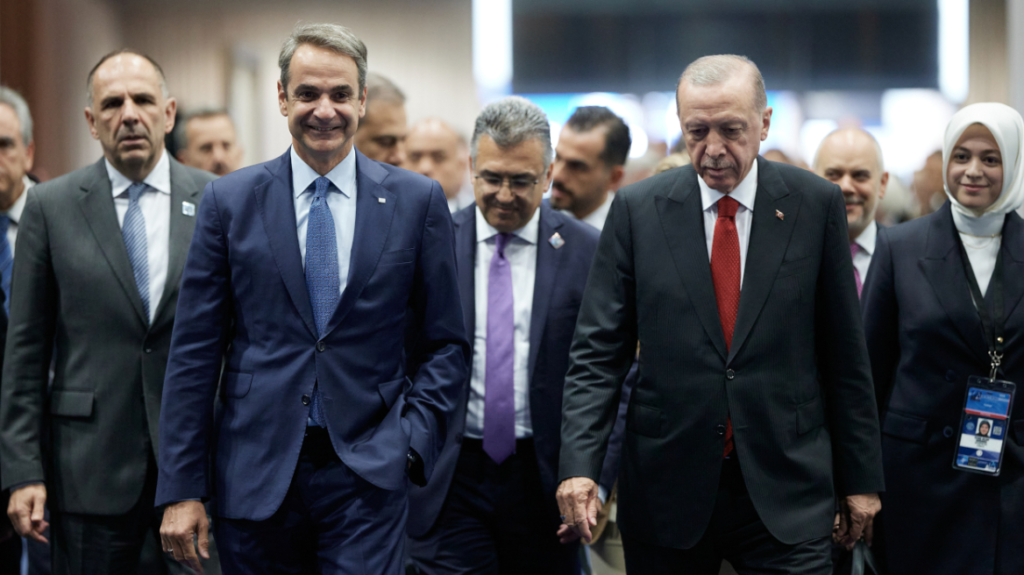
The English edition of Proto Thema spoke with Dr. Ioannis S. Papafloratos, Attorney at Law and Professor of International Law at Hellenic Military Schools, to seek his brief assessment of the meeting between Greek Prime Minister Kyriakos Mitsotakis and Turkish President Recep Tayyip Erdogan at the Ak Saray (meaning “White Palace“) in Ankara last Wednesday, February 11.
Dr. Papafloratos was also asked to share his broader views on key aspects of Greek–Turkish relations, as well as his insights into the prospects for peace in Ukraine.
1. What is an initial assessment of the meeting between Recep Tayyip Erdogan and Kyriakos Mitsotakis?
Most objective analysts agree that the overall sign is positive. None of the existing problems were resolved, nor was the one and only dispute acknowledged by Greece (i.e., the delimitation of the continental shelf and maritime zones) settled. However, no national disaster occurred either. The leaders of the two neighboring states reiterated their positions, seeking to avoid further deterioration of their relations, while several agreements were signed on so-called “low politics” issues. Messrs. Mitsotakis and Erdogan aimed to send a positive message from a region that has historically been a hotspot of problems and conflicts.
2. At the present juncture, what are the respective priorities of Greece and Turkey in their bilateral relations?
Athens has focused on strengthening its deterrent capability by implementing an ambitious armament program, proceeding with the restructuring of its Armed Forces, recovering economically, and at the same time concluding a series of agreements that enhance its diplomatic footprint in the wider region. Ankara, for its part, is primarily focused on Syria and the broader surrounding region, while also seeking to establish footholds in various parts of the globe by implementing an ambitious, expansion-oriented program. Turkey is active across a vast geographical zone stretching from Central Asia, through the Caucasus, to the Middle East, the Eastern Mediterranean, and the Horn of Africa.
3. Is Turkey’s recent friendly stance sincere, and does it serve our interests to help improve its international image, especially when it seeks to acquire the F-35s?
Turkey follows a specific long-term strategy, which naturally does not change overnight. What changes is its tactics. Decision-makers in Athens have understood this and, I believe, have adjusted their own tactics accordingly. Obviously, however, it is not logical to refuse dialogue, when Greece has consistently maintained a position in favor of dialogue, on the basis of the provisions of International Law.
4. Will Turkey’s stance toward Greece be affected by the fact that it is gradually resolving its regional problems, and if so, how?
It is evident that it will be affected, although Ankara has not yet closed all the open fronts it faces. Turkey would like to focus on Cypriot and mainland Hellenism, as many of its vital interests are at stake here.
5. What will concern us most in 2026 regarding Greek-Turkish relations?
No one can prejudge this. As I always tell my students, it is best to avoid predictions. Our role should be limited to analyzing the data in order to provide the political and military leadership with the appropriate information to make sound decisions.
6. Is there any prospect for the resumption of talks on the Cyprus issue?
At present, there appears to be increased interest from the international community in this issue. Therefore, many in the Republic of Cyprus harbor well-founded hopes that negotiations will resume, all the more so since Ersin Tatar is no longer at the leadership of the Turkish Cypriots.
7. Is the assessment that the war in Ukraine will end by the summer of 2026 realistic?
There is cautious optimism within the international community that the bloodshed, which began with Moscow’s responsibility four years ago, is (sooner or later) approaching its end. However, no one can safely predict whether this will occur in the first or second half of the current year (or even in 2027), as on other occasions during this war expectations were raised for its termination, only to be ultimately disappointed. The problem lies in whether a sustainable agreement will be reached, based on International Law, that will prevent the resumption of hostilities in the near future. On this matter, many officials in Europe are understandably very cautious.
Ask me anything
Explore related questions