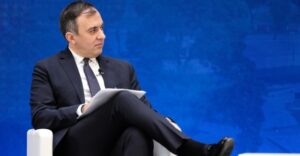
The MP for Serres and Secretary for International Relations and EU Affairs of New Democracy said that Greece is being upgraded into a critical energy-security factor for Central and Eastern Europe.
The agreements signed by Chevron and Helleniq Energy “essentially—implicitly but clearly—amount to recognition of Greece’s sovereign rights,” stressed the MP for Serres and Secretary for International Relations and EU Affairs of New Democracy, Tasos Chatzivasileiou, in an interview with SKAI TV on Tuesday morning.
Mr. Chatzivasileiou underlined that the energy agreements signed yesterday at the Maximos Mansion, in the presence of the Prime Minister, constitute a clear vote of confidence in Greece and are part of a long-term strategic plan that began on the first day of Kyriakos Mitsotakis’s term in office. As he noted, “Greece is now entering the new international energy map, not only as a natural-gas transit hub but also as a potential producer, with the prospect of even becoming a gas exporter in the future.”
He placed particular emphasis on the geopolitical dimension of the agreements, pointing out that they concern the whole of Europe, which—following the strategic decision to reduce dependence on Russian natural gas—is seeking reliable and secure alternative energy sources. In this context, he said, “Greece is being upgraded into a critical energy-security factor for Central and Eastern Europe, leveraging LNG infrastructure at Revithoussa LNG Terminal and Alexandroupoli LNG Terminal, as well as its geographical position,” while stressing the importance of the Vertical Corridor, which will serve as the main energy-transport artery from Greece.
At the same time, the former Deputy Foreign Minister noted that these agreements are yet another practical way in which Greece counters the illegal Turkey–Libya memorandum, strengthening its position in areas under Greek jurisdiction. As he said, Greece will carry out new surveys for the first time in 40 years, doubling the size of the exploration zone—thereby doubling the chances of identifying serious and commercially viable deposits.
Referring to the economic prospects, he noted that potential exploitation of deposits could generate significant new revenues for the Greek state, citing as an example support for the social-security system to the benefit of citizens. In addition, he emphasized that the new landscape could lead to lower energy costs and a boost to domestic industrial activity, while creating new growth opportunities for the Greek economy.
Commenting on reactions in Turkey, Mr. Chatzivasileiou clarified that every Greek initiative in the energy sector is not directed against third countries, but serves exclusively the national interest, with respect for international law and with the aim of stability and security in the wider region.
Finally, regarding the Peace Council, he stressed that Greece will participate as an observer, as it cannot be absent from discussions that directly concern it geographically and politically. He noted that Greece is not joining the new body, as the Prime Minister has already submitted a proposal for the Council to deal exclusively with Gaza for as long as necessary. He added that the European Commission will also have observer status, represented by the Commissioner for the Mediterranean.
Asked about Greece’s possible participation in a stabilization force in Gaza, Mr. Chatzivasileiou said: “Greece must be present in the peacekeeping force if it wants to have a role and a voice in the wider neighborhood. Thirty-two countries expressed interest in the Gaza force, ten of which are European. The final list will depend on acceptance by the involved Israeli and Palestinian parties. Our country, moreover, is recognized as an honest broker. Any possible participation will take place only under the clear mandate of the framework established by the relevant UN Security Council resolution on Gaza.”
Ask me anything
Explore related questions