At the entrance to the Bay of Vlora, where the waters of the Adriatic narrow and become tightly controlled, one of the most paradoxical episodes of the Cold War unfolded in the 1950s. The naval installation at Pashaliman, also known as the Palermo Base, was turned into a Soviet bridgehead in the Mediterranean, at a time when Enver Hoxha’s small Albania was among the Soviet Union’s most loyal allies.
The Soviet bridgehead in the Adriatic
The Palermo (Pashaliman) Base, a few kilometers south of Vlora, was selected for a clear reason: it offered natural protection, depth, and the ability to control the sea routes leading from the Adriatic to the Ionian Sea. Some of the Russians’ 12 Whiskey-class (Project 613) submarines were stationed there—diesel-electric vessels with six torpedo tubes, suitable for surveillance and anti-landing missions in enclosed seas.
The secret naval base of Hoxha inside a mountain in Albania, the clash with the Russians, and the theft of the submarines
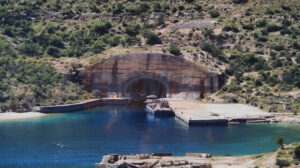
The entrance to the base
For Moscow, the base was not merely a convenience. It was its only stable foothold in the Mediterranean before Russia established a permanent presence in Syria years later. For NATO, the presence of Soviet submarines so close to the Italian coast was a constant reminder that the Cold War was also being played out in the waters of the Adriatic.
Legend has it that since Hoxha’s death, the base has never reopened and no one knows what is inside, as only he and his “inner circle” knew the access codes.
The secret naval base of Hoxha inside a mountain in Albania, the clash with the Russians, and the theft of the submarines
This base was among the most secret installations in Hoxha’s Albania. To build and operate it, a large area was cleared of the general population. The regime banned anyone from approaching the site and established infantry bases on and around the mountain where the naval base was located—both as a diversion (so it would appear to be an infantry base) and for security.
The secret naval base of Hoxha inside a mountain in Albania, the clash with the Russians, and the theft of the submarines
Panoramic view of the base
Other testimonies from citizens serving at nearby military camps at the time claim that a vessel could enter at that point and emerge several kilometers away, literally passing through the mountains.
The ideological conflict that became a military crisis
Hoxha’s break with Russia began to emerge after 1956, when Nikita Khrushchev launched de-Stalinization. Hoxha, unwavering in Stalinist orthodoxy, regarded the new line as “betrayal.” Political disagreement gradually turned into a crisis of trust and ultimately into open confrontation.
In 1960–1961, relations between the two countries collapsed. The Soviets sought to withdraw their submarines and personnel from Pashaliman. The Albanian side disputed ownership of part of the equipment, arguing it had been acquired under bilateral agreements and could not be removed unilaterally.
The evacuation and the “four submarines”
Tensions peaked in the spring of 1961. Albanian forces surrounded the Palermo Base and demanded the Soviets’ departure. Despite threats and pressure from both sides, Moscow chose not to escalate militarily.
By the autumn of 1961, most Soviet units had withdrawn. Of the 12 submarines in the flotilla, eight were taken back by the Soviet Union, while four remained in Albania, passing under the control of the Albanian navy. It was a symbolic as well as substantive defeat for Moscow: for the first time, a small Eastern Bloc country had seized military hardware from the Soviet fleet.
Isolation and a new alliance
The evacuation of the Palermo Base marked the definitive end of the Soviet military presence in Albania. Tirana turned toward the People’s Republic of China, within the context of the Sino-Soviet split, while Hoxha’s regime adopted an even more isolationist policy, investing in fortifications and self-sufficiency.
The Palermo Base remained active under Albanian control for decades, but it never again became a pivotal point in the global naval balance. In 1961, in that enclosed bay of the Adriatic, it was not merely the fate of twelve submarines that was decided—it was the position of a small country vis-à-vis a superpower, and the entire power architecture of the region.
Ask me anything
Explore related questions